Oversight concerns in the pipeline Fuel-delivery safety, environmental protection responsibilities in Manitoba primarily in hands of oil industry, provincial document confirms; changes on way, government says
Read this article for free:
or
Already have an account? Log in here »
To continue reading, please subscribe:
Digital Subscription
One year of digital access for only $1.44 a week*
- Enjoy unlimited reading on winnipegfreepress.com
- Read the E-Edition, our digital replica newspaper
- Access News Break, our award-winning app
- Play interactive puzzles
*Billed as $5.77 plus GST every four weeks. After 52 weeks, price increases to the regular rate of $19.95 plus GST every four weeks. Offer available to new and qualified returning subscribers only. Cancel any time.
To continue reading, please subscribe:
Add Free Press access to your Brandon Sun subscription for only an additional
$1 for the first 4 weeks*
- Enjoy unlimited reading on winnipegfreepress.com
- Read the E-Edition, our digital replica newspaper
- Access News Break, our award-winning app
- Play interactive puzzles
*Your next Brandon Sun subscription payment will increase by $1.00 and you will be charged $17.95 plus GST for four weeks. After four weeks, your payment will increase to $24.95 plus GST every four weeks.
Read unlimited articles for free today:
or
Already have an account? Log in here »
Hey there, time traveller!
This article was published 11/06/2024 (862 days ago), so information in it may no longer be current.
Manitoba has not formally inspected Winnipeg’s main fuel-supply pipeline in the last four years, instead allowing industry to take the lead on oversight — a practice critics say lacks transparency and carries environmental risks.
The absence of formal provincial inspections was confirmed in a letter recently obtained by the Free Press and the Narwhal through a freedom of information request.
Additionally, while inspectors have occasionally visited the pipeline “during the course of carrying out other duties,” no inspection reports were written following those visits, the Department of Economic Development, Investment, Trade and Natural Resources said in the letter.
MIKAELA MACKENZIE / FREE PRESS FILES The Winnipeg Products Pipeline was shut down in March after Alberta-based owner Imperial Oil discovered safety concerns in a section of pipe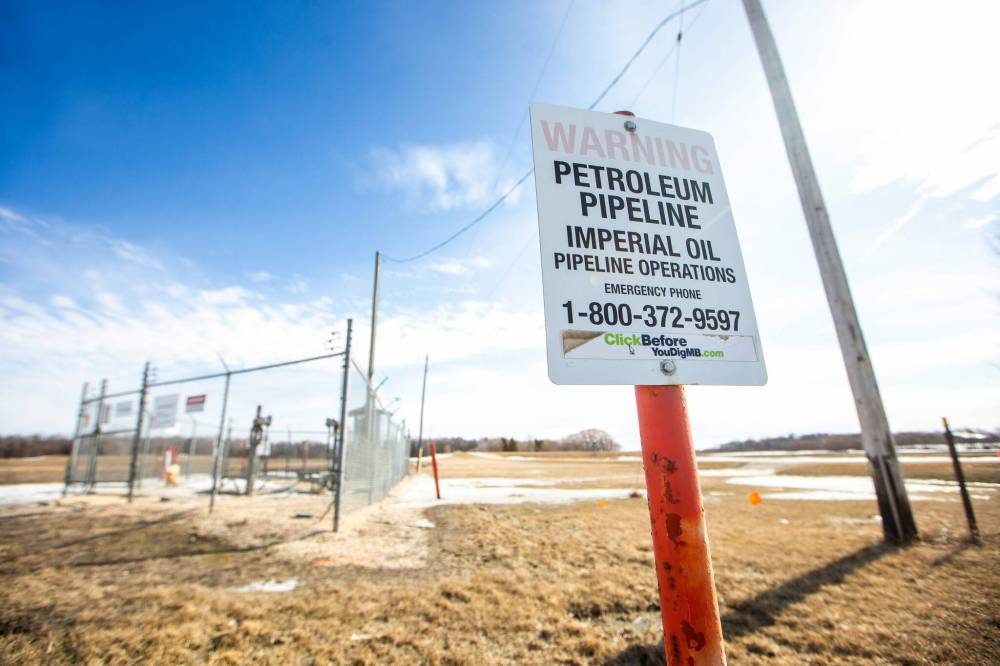
The Winnipeg Products Pipeline was shut down in March after Alberta-based owner Imperial Oil discovered safety concerns in a section of pipe that runs under the Red River near St. Adolphe, south of Winnipeg. In the interim, the city’s supply of diesel, gasoline and jet fuel — which typically flows from a terminal in Gretna to Winnipeg — has been transported by rail and truck.
A lack of provincial oversight can make environmental safety difficult to enforce, experts say.
“This is a pipeline that crosses water bodies and carries several types of fuel, so there’s risk, of course, of pipeline leaks and water contamination,” said Patricia Fitzpatrick, a University of Winnipeg professor and energy and mining governance expert.
Province informally visited pipeline five times in four years
According to the freedom of information letter, provincial inspectors visited sites along the pipeline five times in the last four years. Three informal inspections were completed in 2021, and inspectors were called to the site twice in 2022 and 2023. None were considered formal inspections. No inspections were conducted in 2020.
When pressed for additional details last week on how Manitoba conducts pipeline inspections, a spokesperson said the province is changing its oversight practices and adding more staffing resources.
“Inspection capacity has been increased, which should ensure annual inspections are completed on a regular basis. Formal inspection reports will now be generated following each inspection,” the spokesperson said.
Winnipeg environmental law expert Heather Fast said it’s difficult to assess whether a company or government is adequately monitoring environmental protection without transparent and accessible documentation of emergency plans, inspection systems and enforcement actions.
“I think there’s an obligation on the part of government when you think about their duty to protect the environment, natural resources and human health, to make sure that monitoring and followup processes are working properly,” she said.
Two requests to interview a representative from Natural Resources’ petroleum branch — responsible for regulating provincial pipelines — were denied.
Related Articles
Pipeline situation not quite a crisis




Over an email exchange, a provincial spokesperson was unclear on the frequency and formality of pipeline inspections.
The spokesperson initially said the province “relies on both formal and informal inspections,” adding “there were informal inspections” of the pipeline in 2023. They later clarified there was a single informal inspection last September.
When asked to clarify the distinction between formal and informal inspections, the spokesperson provided only an example of an informal inspection, such as examining how a proposed development might impact a pipeline’s infrastructure.
The spokesperson said the province “has always required inspection forms to accompany formal inspection but recently changed the requirement so that inspection reports must accompany all inspections.” They did not specify why or when the requirement was changed.
According to the spokesperson, provincial inspectors “work collaboratively” with industry to maintain regular inspections, “with the provincial inspections supporting the more extensive ones that are done by industry.”
“The outcomes of these inspections are carefully documented and provided to the province annually,” the province said.
Company inspection prompted ‘proactive’ pipeline shutdown
It was a company inspection earlier this year that determined riverbank erosion was causing stress on the decades-old pipes, leading to the “proactive” decision to shut it down for maintenance, Imperial Oil public affairs manager Keri Scobie said in a statement.
Scobie said the company has “a robust inspection program,” and their nationwide lines are regularly inspected both by Imperial Oil and third-party inspectors.
MIKAELA MACKENZIE / FREE PRESS A crew member works along temporary survey markers at the Imperial Oil pipeline just south of St. Adolphe in March.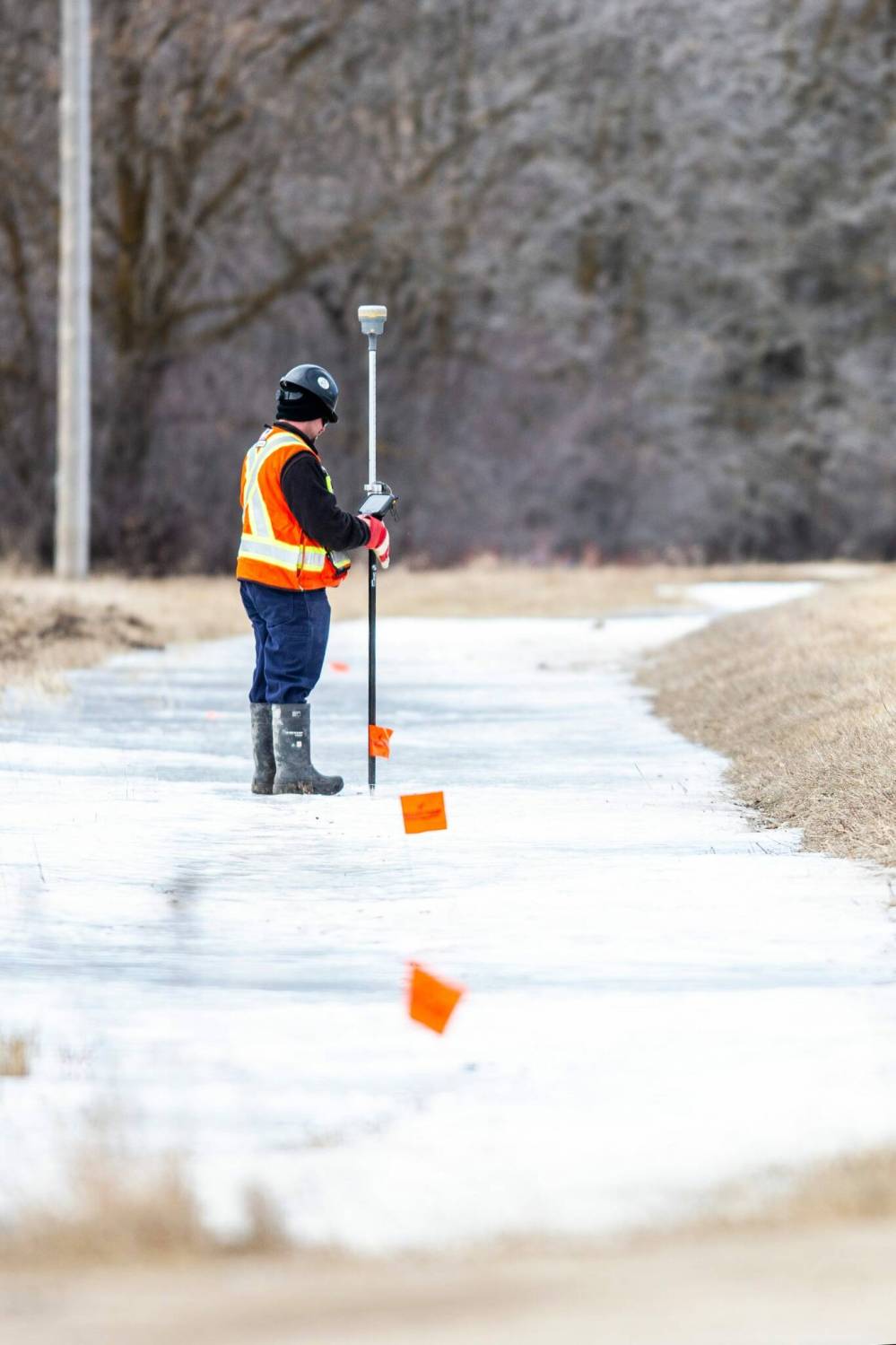
She did not specify how often the Winnipeg Products Pipeline is inspected or how often reports are made to the province.
Under oil and gas legislation, pipeline operators are mandated to provide annual reports that include volumes of oil transported, leaks, damage, major modifications, maintenance and other information.
Imperial Oil provided annual reports in March 2023 and February 2024, according to documents obtained via freedom of information requests. The three-page reports were redacted, citing legislation protecting the business interests of a third party.
Allowing resource companies to monitor their own work isn’t uncommon, but it’s increasingly considered a risky and outdated practice.
“No industry polices itself well,” said Bill Caram, executive director of the U.S.-based pipeline watchdog organization Pipeline Safety Trust.
“Of course, no one knows the pipeline system as well as the operator and they need to perform frequent inspections in order to maintain the integrity of their pipelines and make appropriate repairs. However, these should not replace the need for independent regulatory inspections.”
“No industry polices itself well.”–Bill Caram, executive director of Pipeline Safety Trust
Fitzpatrick has spent her career focusing on governance of energy and mining projects, including serving as an expert witness for several national pipeline project reviews.
“I don’t think the Canadian public really knows how self-regulated large-scale resource management is — including pipelines,” she said.
While companies are invested in the safety of their infrastructure, government monitoring is important to mitigate environmental and human health risks, and to ensure proper enforcement can be applied when needed, she said.
Province slow to update legislation
Manitoba, along with other provinces, has been slow to update its legislation to address these issues.
“We are operating under some old legislation that needs significant refreshers,” she said.
While Fitzpatrick argues there are no best practices for pipeline monitoring in Canada now, more effective practices have emerged in British Columbia, Alberta and at the federal level.
The Canada, B.C. and Alberta energy regulators have adopted a risk-based inspection system: oil and gas infrastructure is assessed based on several factors, including the facility’s last inspection date, the company’s compliance history, the resource being produced and the size and location of facilities. Companies still carry out their own inspections on a regular basis, but the province regularly inspects facilities and audits company compliance reports, prioritizing higher-risk facilities — including pipelines that cross waterways.
Fitzpatrick doesn’t necessarily think these risk-based assessments mean inspections happen as often as they should but said Manitoba should consider adopting such an approach.
Part of the problem, Fitzpatrick said, is the province’s oversight bodies are sorely under-resourced when it comes to both funds and staff.
The provincial government currently lists just two petroleum inspectors in its staff directory, while two positions appear to be vacant.
julia-simone.rutgers@freepress.mb.ca
FIPPA response on pipeline inspection

Julia-Simone Rutgers is an investigative reporter who joined the Free Press in 2020. Read more about Julia-Simone.
Every piece of reporting Julia-Simone produces is reviewed by an editing team before it is posted online or published in print — part of the Free Press‘s tradition, since 1872, of producing reliable independent journalism. Read more about Free Press’s history and mandate, and learn how our newsroom operates.
Our newsroom depends on a growing audience of readers to power our journalism. If you are not a paid reader, please consider becoming a subscriber.
Our newsroom depends on its audience of readers to power our journalism. Thank you for your support.