Province took nine days before alerting public about pipeline safety risk, documents reveal Handling of the Imperial pipeline saga raises questions about transparency and oversight
Read this article for free:
or
Already have an account? Log in here »
To continue reading, please subscribe:
Digital Subscription
One year of digital access for only $1.44 a week*
- Enjoy unlimited reading on winnipegfreepress.com
- Read the E-Edition, our digital replica newspaper
- Access News Break, our award-winning app
- Play interactive puzzles
*Billed as $5.77 plus GST every four weeks. After 52 weeks, price increases to the regular rate of $19.95 plus GST every four weeks. Offer available to new and qualified returning subscribers only. Cancel any time.
To continue reading, please subscribe:
Add Free Press access to your Brandon Sun subscription for only an additional
$1 for the first 4 weeks*
- Enjoy unlimited reading on winnipegfreepress.com
- Read the E-Edition, our digital replica newspaper
- Access News Break, our award-winning app
- Play interactive puzzles
*Your next Brandon Sun subscription payment will increase by $1.00 and you will be charged $17.95 plus GST for four weeks. After four weeks, your payment will increase to $24.95 plus GST every four weeks.
Read unlimited articles for free today:
or
Already have an account? Log in here »
Hey there, time traveller!
This article was published 12/09/2024 (773 days ago), so information in it may no longer be current.
The province waited nine days last spring before alerting the public of potential structural risks to the main gas pipeline that serves Winnipeg, internal government records reveal.
Departmental emails, obtained via freedom of information request, show Imperial Oil informed Manitoba officials on March 8 it would be shutting down Winnipeg’s primary fuel pipeline for “required maintenance.”
Co-ordinated statements from provincial staff and Imperial Oil were not released to the public until the evening of March 17.
In a March 8 email to the deputy minister of Economic Development, Investment, Trade and Natural Resources, department staff said Imperial Oil had requested a same-day briefing.
“This lady (from Imperial Oil government relations) called this morning and made it sound fairly urgent that her and her team brief you today,” a staff member wrote in an email to deputy minister Dana Rudy.
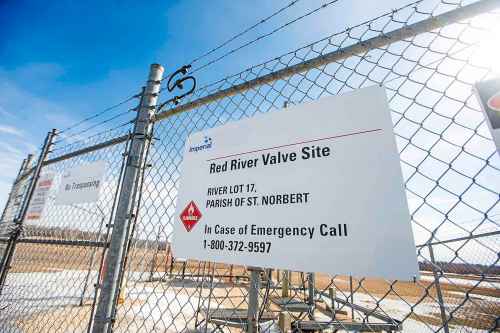
The Winnipeg Products Pipeline — the sole diesel, gasoline and jet fuel supply line for Winnipeg and parts of northern Ontario — was shut down from March until late June due to safety concerns flagged by the Alberta-based owner, Imperial Oil, along a section of pipe that runs under the Red River near St. Adolphe, south of Winnipeg.
Related Articles
Manitoba hints at ‘regulatory changes’ in wake of March shutdown of fuel link



“This time was used to determine the potential impact of the shutdown on supply and to judiciously mitigate the possibility of panic purchasing and a supply crunch,” a spokesperson for the Manitoba government said in an emailed response to questions about the delay.
Fuel was transported by truck and rail in the interim. Several gas stations navigated shortages in the early days of the repairs; some ran out of gas altogether.
The government’s handling of the Imperial pipeline saga has raised questions for legal experts about transparency and oversight.
“The right to access information around the environment should be a universal right,” Alan Andrews, a Vancouver-based environmental lawyer working with the environmental charity Ecojustice, said in an interview earlier this summer.
“Transparency is really critical to an effective inspection regime.”
A spokesperson for the Manitoba government said by email that when it was notified of the pipeline concerns on March 8, Imperial Oil said the pipeline would be cleared for repair by March 16.
“During this time, the province worked closely with all fuel suppliers and distributors to identify alternate means of transporting fuel and to ensure that supply would be met with as little impact to the consumer as possible,” the spokesperson said.
Imperial Oil pipeline signs in March this year just south of St. Adolphe, near the Red River. (Mikaela MacKenzie / Free Press files)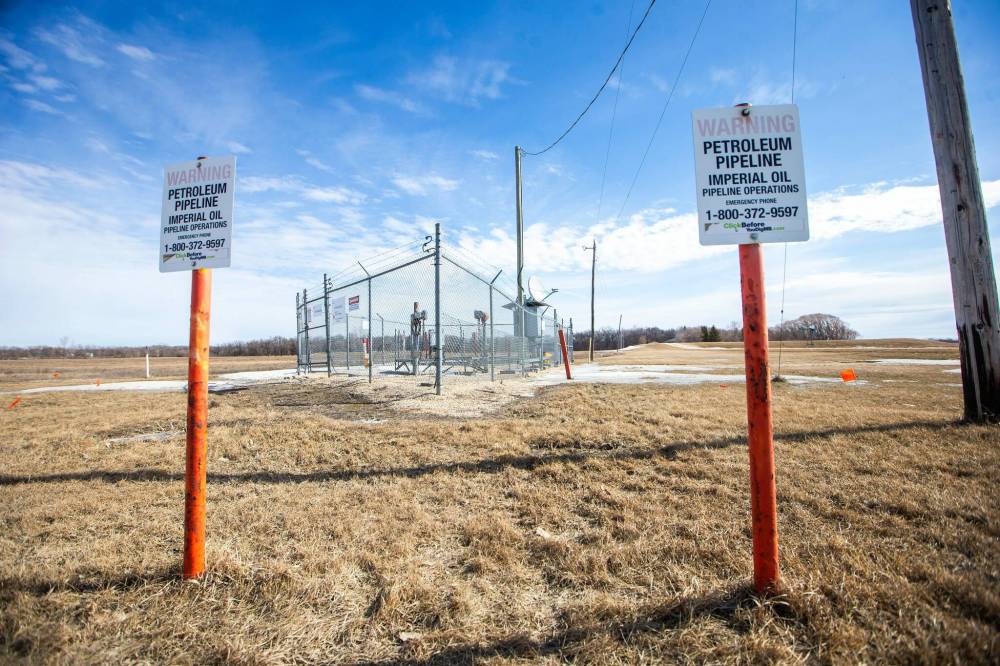
The spokesperson did not specifically answer questions about when government inspectors arrived on site, saying “provincial inspectors, as well as Imperial staff, were on site to confirm that no spillage occurred during this time. On average, both petroleum and environmental provincial inspectors were on site multiple times a week throughout the shutdown.”
The department was understaffed at the time the shutdown was announced, documents show.
In an email intended to help update Manitoba’s premier on provincial pipeline regulations and inspection staffing levels, Jeff Kraynyk, the assistant deputy minister for the minerals, petroleum and geoscience branch, explained inspection staff had been cut from five full-time positions to four in 2021 and two positions had been largely vacant since 2022.
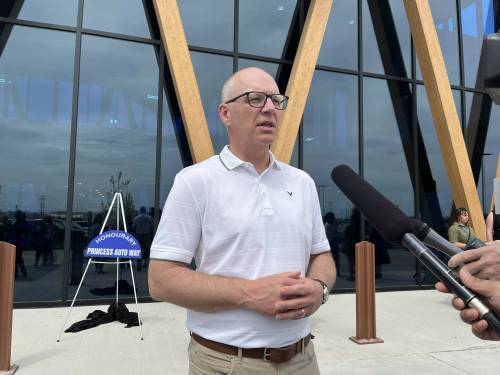
In an interview earlier this summer, Manitoba Environment Minister Tracy Schmidt said the Imperial Oil incident “really highlighted some of the gaps, perhaps, in governmental oversight,” adding the department had been “decimated” by cuts under the previous government.
As a result, she said, environmental inspections across the province — be it oil and gas or otherwise — were reduced by half.
As staff circulated a March 13 internal briefing note outlining Imperial’s plan to replace 1,500 feet of pipeline for “preventative repair,” members of Schmidt’s department were looking for information on the inspection and repair history of the pipeline.
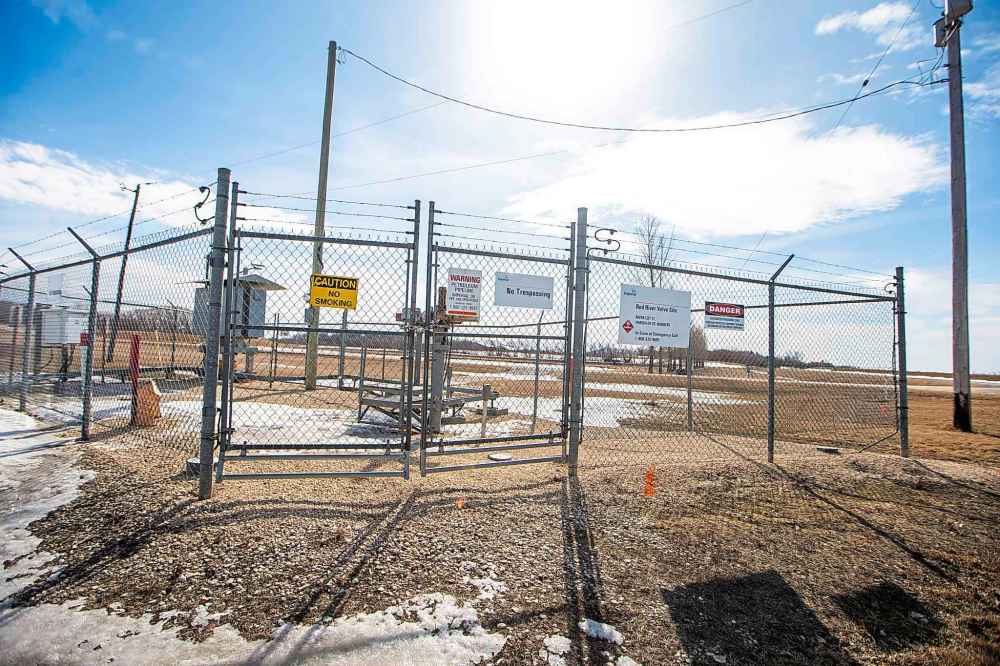
In an email to a member of Schmidt’s staff, Kraynyk said provincial inspectors were on site for repairs to other sections of the pipeline in 2022 and 2016. The company had completed two inspections of its own, using surveying equipment to “assess the thickness, pittings, obstructions, asymmetrical anomalies, etc.,” along the length of the pipeline in 2023.
An analysis earlier this summer by the Free Press/The Narhwhal revealed government inspectors conduct few formal, documented inspections. Staff informally visit and inspect oil and gas infrastructure, but there are no records of these inspections.
According to a provincial spokesperson, there were a total of 13 formal inspections for all 5,000 kilometres of active pipelines and flowlines in the last five years.
Instead, Manitoba relies on the oil industry to conduct its own monitoring, inspections and remediation. Those activities are documented for the province through annual reports.
Transparency is critical to effective monitoring — both between the regulator and industry and with the public, according to Andrews, the lawyer with Ecojustice.
“The risk of this self-regulation model is that industry has no real incentive for being transparent and owning up to their mistakes,” he said in an interview earlier this summer.
julia-simone.rutgers@freepress.mb.ca

Julia-Simone Rutgers is an investigative reporter who joined the Free Press in 2020. Read more about Julia-Simone.
Every piece of reporting Julia-Simone produces is reviewed by an editing team before it is posted online or published in print — part of the Free Press‘s tradition, since 1872, of producing reliable independent journalism. Read more about Free Press’s history and mandate, and learn how our newsroom operates.
Our newsroom depends on a growing audience of readers to power our journalism. If you are not a paid reader, please consider becoming a subscriber.
Our newsroom depends on its audience of readers to power our journalism. Thank you for your support.