Cyclists want to stop… having to stop Advocates point to U.S. experience, say carefully rolling through on bikes safer, less frustrating for drivers
Read this article for free:
or
Already have an account? Log in here »
To continue reading, please subscribe:

Digital Subscription
One year of digital access for only $205*
- Enjoy unlimited reading on winnipegfreepress.com
- Read the E-Edition, our digital replica newspaper
- Access News Break, our award-winning app
- Play interactive puzzles
*First annual payment billed as $205.00 + GST for one year. This annual subscription will automatically renew at $233.00 + GST every 52 weeks (10% off the regular annual price of $259.35). Offer available to new and qualified returning subscribers only. Cancel any time.
To continue reading, please subscribe:
Add Free Press access to your Brandon Sun subscription for only an additional
$1 for the first 4 weeks*
- Enjoy unlimited reading on winnipegfreepress.com
- Read the E-Edition, our digital replica newspaper
- Access News Break, our award-winning app
- Play interactive puzzles
*Your next Brandon Sun subscription payment will increase by $1.00 and you will be charged $17.95 plus GST for four weeks. After four weeks, your payment will increase to $24.95 plus GST every four weeks.
Read unlimited articles for free today:
or
Already have an account? Log in here »
Hey there, time traveller!
This article was published 21/08/2024 (755 days ago), so information in it may no longer be current.
Some cyclists are calling on the province to change a traffic law so bike riders can legally treat stop signs as yields and roll through any clear routes.
But while they expect removing the requirement for bikes to make a full stop would improve safety, others fear it could introduce new risks.
Proponents say amending the Highway Traffic Act to allow the “Idaho stop” would reduce driver-cyclist conflicts and collisions.

NIC ADAM / FREE PRESS
Cyclist Julia Schroeder rides her cargo bike along Annabella St. Wednesday with her dog Willow. She will be participating in Thursday’s group ride.
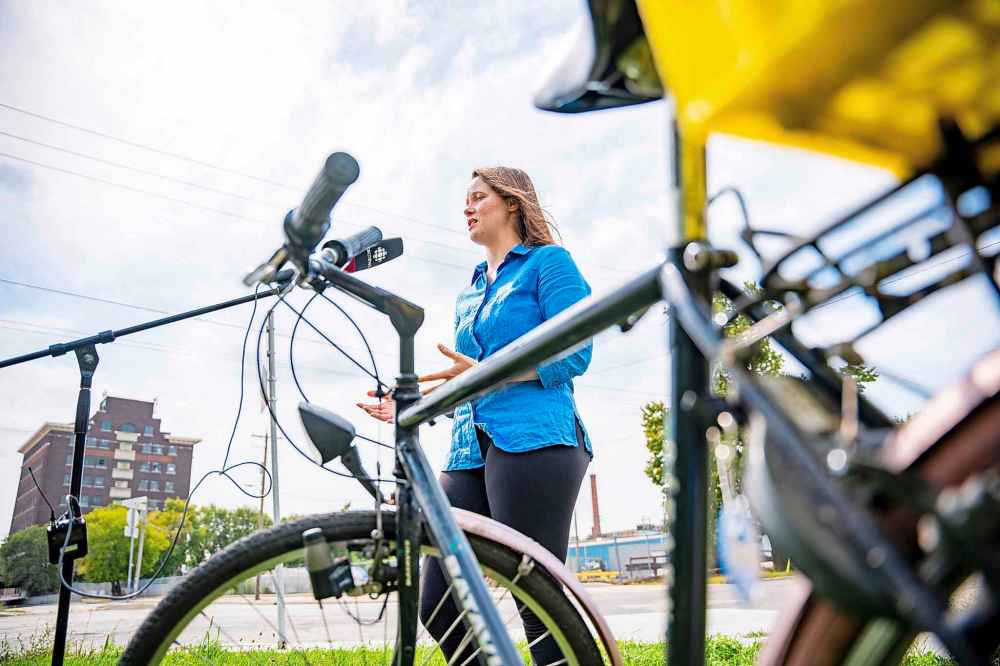
“As someone who rides a bike frequently, I actually have had (drivers) behind me express frustration and even verbally assault me for coming to a complete stop…. By using the Idaho stop, a cyclist actually spends less time in an intersection, which is where they’re most likely to come in contact with a vehicle,” said cycling advocate Hillary Rosentreter.
Rosentreter said the “Idaho stop” was legalized in the state of Idaho in the early 1980s and has since been linked to a decline in collisions between cyclists and vehicles. She said studies have found cyclist-vehicle collisions decrease by between 13 and 24 per cent after such laws are put in place.
Rosentreter said making the commonly used practice legal could also help avoid traffic delays.
“Forcing cyclists to come to a complete stop is actually bad for drivers, too, because it really halts traffic flow,” she said.
Rosentreter is helping organize a “compliance protest” to call attention to the issue. From 5 p.m. to 6 p.m. Thursday in the Westminster Avenue area, every participating cyclist will come to a complete stop at each stop sign to display the impact on traffic delays.
While some states also let cyclists treat red lights as stop signs, Rosentreter said her group isn’t pursuing that change right now.
In 2024 so far, there have been 127 cyclist-involved collisions in Manitoba, including 125 that caused injuries and two that resulted in fatalities, according to Manitoba Public Insurance. That compares with 203 collisions, including 202 that caused injury and one fatal crash throughout 2023.
This year, most of the crashes took place in Winnipeg, which accounted for 115 cyclist-involved collisions, including 113 injury crashes and two fatalities.
Rob Jenner, a 61-year-old cyclist, was killed in a hit-and-run on Wellington Crescent in June. A a 67-year-old male cyclist died after crashing into a parked tractor-trailer on the side of Kenaston Boulevard earlier this month.
Some cyclists surveyed at The Forks supported the call to change the law.
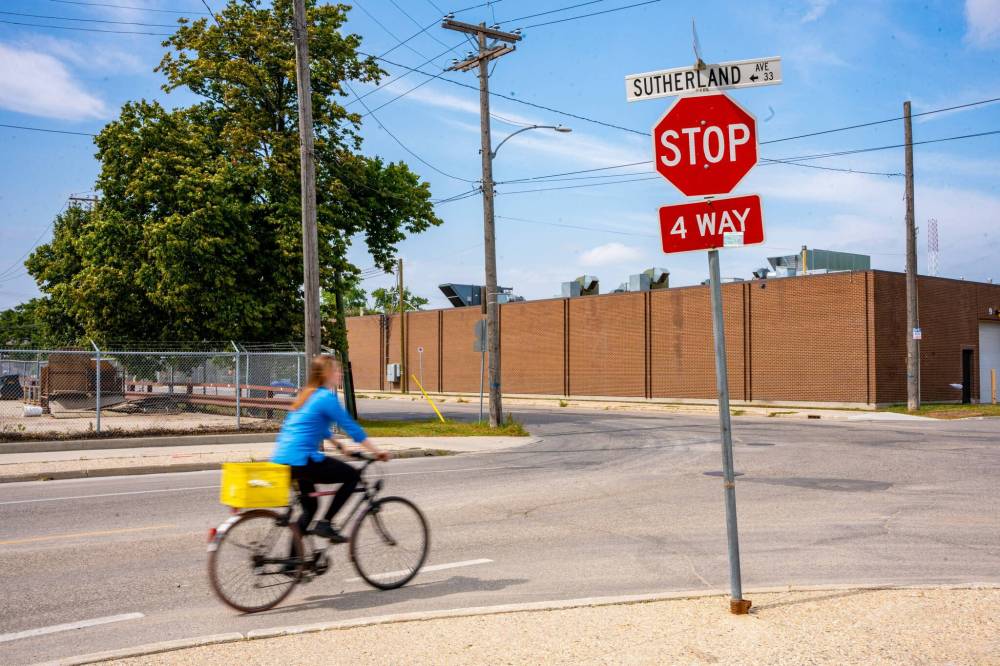
NIC ADAM / FREE PRESS
Hillary Rosentreter is calling for the province to change the Highway Traffic Act to allow those on bikes to do an “Idaho stop,” basically treating stop signs as yields.
“I am vulnerable in the middle of the intersection. That’s the most dangerous part of the road, because that’s where the interaction (between different modes of transportation) is happening,” said Karla Braun.
But some drivers fear the change would make it more difficult to predict a cyclist’s next move.
“If you’re going to be on the road as a cyclist, you should have to follow the same rules that everybody else does,” said Danielle Blaich.
Blaich said a bike rider recently pulled up alongside her vehicle instead of waiting for their turn to move forward. She fears those on bikes may be more likely to try to pass cars in that fashion if they are no longer required to stop at stop signs.
“I am vulnerable in the middle of the intersection. That’s the most dangerous part of the road.”–cyclist Karla Braun
“It would just be more hazard on the road, more ability for a car to hit them if (drivers) don’t see them,” said Blaich.
North Kildonan Coun. Jeff Browaty said he believes it would be safest to stick with the current law.
“My concern is it might encourage more cyclists to just blow through stop signs and traffic lights without yielding or stopping.… Erring on the side of caution, requiring cyclists to stop, is more consistent with expected behaviours and, I believe, safer for all road users,” Browaty said in an email.
Coun. Janice Lukes, chairwoman of public works, could not be reached for comment.
A driving instructor who previously worked at MPI said he believes many driving teachers might dismiss the idea of using the Idaho stop to improve safety, though he believes Manitoba should explore the option.
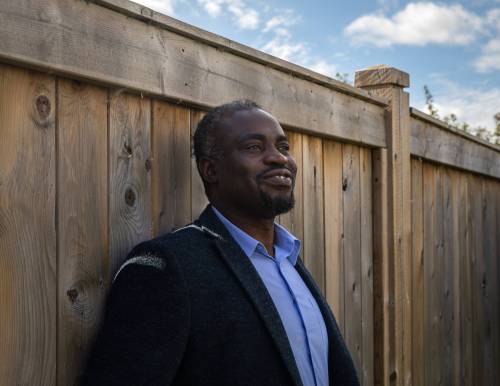
“On the surface, the legislation seems like it would be contrary to road safety and logic,” said Lou Gervino, who owns his own driving school. “I think the biggest thing would be to try to educate people (about it) because they seem to be having success (with it) in the U.S.”
If Manitoba tries the change, it would be best to apply on a limited basis, such as on two-lane roads only, not major thoroughfares, Gervino said.

“It seems to be more logical and more likely to have road-safety benefits (on smaller streets) than letting (cyclists) do it on regional streets, like Corydon, Stafford, Pembina, Main. The numbers are showing (that) it’s definitely worth looking at in Manitoba,” he said.
A provincial government spokesperson did not directly answer whether the government would make the change.
“We will continue to work with organizations that advocate for the safety of everyone on our roads, and we encourage all road users to respect road and traffic laws in hopes that all Manitobans can safely get to wherever they are going,” the spokesperson wrote in an email.
joyanne.pursaga@freepress.mb.ca
X: @joyanne_pursaga

Joyanne is city hall reporter for the Winnipeg Free Press. A reporter since 2004, she began covering politics exclusively in 2012, writing on city hall and the Manitoba Legislature for the Winnipeg Sun before joining the Free Press in early 2020. Read more about Joyanne.
Every piece of reporting Joyanne produces is reviewed by an editing team before it is posted online or published in print — part of the Free Press‘s tradition, since 1872, of producing reliable independent journalism. Read more about Free Press’s history and mandate, and learn how our newsroom operates.
Our newsroom depends on a growing audience of readers to power our journalism. If you are not a paid reader, please consider becoming a subscriber.
Our newsroom depends on its audience of readers to power our journalism. Thank you for your support.
Related Articles
Cyclists demand safety improvements after teen hurt in Wellington Crescent crash





History
Updated on Wednesday, August 21, 2024 6:25 PM CDT: Formatting