

City looking to test rail-crossing sensors that could improve emergency-crew response times

Advertisement
Read this article for free:
or
Already have an account? Log in here »
To continue reading, please subscribe:

Digital Subscription
One year of digital access for only $205*
- Enjoy unlimited reading on winnipegfreepress.com
- Read the E-Edition, our digital replica newspaper
- Access News Break, our award-winning app
- Play interactive puzzles
*First annual payment billed as $205.00 + GST for one year. This annual subscription will automatically renew at $233.00 + GST every 52 weeks (10% off the regular annual price of $259.35). Offer available to new and qualified returning subscribers only. Cancel any time.
To continue reading, please subscribe:
Add Free Press access to your Brandon Sun subscription for only an additional
$1 for the first 4 weeks*
- Enjoy unlimited reading on winnipegfreepress.com
- Read the E-Edition, our digital replica newspaper
- Access News Break, our award-winning app
- Play interactive puzzles
*Your next Brandon Sun subscription payment will increase by $1.00 and you will be charged $17.95 plus GST for four weeks. After four weeks, your payment will increase to $24.95 plus GST every four weeks.
Read unlimited articles for free today:
or
Already have an account? Log in here »
Hey there, time traveller!
This article was published 03/01/2025 (611 days ago), so information in it may no longer be current.
The city is on track to test sensors at Winnipeg rail crossings that would redirect emergency vehicles to alternate routes if a train is blocking traffic.
A grant of more than $417,000 from Transport Canada would cover the majority of costs to activate a city-wide system of sensors at rail crossings for five years.
“I think it’s great,” said Coun. Janice Lukes, chair of the civic public works committee, which will get a look at the idea next week.
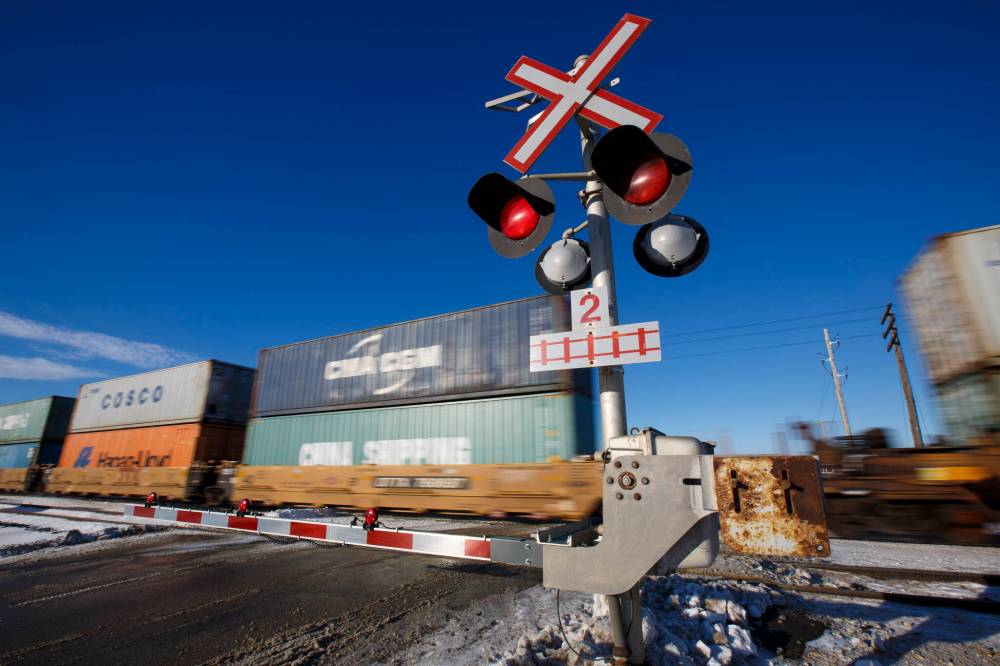
MIKE DEAL / FREE PRESS FILES
There are more than 110 rail crossings in Winnipeg.
“The technology was developed and made right here in Winnipeg. And, if it will better improve the response times of firefighters and paramedics, that is a good thing.”
In fact, the TRAINFO technology is in place at several city crossings installed in a 2020 study to prove the system’s effectiveness.
There are more than 110 rail crossings in the city, but sensors installed at 19 that collected data for a year were sufficient to analyze traffic information.
The study found, by comparing train-traffic data with dates and times emergency crews were dispatched, if the system had been fully operational, first responders would have encountered a 71 per cent reduction in delays at rail crossings.
At one crossing on Shaftesbury Boulevard just north of Wilkes Avenue, the study determined that if an emergency crew dispatched to a seniors complex there was blocked by a train for five minutes, it could have arrived one minute faster if it had instead been rerouted by an extra four kilometres via Kenaston Boulevard, Grant Avenue and Shaftesbury.
An official with TRAINFO could not be reached for comment.
Lukes said the system is being looked at now because civic officials discovered that a new residential and commercial development planned for the site of the former Canada Packers and Union Stock Yards — where up to 2,000 housing units would be constructed — is bounded by rail lines on both east and west sides, blocking emergency access several times a day.
“There are only one or two access points to the new development and one would be blocked if there is a train,” she said.
“With the funding for five years, we will be able to do a very great analysis of the system’s effectiveness.”

City spokesman David Driedger said currently responding Winnipeg Fire Paramedic Service crews “use their judgment and knowledge of their areas in selecting their routes.
“If a responding crew is blocked by a train, they will notify the 911 Communications Centre, who will access the availability of resources and determine if another resource should be dispatched to respond. Using TRAINFO could potentially help reroute emergency vehicles in advance if the dispatchers know the locations of rail activity at the time of dispatch.”
Driedger said in future the technology could alert motorists to avoid blocked rail crossings.
The city says the busiest crossings include Shaftesbury at Wilkes, Ravenhurst Street near Dugald Road, Route 90 near Lindenwood Drive, and Marion Street, Fermor Avenue and Abinojii Mikanah near Archibald Street.
kevin.rollason@freepress.mb.ca
Kevin Rollason
Reporter
Kevin Rollason was a general assignment reporter at the Free Press.
Our newsroom depends on a growing audience of readers to power our journalism. If you are not a paid reader, please consider becoming a subscriber.
Our newsroom depends on its audience of readers to power our journalism. Thank you for your support.
Kevin Rollason
Reporter
Kevin Rollason was a general assignment reporter at the Free Press.
Our newsroom depends on a growing audience of readers to power our journalism. If you are not a paid reader, please consider becoming a subscriber.
Our newsroom depends on its audience of readers to power our journalism. Thank you for your support.
Advertisement Advertise With Us
Advertisement Advertise With Us