

Hockey Canada picks up the pieces after another quarterfinal exit at world junior
Advertisement
Read this article for free:
or
Already have an account? Log in here »
To continue reading, please subscribe:

Digital Subscription
One year of digital access for only $205*
- Enjoy unlimited reading on winnipegfreepress.com
- Read the E-Edition, our digital replica newspaper
- Access News Break, our award-winning app
- Play interactive puzzles
*First annual payment billed as $205.00 + GST for one year. This annual subscription will automatically renew at $233.00 + GST every 52 weeks (10% off the regular annual price of $259.35). Offer available to new and qualified returning subscribers only. Cancel any time.
To continue reading, please subscribe:
Add Free Press access to your Brandon Sun subscription for only an additional
$1 for the first 4 weeks*
- Enjoy unlimited reading on winnipegfreepress.com
- Read the E-Edition, our digital replica newspaper
- Access News Break, our award-winning app
- Play interactive puzzles
*Your next Brandon Sun subscription payment will increase by $1.00 and you will be charged $17.95 plus GST for four weeks. After four weeks, your payment will increase to $24.95 plus GST every four weeks.
Read unlimited articles for free today:
or
Already have an account? Log in here »
Hey there, time traveller!
This article was published 03/01/2025 (602 days ago), so information in it may no longer be current.
OTTAWA – Scott Salmond and the rest of Hockey Canada’s brain trust took their places in front of pictures featuring tourist sites around the nation’s capital.
Parliament Hill, the National Gallery and the Rideau Canal made up the backdrop as the trio prepared to face the music.
What they — and the rest of the country — had just watched over the previous week wasn’t nearly as pleasing on the eye.
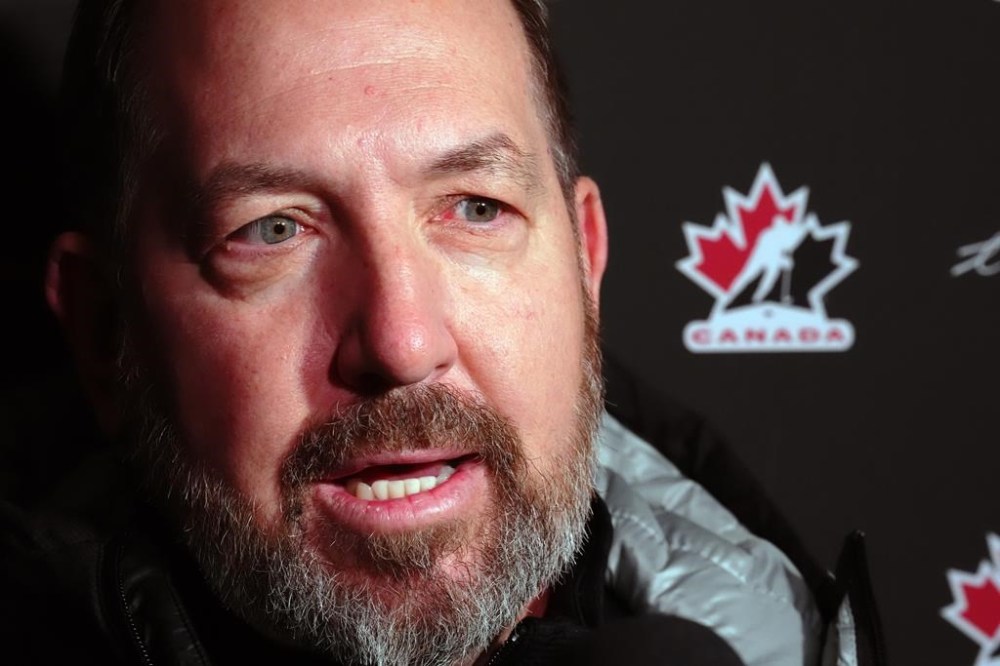
Canada was ousted from the world junior hockey championship at the quarterfinal stage with Thursday’s last-minute 4-3 loss to Czechia. That shambolic result followed another disastrous exit at the same stage to the same opponent at the same tournament 12 months ago.
Salmond, the program’s senior vice-president of high performance and hockey operations, along with management lead Peter Anholt and head scout Al Murray, trumpeted a skilled, competitive group heading into the annual showcase.
But what Canadians instead saw over five games was a disjointed roster that had difficulty putting the puck in the net and a propensity for taking a seat in the penalty box.
“Who do you blame? You can blame me,” Salmond said Friday at a downtown hotel. “If you think it’s scouting, I hire the scout. If you think it’s coaching, I hire the coach. You want to blame someone, you can blame me.”
“In our country, you gotta win way more often than you lose,” he added. “That’s what we sign up for. “
There were significant concerns on the outside when Canada declined to invite a number of offensively gifted players to its under-20 selection camp, instead keying on what were viewed internally as more well-rounded options.
“Players that had talent, but would also compete hard,” Murray said. “I don’t think we were short on talent. We didn’t score at times and that seemed to be a collective thing. I don’t know how to explain that.”
Anholt said simply bringing the best players and adjusting their roles wasn’t the right path despite Hockey Canada’s success at other levels using a similar formula.
“I don’t think that really does it,” he said. “You have to look at character, you have to look at how they play, how they compete.”
Anholt said he wouldn’t have changed a thing with the roster despite a second straight fifth-place finish — a first for Canada since the early 1980s.
“We had a high-character group,” he said. “Just didn’t get it done.”
A stunning 3-2 shootout loss to Latvia in the second preliminary round game — Canada had won four previous meetings 41-4 — following a solid 4-0 victory over Finland on Boxing Day turned out to be a bloody nose from which the country couldn’t recover.
“It affected the group,” said Salmond, whose team lost star 17-year-old defenceman Matthew Schaefer to injury for the rest of the tournament in that game. “I felt a little bit of a difference.”
Canada then came out flat in an unconvincing 3-0 victory over Germany and played well at times against the United States in a 4-1 loss that forced the hosts into that tricky matchup with Czechia as the third-place team in Group A.
“This tournament means a lot to Canadians,” Salmond said. “There’s a lot of opinions, there’s a lot of things that are written, there’s a lot of things are said, but that’s only because people care.”
Much like with the roster, Hockey Canada declined to pin blame on head coach Dave Cameron, whose lineup and deployment decisions were criticized on the outside.
“We had an identity how we wanted to play,” Salmond said. “He doesn’t score goals. It’s his job to put players in positions to do that. I thought he did.”
Canada scored 13 times in five games — just two more than lowly Kazakhstan — thanks to a tournament-worst 6.34 shooting percentage and by far the most penalized team.
“That combination was lethal,” Anholt said.
“The buck stops with me,” Salmond added. “Like other Canadians, I’m incredibly disappointed.”
So where does Hockey Canada go from here with a world junior setup that has won a record 20 gold medals, but also now failed to reach the podium three times since 2019?
The organization has been loyal to players who have won at lower levels, but Salmond said it might need to be more nimble as teenagers develop and mature at different rates.
“Do we need to blow everything up and start over? I don’t think so,” he said. “We need to probably fine-tune some things.”

Salmond was asked point-blank why Canadians — used to watching their team play for gold every Jan. 5 — should believe in the current regime?
“Our program has proven to be successful,” he said. “We’ve proven to do things the right way with the right people. That’s not going to change. I don’t think that the results are always indicative of the people or the process.
“Sometimes you win at sport and sometimes you lose.”
The autopsy now begins anew.
This report by The Canadian Press was first published Jan. 3, 2025.