Kinew unveils plan to move hundreds living in city’s tent camps to safe housing ‘MVP’ Blaikie Whitecloud to begin implementing $20-M, two-year camp-by-camp strategy next month
Read this article for free:
or
Already have an account? Log in here »
To continue reading, please subscribe:

Digital Subscription
One year of digital access for only $205*
- Enjoy unlimited reading on winnipegfreepress.com
- Read the E-Edition, our digital replica newspaper
- Access News Break, our award-winning app
- Play interactive puzzles
*First annual payment billed as $205.00 + GST for one year. This annual subscription will automatically renew at $233.00 + GST every 52 weeks (10% off the regular annual price of $259.35). Offer available to new and qualified returning subscribers only. Cancel any time.
To continue reading, please subscribe:
Add Free Press access to your Brandon Sun subscription for only an additional
$1 for the first 4 weeks*
- Enjoy unlimited reading on winnipegfreepress.com
- Read the E-Edition, our digital replica newspaper
- Access News Break, our award-winning app
- Play interactive puzzles
*Your next Brandon Sun subscription payment will increase by $1.00 and you will be charged $17.95 plus GST for four weeks. After four weeks, your payment will increase to $24.95 plus GST every four weeks.
Read unlimited articles for free today:
or
Already have an account? Log in here »
Hey there, time traveller!
This article was published 14/01/2025 (620 days ago), so information in it may no longer be current.
Premier Wab Kinew unveiled an ambitious plan Tuesday to move several hundred people out of tent encampments and into “attractive” alternative housing beginning next month.
“We’re here to say that as a province, people in Manitoba are no longer satisfied with having people live in tents,” said Kinew, who was flanked by Housing, Addictions and Homelessness Minister Bernadette Smith, Mayor Scott Gillingham and Siloam Mission CEO Tessa Blaikie Whitecloud inside the Granite Curling Club, where a neighbouring encampment was dismantled late last year.
“We’re going to work together, ensure that everybody has a place to call home, and importantly, that you have the addictions and mental-health services to succeed in living with a roof over your head.”
The 15-page strategy — called Your Way Home: Manitoba’s Plan to End Chronic Homelessness — promises to move residents of one encampment at a time into housing — including 300 new social units — owned either by the province or the non-profit sector, that will be supported by non-profit organizations, Kinew said at the morning news conference.
Blaikie Whitecloud, referred to by the premier as the “MVP” from the not-for-profit sector, was recruited to quarterback the plan as his senior adviser on ending chronic homelessness.
Smith wasn’t able to provide details about the apartment buildings that the province is purchasing for social housing, or say where Blaikie Whitecloud, who will leave Siloam Mission at the end of the month after three years at the helm, will be working, or if she’ll have a staff or budget.
The former executive director of 1JustCity previously taught sociology at the University of Winnipeg.
“Tessa is known for her ability to bring people together and build consensus,” Smith said. “(She) will help ensure that the work is co-ordinated, effective and lasting.”
The plan is to work with the non-profit sector and the city on a 30-day timeline beginning in February to help move an estimated 700 Manitobans living in tent encampments.
Camps will be selected based on health, safety and community issues and the availability of suitable housing for its residents. They’ll be offered access to social housing, help accessing market housing and an array of health supports. The approach will be “grounded in compassion,” the premier said.
MIKE DEAL / FREE PRESS From left: Tessa Blaikie Whitecloud, MLA David Pankratz (Waverley), Premier Wab Kinew, Housing, Addictions and Homelessness Minister Bernadette Smith and Mayor Scott Gillingham announced a new strategy to tackle chronic homelessness during a news conference Tuesday.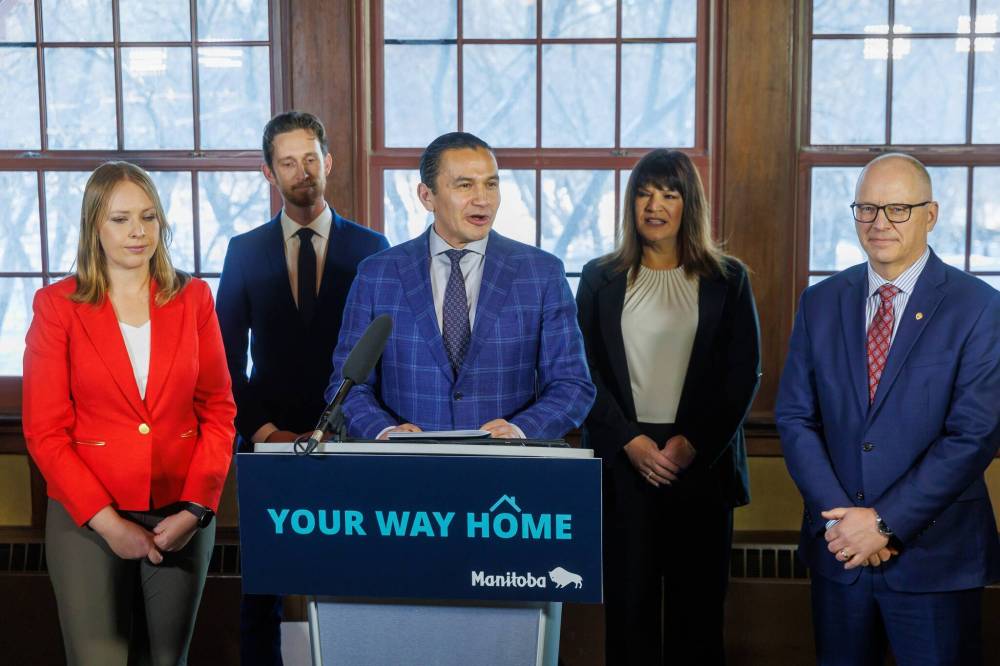
Kinew called it a $20-million, two-year commitment to work with people: “hitting the streets, going camp to camp.”
He said there will be no going “tent to tent” to “cherry pick” people who would be the easiest to successfully house. Rather, encampments will be moved only after housing is secured for every person living there. The sites will then be cleared by cleanup teams and monitored by foot patrols so they are not repopulated.
The solution to homelessness is housing units, Blaikie Whitecloud said.
“Right now, every month, there’s an average of 100 units available at a deeply affordable rate, and there are roughly 3,500 people competing for those units in our city,” she said, adding more housing is needed if those living in encampments are to be offered an alternative.
The strategy also includes “flex funding” to help people whose only barrier to housing may be a plane or bus ticket home, Kinew said.
Blaikie Whitecloud said the “person-centred” flex funding could be used to solve homelessness before it starts, citing examples from Siloam Mission in which someone’s car insurance was paid so they didn’t lose their job, or they received help if they were behind on rent.
MIKE DEAL / FREE PRESS Mayor Scott Gillingham (right) with Tessa Blaikie Whitecloud (left), Premier Wab Kinew’s new senior adviser on ending chronic homelessness.
Gillingham praised the plan.
“First, it takes a systematic but compassionate approach to help people who are right now homeless, moving them out of encampments into safe housing with the support that they need,” the mayor said. “And, second, it aims to restore public spaces as safe, clean, welcoming areas for everyone to use and to enjoy.”
The city — from the fire and paramedic service to bylaw enforcement, administration and public works — is fully committed to supporting the plan, he said.
“We are all in. Collaboration is key and it’s critical that everyone’s working towards the same goal.”
City funding for mobile outreach units will move to an RFP model that ensures future funding is aligned with the plan, he said.
Last summer, outreach workers with Main Street Project and St. Boniface Street Links clashed over how to help people living in a park in Southwood.
MIKE DEAL / FREE PRESS Mayor Scott Gillingham praised the plan, calling Tuesday a “very great day.”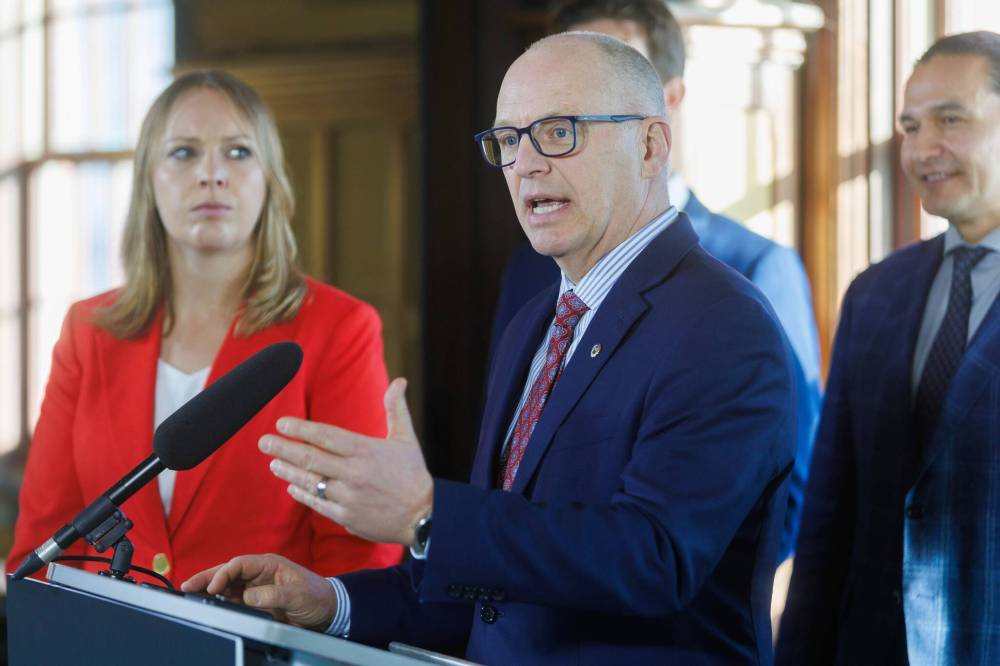
Both non-profit organizations applauded the strategy Tuesday, but are waiting to see how it’s rolled out.
“We are looking forward to learning more about the plan and its implementation, and how the Truth and Reconciliation Commission of Canada’s 94 Calls to Action, the United Nations Declaration on the Rights of Indigenous People and the Federal Housing Advocate’s review of homeless encampments guides this important work in housing people in a good way,” Main Street Project said in a news release.
St. Boniface Street Links executive director Marion Willis said “the devil is in the details,” but added the province had pulled together a new approach to ending homelessness with a plan similar to the operations of her organization, which has housed approximately 1,500 people over the past four years.
“I’m confident that in the weeks and the months ahead, Winnipeggers will start to see meaningful change on our streets, in our parks, on the riverbanks and in other public spaces,” Gillingham said. “Most importantly, those who are unhoused across our city right now will begin to move into housing with the supports they need to provide health and stability to their lives.”
Progressive Conservative housing, addictions and homelessness critic Carrie Hiebert asked how the province is going to find the required support workers amid a current shortage, and how they’ll be able to convince people in encampments to leave if they don’t want to move.
carol.sanders@freepress.mb.ca
Your Way Home: Manitoba’s Plan to End Chronic Homelessness

Carol Sanders
Legislature reporter
Carol Sanders is a reporter at the Free Press legislature bureau. The former general assignment reporter and copy editor joined the paper in 1997. Read more about Carol.
Every piece of reporting Carol produces is reviewed by an editing team before it is posted online or published in print — part of the Free Press‘s tradition, since 1872, of producing reliable independent journalism. Read more about Free Press’s history and mandate, and learn how our newsroom operates.
Our newsroom depends on a growing audience of readers to power our journalism. If you are not a paid reader, please consider becoming a subscriber.
Our newsroom depends on its audience of readers to power our journalism. Thank you for your support.
Related Articles
A housing opportunity for Manitoba



















History
Updated on Tuesday, January 14, 2025 10:40 AM CST: Adds fresh quote from Kinew
Updated on Tuesday, January 14, 2025 11:02 AM CST: Adds PDF of strategy document
Updated on Tuesday, January 14, 2025 12:43 PM CST: Adds photo
Updated on Tuesday, January 14, 2025 6:42 PM CST: Adds details, photos.
Updated on Wednesday, January 15, 2025 8:33 AM CST: Fixes typo