

Booth University College debuts ‘Shelter U’ educational project
Aimed at those experiencing economic hardship

Advertisement
Read this article for free:
or
Already have an account? Log in here »
To continue reading, please subscribe:
Digital Subscription
One year of digital access for only $1.44 a week*
- Enjoy unlimited reading on winnipegfreepress.com
- Read the E-Edition, our digital replica newspaper
- Access News Break, our award-winning app
- Play interactive puzzles
*Billed as $5.77 plus GST every four weeks. After 52 weeks, price increases to the regular rate of $19.95 plus GST every four weeks. Offer available to new and qualified returning subscribers only. Cancel any time.
To continue reading, please subscribe:
Add Free Press access to your Brandon Sun subscription for only an additional
$1 for the first 4 weeks*
- Enjoy unlimited reading on winnipegfreepress.com
- Read the E-Edition, our digital replica newspaper
- Access News Break, our award-winning app
- Play interactive puzzles
*Your next Brandon Sun subscription payment will increase by $1.00 and you will be charged $17.95 plus GST for four weeks. After four weeks, your payment will increase to $24.95 plus GST every four weeks.
Read unlimited articles for free today:
or
Already have an account? Log in here »
Hey there, time traveller!
This article was published 27/02/2025 (601 days ago), so information in it may no longer be current.
Manitoba’s newest university campus has a self-imposed mandate to recruit students who are experiencing poverty and searching for stable housing.
Shelter U — a pilot project by Booth University College — is up and running in Winnipeg, as of the start of the winter semester.
“On the one hand, universities have all this academic intelligence — but we’re often criticized for the ivory-tower model or practice. The shelter, on the other hand, has all these wonderful wraparound, practical supports,” said Aaron Klassen, who is teaching a first-of-its-kind course at the Winnipeg Centre of Hope this term.
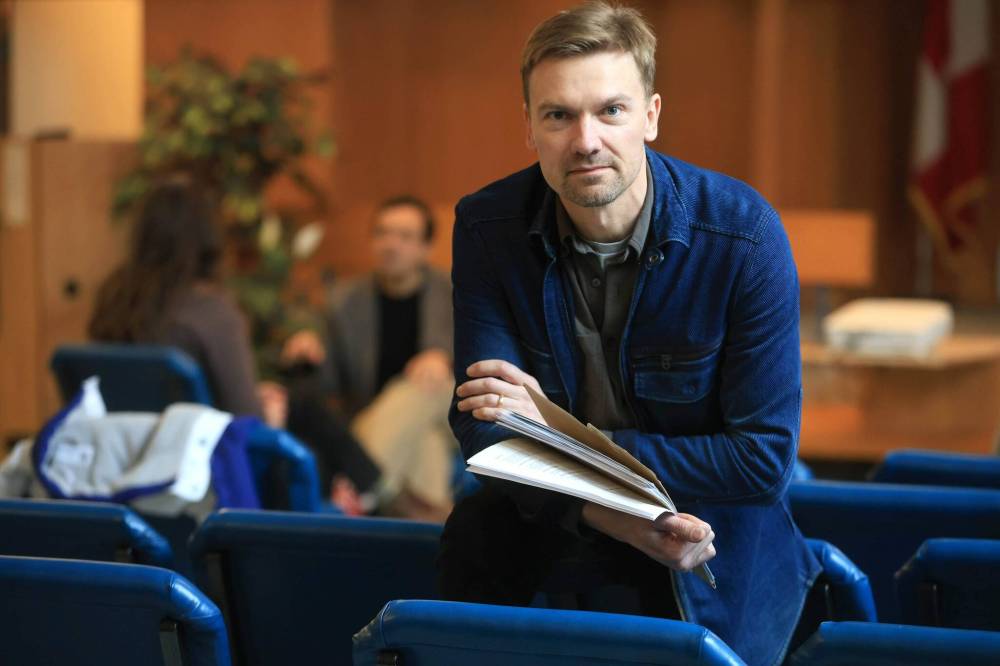
Ruth Bonneville / Free Press
Instructor Aaron Klassen says ‘Shelter U’ aims to address the ‘ivory tower’ model of learning academia is often criticized for.
Citing a goal to reduce barriers to higher education in his hometown, Klassen began looking for programs around the world that had been successful.
The assistant professor of sociology said he was inspired by the Clemente Course in the Humanities.
Its model, which was developed in Manhattan more than 30 years ago and has been replicated across the United States and Canada, gives non-traditional adult learners who are facing economic hardships an opportunity to study the social sciences.
Instructors aim to empower participants to further their schooling and careers, learn how to advocate for themselves and engage in the cultural and civic lives of their communities, its website said. The subjects include philosophy, history, literature, art history and writing.
Klassen’s local rollout reflects his passion for music education. The academic, who oversees his school’s community and urban transformation program, researches the intersection of music and social change.
Textbooks, field trips and other expenses are paid for with private donations and a roughly $60,000 community grant from the Winnipeg Foundation.
The Salvation Army is providing space at 180 Henry Ave., as well as laptops to its clients who are registered in the intro to music sociology course.
On Wednesday, 11 students gathered for their latest lecture on the grounds of the emergency dorm, transitional room and family shelter facility in Point Douglas.
The Winnipeg Centre of Hope is the logical host for Shelter U, given the Christian university’s ties to the Salvation Army, Klassen said.
His students, a mix of typical Booth attendees and shelter residents, took their seats in the facility’s chapel shortly after 1 p.m. to review the chapter they were assigned to read in Understanding Society through Popular Music.
This week’s focus? Youth, deviance and subcultures — topics that ignited discussion about the moral panic associated with rock and roll, the Beatles’ mop-top haircuts and parent advisory labels on albums containing explicit lyrics.
Participants were asked to share examples of “deviant music.”
“What about electric powwow?” one student mused. “I’ve gotten grief from elders, but also, I’ve gotten the go-ahead from elders praising electric powwow just to get the young people interested in it.”
Another noted Kendrick Lamar’s Super Bowl halftime show was deemed rogue due to his public diss against Drake, continuing the rappers’ longtime feud, and critiques of capitalist exploitation and African-American struggles throughout history.
The three-hour-long seminars are taking place every Wednesday, from late January to mid-April. An extra meet-up is scheduled for Thursday so the group, made up of Winnipeggers of all ages, can watch the Winnipeg Symphony Orchestra perform during Shelter U’s inaugural field trip.
“The most important thing for me was that (our clients) were students. They get the same exact treatment that any university student would get,” said Mark Stewart, executive director of the Winnipeg Centre of Hope.
The majority of people who access the facility, which houses close to 500 people nightly in the winter months, have either had their schooling disrupted or have never had the opportunity to pursue higher education, Stewart said.
He noted Salvation Army leaders recognize education is key to help their clients build confidence and community, find employment and break intergenerational cycles of poverty.
Klassen said he plans to offer letters of reference to graduates who “discover a desire for learning” so they can apply to a college, university or vocational school of their choice.

“We’re trying to do all that we can to leave our students with more than they came with,” Klassen said.
During a mid-class coffee break, one student — a 36-year-old mother who accesses shelter services — said she joined the program to build self-esteem and expand her knowledge.
The student said she’s always been interested in post-secondary studies, but had never been presented with an opportunity to fulfil that goal before learning about tuition-free Shelter U.
“(Studying palliative care) has always been my goal,” she said, “but my confidence was in the way.”
maggie.macintosh@freepress.mb.ca
Maggie Macintosh
Education reporter
Maggie Macintosh reports on education for the Free Press. Originally from Hamilton, Ont., she first reported for the Free Press in 2017. Read more about Maggie.
Funding for the Free Press education reporter comes from the Government of Canada through the Local Journalism Initiative.
Every piece of reporting Maggie produces is reviewed by an editing team before it is posted online or published in print — part of the Free Press‘s tradition, since 1872, of producing reliable independent journalism. Read more about Free Press’s history and mandate, and learn how our newsroom operates.
Our newsroom depends on a growing audience of readers to power our journalism. If you are not a paid reader, please consider becoming a subscriber.
Our newsroom depends on its audience of readers to power our journalism. Thank you for your support.
Maggie Macintosh
Education reporter
Maggie Macintosh reports on education for the Free Press. Originally from Hamilton, Ont., she first reported for the Free Press in 2017. Read more about Maggie.
Funding for the Free Press education reporter comes from the Government of Canada through the Local Journalism Initiative.
Every piece of reporting Maggie produces is reviewed by an editing team before it is posted online or published in print — part of the Free Press‘s tradition, since 1872, of producing reliable independent journalism. Read more about Free Press’s history and mandate, and learn how our newsroom operates.
Our newsroom depends on a growing audience of readers to power our journalism. If you are not a paid reader, please consider becoming a subscriber.
Our newsroom depends on its audience of readers to power our journalism. Thank you for your support.
Advertisement Advertise With Us
Advertisement Advertise With Us