

Next generation of scientists and innovators showcase their creativity, curiosity
Turnout for latest Manitoba Schools Science Symposium rebounds to pre-COVID levels

Advertisement
Read this article for free:
or
Already have an account? Log in here »
To continue reading, please subscribe:

Digital Subscription
One year of digital access for only $205*
- Enjoy unlimited reading on winnipegfreepress.com
- Read the E-Edition, our digital replica newspaper
- Access News Break, our award-winning app
- Play interactive puzzles
*First annual payment billed as $205.00 + GST for one year. This annual subscription will automatically renew at $233.00 + GST every 52 weeks (10% off the regular annual price of $259.35). Offer available to new and qualified returning subscribers only. Cancel any time.
To continue reading, please subscribe:
Add Free Press access to your Brandon Sun subscription for only an additional
$1 for the first 4 weeks*
- Enjoy unlimited reading on winnipegfreepress.com
- Read the E-Edition, our digital replica newspaper
- Access News Break, our award-winning app
- Play interactive puzzles
*Your next Brandon Sun subscription payment will increase by $1.00 and you will be charged $17.95 plus GST for four weeks. After four weeks, your payment will increase to $24.95 plus GST every four weeks.
Read unlimited articles for free today:
or
Already have an account? Log in here »
Hey there, time traveller!
This article was published 12/04/2025 (533 days ago), so information in it may no longer be current.
Up-and-coming researchers showed off their microplastic extractions and homemade artificial intelligence models at the 2025 Manitoba Schools Science Symposium.
Five years after it was abruptly called off due to COVID-19, the annual event inviting Grade 4 to 12 students to put their hypotheses to the test is rebounding.
The competition has returned to the University of Manitoba’s Max Bell Centre and its latest edition drew 335 competitors from 35 schools — the strongest turnout since 2018-19.

MAGGIE MACINTOSH/FREE PRESS
Ella Strachan, a Grade 12 student from Grant Park High School, discovered microplastics in water samples she collected from Lake Winnipeg.
Veteran Ella Strachan was among them.
For her final science fair, the Grade 12 student wanted to measure plastic pollution in Lake Winnipeg and determine where it is most likely to accumulate.
She had a dozen vials of lake water containing colourful debris on display beside her “Mapping Microplatics” posterboard on Saturday.
Ella had collected water samples from different sections of the waterway and, following a filtration and wet peroxide oxidation process, took a closer look; each of them were found to contain tiny pieces of plastic.
“This definitely raises concerns of microplastics as an emerging contaminant in Lake Winnipeg,” the 17-year-old said.

The final-year student at Grant Park High School indicated her findings suggest the lake should be regularly monitored for these particles, in addition to nutrients such as nitrogen and phosphorus.
“The health of the lake is very important to the many people who depend on it — there are 650 commercial fishers that operate on the lake, 23,00 permanent residents and 11 First Nations,” she added.
Her neighbours at the provincial science fair studied how screen time impacts attention spans, the prevalence of microplastics in snow and AI’s usefulness in bridging language barriers, along with dozens of other topics.
MAGGIE MACINTOSH/FREE PRESS
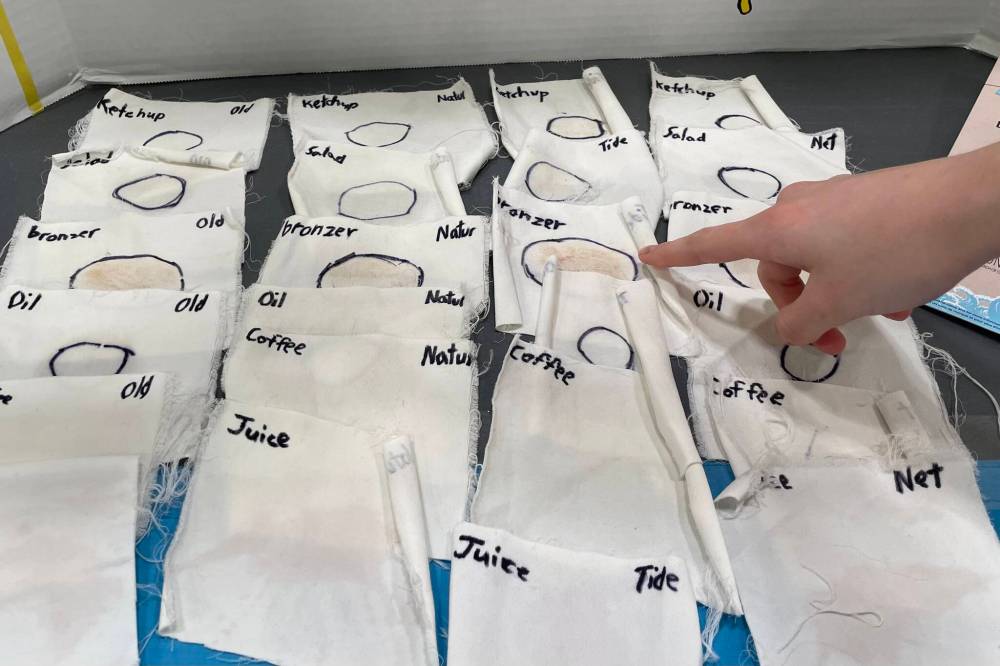
Grade 8 student Patience Doucet put different laundry detergents to the test for her science fair project.
A science fair staple — a baking soda and vinegar-powered volcano — was temporarily out of commission on Saturday after too many explosive ingredients were poured into its summit at once.
Another student in the elementary category tried a handful of toothpastes to find out what ones, if any, were effective at whitening after repeated use. Another youngster built a solar-integrated hydroelectric generator that relied on a waterfall made out of a plastic tube.
Even the most basic projects are important because they get students inspired and thinking about what a future in science could look like for them, said Rohan Sethi, co-chair of the planning committee that put on the 2025 symposium.
“This is a very important platform for students who are going to be our next generation of scientists, innovators, engineers and physicians to showcase their creativity, curiosity, intellect and inquisitiveness,” said Sethi, a health sciences student at the U of M and alum of the symposium.
The Laureate Academy’s Patience Doucet tested biological laundry detergents against non-biological ones. The former proved more effective at cleaning coffee, juice and other blemishes.
“I get a lot of stains. I’m really prone to spilling stuff on myself,” the 13-year-old said, followed by a chuckle, when asked about what inspired her to study the subject.
The Grade 8 student’s findings have already impacted her family’s buying habits, she noted.
Sethi, one of the organizers, noted that AI was a trendy research topic this year. He attributed student interest to the “AI boom.”
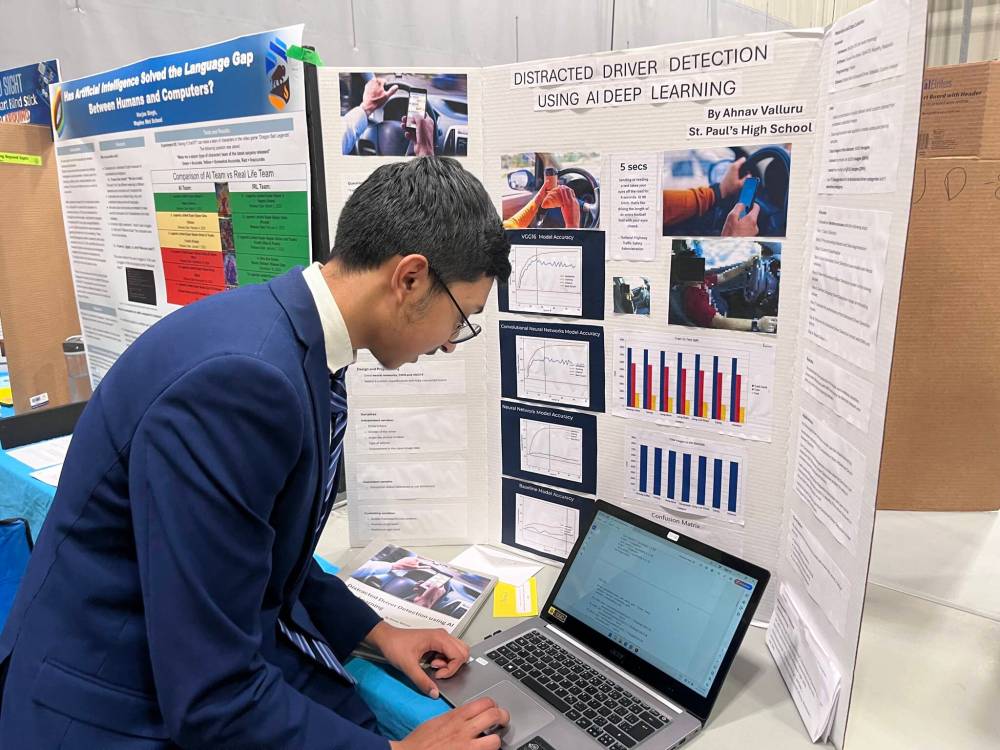
Grade 10 student Ahnav Valluru was one of several teenagers who developed his own AI model. He created a code that helps a webcam installed in a passenger seat determine whether or not a driver is paying attention to the road.
MAGGIE MACINTOSH/FREE PRESS
Ahnav Valluru, 15, created an AI model that can determine if a driver is distracted based on their eye and hand movements.
Although the 15-year-old is not yet eligible to get his learner’s permit, he said he is concerned about the state of distracted driving.
“I want to help make roads safer and accident-free,” said Ahnav, who attends St. Paul’s High School.
His code analyzes a driver’s posture and eye movements.
This year’s judges, some of whom are U of M faculty members, are asked to analyze creativity, scientific methods and presentation styles.
The winners of the competition are slated to be announced on Sunday.
maggie.macintosh@freepress.mb.ca
Maggie Macintosh
Education reporter
Maggie Macintosh reports on education for the Free Press. Originally from Hamilton, Ont., she first reported for the Free Press in 2017. Read more about Maggie.
Funding for the Free Press education reporter comes from the Government of Canada through the Local Journalism Initiative.
Every piece of reporting Maggie produces is reviewed by an editing team before it is posted online or published in print — part of the Free Press‘s tradition, since 1872, of producing reliable independent journalism. Read more about Free Press’s history and mandate, and learn how our newsroom operates.
Our newsroom depends on a growing audience of readers to power our journalism. If you are not a paid reader, please consider becoming a subscriber.
Our newsroom depends on its audience of readers to power our journalism. Thank you for your support.
Maggie Macintosh
Education reporter
Maggie Macintosh reports on education for the Free Press. Originally from Hamilton, Ont., she first reported for the Free Press in 2017. Read more about Maggie.
Funding for the Free Press education reporter comes from the Government of Canada through the Local Journalism Initiative.
Every piece of reporting Maggie produces is reviewed by an editing team before it is posted online or published in print — part of the Free Press‘s tradition, since 1872, of producing reliable independent journalism. Read more about Free Press’s history and mandate, and learn how our newsroom operates.
Our newsroom depends on a growing audience of readers to power our journalism. If you are not a paid reader, please consider becoming a subscriber.
Our newsroom depends on its audience of readers to power our journalism. Thank you for your support.
Advertisement Advertise With Us
Advertisement Advertise With Us
History
Updated on Saturday, April 12, 2025 7:22 PM CDT: Updates headline