

Police non-emergency line AI call-taking program delayed

Advertisement
Read this article for free:
or
Already have an account? Log in here »
To continue reading, please subscribe:

Digital Subscription
One year of digital access for only $205*
- Enjoy unlimited reading on winnipegfreepress.com
- Read the E-Edition, our digital replica newspaper
- Access News Break, our award-winning app
- Play interactive puzzles
*First annual payment billed as $205.00 + GST for one year. This annual subscription will automatically renew at $233.00 + GST every 52 weeks (10% off the regular annual price of $259.35). Offer available to new and qualified returning subscribers only. Cancel any time.
To continue reading, please subscribe:
Add Free Press access to your Brandon Sun subscription for only an additional
$1 for the first 4 weeks*
- Enjoy unlimited reading on winnipegfreepress.com
- Read the E-Edition, our digital replica newspaper
- Access News Break, our award-winning app
- Play interactive puzzles
*Your next Brandon Sun subscription payment will increase by $1.00 and you will be charged $17.95 plus GST for four weeks. After four weeks, your payment will increase to $24.95 plus GST every four weeks.
Read unlimited articles for free today:
or
Already have an account? Log in here »
Hey there, time traveller!
This article was published 13/06/2025 (436 days ago), so information in it may no longer be current.
An artificial intelligence program designed to handle non-emergency calls to Winnipeg police has been delayed, after initial tests had disappointing results.
“(With) the first two rounds (of testing), we were not entirely pleased with the results…. A lot of calls were being forwarded to the (human) call-takers, more than the number we were anticipating…. (The system) was missing transcriptions, the words were not being picked up and there was a lot of slow responsiveness in the conversational aspect of the product,” said Scot Halley, deputy chief of operations for the Winnipeg Police Service, during Friday’s Winnipeg Police Board meeting.
Following those issues, Halley said police switched to a new text-to-speech service provider and a third round of testing had much better results. In that case, 58 of 60 calls were handled entirely through AI and only two had to be diverted to a human call-taker, he said.
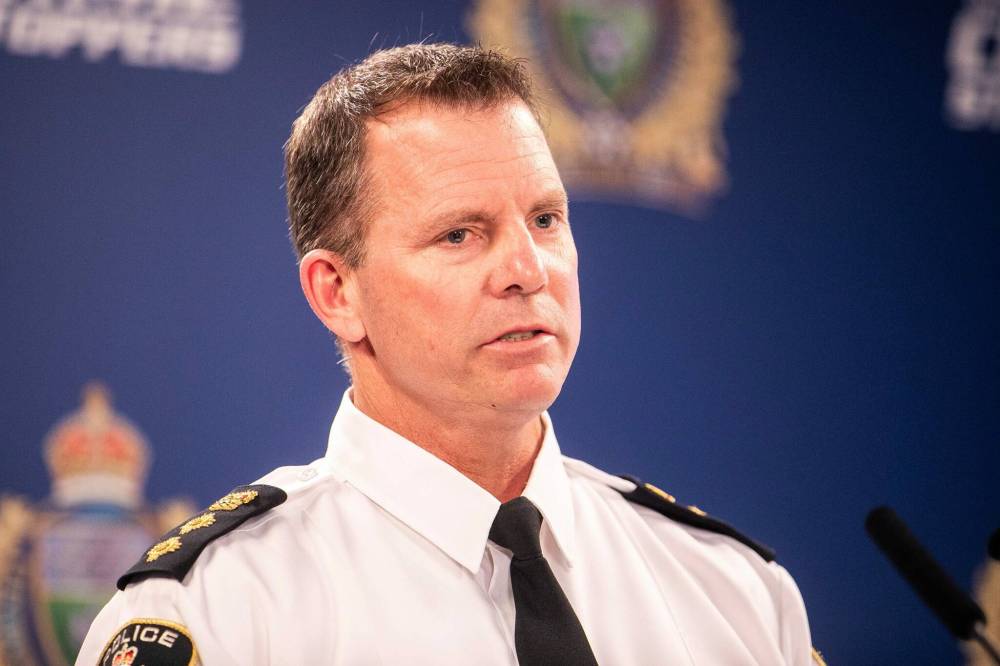
MIKAELA MACKENZIE / FREE PRESS FILES
Scot Halley, deputy chief of operations, says the project may be ready by the end of the year, though there is no set timeline.
After the meeting, Halley told media the project was supposed to be fully implemented by now. He said the completion date may now be closer to the end of this year, though there’s no set timeline.
The AI system will replace the current voice-response program for non-emergency calls, which prompts callers to press buttons to help direct their inquiries. The new automated, more conversational system will be able to ask and respond to questions.
“The first two phases, we didn’t achieve the results we were hoping for (but) there was no risk to the public, even on the non-emergency line, because if there was an issue with the AI tool, it would be immediately directed to a call-taker,” said Halley.
He stressed the tool will not be used to handle urgent emergency calls.

“Nine-one-one calls will continue to go through to a 911 operator. This is designed for the non-emergency (calls only),” said Halley.
For the rounds of unsuccessful testing, WPS did not provide the number or portion of calls that had to be diverted to human operators. Halley said both rounds missed a target to handle at least 85 per cent of the calls successfully through AI.
WPS hopes the technology will eventually free up time for communications centre staff to take more emergency calls.
joyanne.pursaga@freepress.mb.ca
X: @joyanne_pursaga
Joyanne is city hall reporter for the Winnipeg Free Press. A reporter since 2004, she began covering politics exclusively in 2012, writing on city hall and the Manitoba Legislature for the Winnipeg Sun before joining the Free Press in early 2020. Read more about Joyanne.
Every piece of reporting Joyanne produces is reviewed by an editing team before it is posted online or published in print — part of the Free Press‘s tradition, since 1872, of producing reliable independent journalism. Read more about Free Press’s history and mandate, and learn how our newsroom operates.
Our newsroom depends on a growing audience of readers to power our journalism. If you are not a paid reader, please consider becoming a subscriber.
Our newsroom depends on its audience of readers to power our journalism. Thank you for your support.
Joyanne is city hall reporter for the Winnipeg Free Press. A reporter since 2004, she began covering politics exclusively in 2012, writing on city hall and the Manitoba Legislature for the Winnipeg Sun before joining the Free Press in early 2020. Read more about Joyanne.
Every piece of reporting Joyanne produces is reviewed by an editing team before it is posted online or published in print — part of the Free Press‘s tradition, since 1872, of producing reliable independent journalism. Read more about Free Press’s history and mandate, and learn how our newsroom operates.
Our newsroom depends on a growing audience of readers to power our journalism. If you are not a paid reader, please consider becoming a subscriber.
Our newsroom depends on its audience of readers to power our journalism. Thank you for your support.
Advertisement Advertise With Us
Advertisement Advertise With Us