

Underage drinking accounted for most 911 emergencies at city schools last year, police data shows

Advertisement
Read this article for free:
or
Already have an account? Log in here »
To continue reading, please subscribe:
Monthly Digital Subscription
$1 per week for 24 weeks*
- Enjoy unlimited reading on winnipegfreepress.com
- Read the E-Edition, our digital replica newspaper
- Access News Break, our award-winning app
- Play interactive puzzles
*Billed as $4.00 plus GST every four weeks. After 24 weeks, price increases to the regular rate of $19.95 plus GST every four weeks. Offer available to new and qualified returning subscribers only. Cancel any time.
Monthly Digital Subscription
$4.99/week*
- Enjoy unlimited reading on winnipegfreepress.com
- Read the E-Edition, our digital replica newspaper
- Access News Break, our award-winning app
- Play interactive puzzles
*Billed as $19.95 plus GST every four weeks. Cancel any time.
To continue reading, please subscribe:
Add Free Press access to your Brandon Sun subscription for only an additional
$1 for the first 4 weeks*
*Your next subscription payment will increase by $1.00 and you will be charged $16.99 plus GST for four weeks. After four weeks, your payment will increase to $23.99 plus GST every four weeks.
Read unlimited articles for free today:
or
Already have an account? Log in here »
Hey there, time traveller!
This article was published 20/08/2025 (220 days ago), so information in it may no longer be current.
There were multiple meth and opioid-related emergencies at city schools last year, but underage drinking accounted for the largest number of 911 calls linked to illegal substance use.
The Winnipeg Police Service received 33 reports of people who were intoxicated on a kindergarten-to-Grade 12 school property between September and June.
At least half of all incidents involved alcohol, either consumed on its own or mixed with one or more substances.
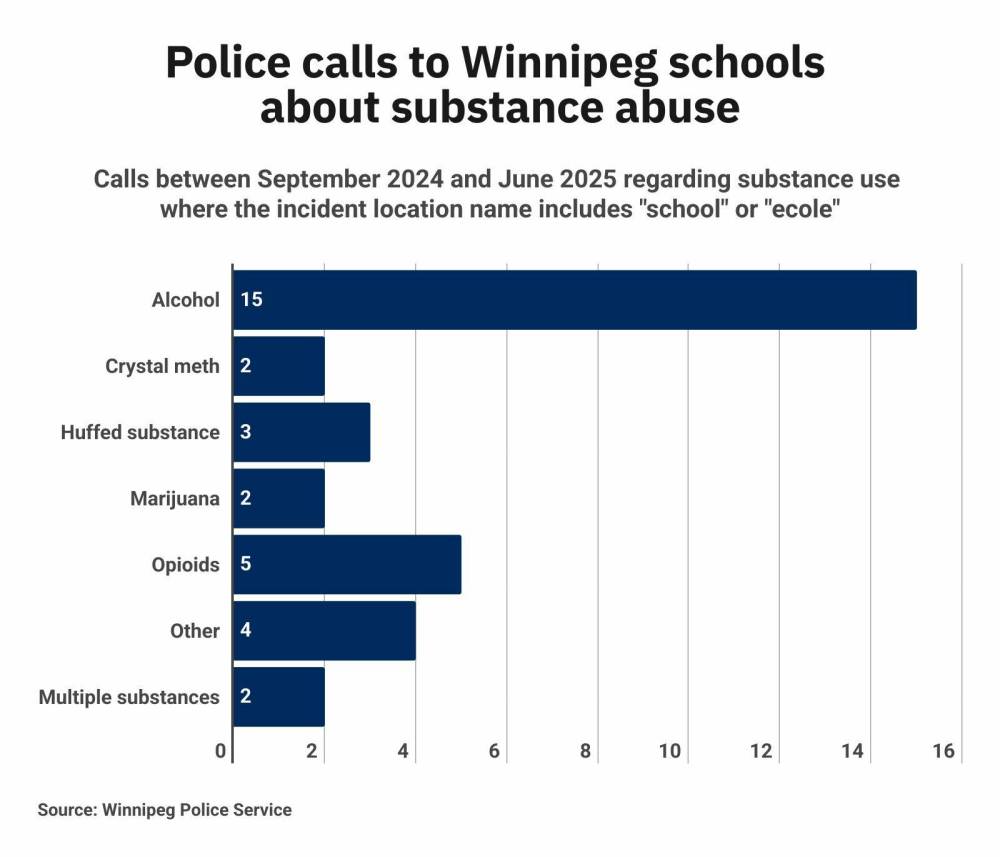
As school divisions begin to stock opioid-rescue naloxone kits and train staff members to administer them, the Free Press sought a breakdown of recent drug-related emergencies.
The data — obtained via freedom of information request — show when and why police officers were called to K-12 schools during the 2024-25 school year. The drug that prompted a 911 call was not listed in a handful of cases.
“There’s many incidents that go undetected, for sure. I would think it’s (a realistic tally) far more than 33,” said Allison Ficzycz, who manages a team of about a dozen school-based addictions workers at Shared Health.
Ficzycz noted that alcohol consumption, owing to related outbursts and other associated behaviours, is often easier to detect than other substances.
Rehabilitation counsellors, also known as school-based addiction workers or substance-use counsellors, have been particularly busy helping youth quit vaping, Ficzycz said.
Five emergencies involved opioids while cannabis and meth were identified in three and two cases, respectively.
There were one-time calls related to the consumption of oven cleaner and the inhalation of dry shampoo and AXE body spray.
After reviewing the data, Ficzycz called the apparent usage of opioids among students “very concerning.”
The manager of school-based mental health and addictions services credited “forward-thinking” school leaders for wanting to have naloxone kits at the ready.
The River East Transcona School Division recently equipped all of its Grade 9-12 buildings with the life-saving medication that temporarily reverses an opioid overdose.
Its senior administration team prides itself on being a leader in embracing “a comprehensive school health model” in northeast Winnipeg.
The division is both hiring a third substance-use counsellor and introducing a new workshop series for Grade 7 students to teach them healthy coping strategies in the upcoming school year.
Supt. Sandra Herbst said identifying and addressing barriers to student well-being and academic success is “at the heart of everything we do.”
A total of 385 students accessed one-on-one services from the substance-use counselling team, which is the only one of its kind in the metro region and operates in partnership with Shared Health, last year.
“This programming comes about as a result of not only seeing a need, but in talking and speaking with community members and families and our school leaders and teachers,” said Herbst, who oversees the education of approximately 19,000 students in and around Transcona.
She indicated that alcohol and cannabis tend to be the most commonly used drugs among students, and there was a notable increase in youth accessing services for alcohol-related support last year.
The newest addition to RETSD will be tasked with doing preventative work with middle-years students. The two existing counsellors focus on senior years-level presentations, consultations and meetings.
The ultimate goal is for these specialists, through compassion and evidence-based strategies, to help students tackle personal challenges so they can graduate, said Jón Olafson, assistant superintendent of student services.
Hosting these workers in schools reduces barriers to access related to transportation and the potential stigma associated with entering a clinic, Olafson said.
Ficzycz echoed those comments. “To be able to meet kids where they’re at is hugely valuable,” she said, noting that the Shared Health-RETSD model ensures working parents do not have to find time to take their child to external appointments to seek support.
“I’m huge on collaboration between health and school systems,” the Shared Health manager added.
Police officers also partner with city schools to address concerns about drug use among students.
Sgt. Dean Rochon of the WPS school engagement section said they collaborate on delivering age-appropriate lessons about the risks of drugs and relationship-building initiatives.

“Through open dialogue, classroom presentations, and ongoing mentorship, our school resource officers help build strong relationships that encourage students to reach out when they need help,” Rochon said in a statement.
The newly released WPS report of 911 calls shows the overwhelming majority of drug emergencies happened in the Winnipeg School Division, the largest of its kind, encompassing 80 buildings in inner-city and central neighbourhoods.
There were also incidents in Seven Oaks, River East Transcona, Louis Riel and St. James-Assiniboia.
Police responded to calls from four private schools — St. Aidan’s Christian School, Holy Ghost School, IQRA Islamic School and Marymound School.
maggie.macintosh@freepress.mb.ca
Maggie Macintosh
Education reporter
Maggie Macintosh reports on education for the Free Press. Originally from Hamilton, Ont., she first reported for the Free Press in 2017. Read more about Maggie.
Funding for the Free Press education reporter comes from the Government of Canada through the Local Journalism Initiative.
Every piece of reporting Maggie produces is reviewed by an editing team before it is posted online or published in print — part of the Free Press‘s tradition, since 1872, of producing reliable independent journalism. Read more about Free Press’s history and mandate, and learn how our newsroom operates.
Our newsroom depends on a growing audience of readers to power our journalism. If you are not a paid reader, please consider becoming a subscriber.
Our newsroom depends on its audience of readers to power our journalism. Thank you for your support.
Maggie Macintosh
Education reporter
Maggie Macintosh reports on education for the Free Press. Originally from Hamilton, Ont., she first reported for the Free Press in 2017. Read more about Maggie.
Funding for the Free Press education reporter comes from the Government of Canada through the Local Journalism Initiative.
Every piece of reporting Maggie produces is reviewed by an editing team before it is posted online or published in print — part of the Free Press‘s tradition, since 1872, of producing reliable independent journalism. Read more about Free Press’s history and mandate, and learn how our newsroom operates.
Our newsroom depends on a growing audience of readers to power our journalism. If you are not a paid reader, please consider becoming a subscriber.
Our newsroom depends on its audience of readers to power our journalism. Thank you for your support.
Advertisement Advertise With Us
Advertisement Advertise With Us