

Making up for classroom funding shortfalls a given for Manitoba teachers, survey results show

Advertisement
Read this article for free:
or
Already have an account? Log in here »
To continue reading, please subscribe:

Digital Subscription
One year of digital access for only $205*
- Enjoy unlimited reading on winnipegfreepress.com
- Read the E-Edition, our digital replica newspaper
- Access News Break, our award-winning app
- Play interactive puzzles
*First annual payment billed as $205.00 + GST for one year. This annual subscription will automatically renew at $233.00 + GST every 52 weeks (10% off the regular annual price of $259.35). Offer available to new and qualified returning subscribers only. Cancel any time.
To continue reading, please subscribe:
Add Free Press access to your Brandon Sun subscription for only an additional
$1 for the first 4 weeks*
- Enjoy unlimited reading on winnipegfreepress.com
- Read the E-Edition, our digital replica newspaper
- Access News Break, our award-winning app
- Play interactive puzzles
*Your next Brandon Sun subscription payment will increase by $1.00 and you will be charged $17.95 plus GST for four weeks. After four weeks, your payment will increase to $24.95 plus GST every four weeks.
Read unlimited articles for free today:
or
Already have an account? Log in here »
Hey there, time traveller!
This article was published 28/08/2025 (383 days ago), so information in it may no longer be current.
Out-of-pocket spending to create “Pinterest-worthy” classrooms and support students is a universal experience for Manitoba teachers, a new study has found.
People for Public Education released the results of a small survey of kindergarten-to-Grade 12 teachers on work-related expenses before the first day of classes in 2025-26.
The collective, run by academics, parents and other supporters of equitable, accessible and well-funded public schools, conducted an online poll in February and March.
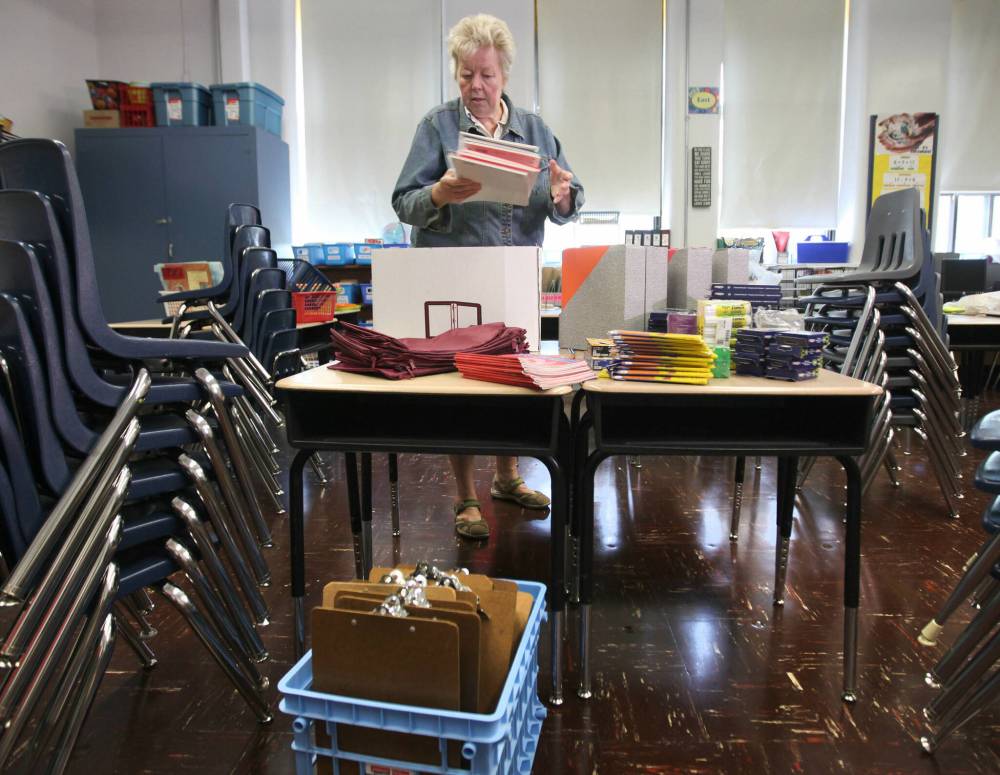
RUTH BONNEVILLE / FREE PRESS FILES
A recent survey of 33 kindergarten-to-Grade 12 teachers on work-related expenses found that although 64 per cent of them said their school gives them some money to spend on their classrooms, all of them spend personal money every year.
Founding member Shannon Moore said the results expose how common it is for staff members to subsidize public education, and that’s cause for serious concern.
“When they do not (chip in), those classrooms go without and when they do, that becomes part of the budget line,” said Moore, a researcher and associate professor of education at the University of Manitoba.
“As soon as a teacher makes up for those budget shortfalls, then the expectation is not placed on the system itself.”
All but one of 33 respondents — half of whom work in an elementary school — were classroom teachers. The outlier identified as a teacher-librarian.
Although 64 per cent of teachers said their school gives them some money to spend on their classrooms, all of them indicated they spend personal money every year.
Nearly a third of the teachers reported buying upwards of $500 worth of items annually.
Three-quarters of them said they spend personal funds on materials for classroom activities.
Other common purchases included books, decor, furniture, arts and crafts, fidget spinners and toys, food and personal-care items for students.
“We want to make sure our students have what they need to be successful,” said Lillian Klausen, a 30-year career teacher who is the current president of her profession’s union.
Klausen recalled buying granola bars and cups of soup to put in designated drawers that her students could open when they were hungry.
Extra pens, binders and other items were also in her shopping cart when she was on the front lines, she said, noting that supply closets are primarily outfitted with staff members’ personal needs in mind.
The president of the Manitoba Teachers’ Society said she’s noticed more of her colleagues have started making wishlists and crowdsourcing in recent years.
“Teachers in the current context are often judged by parents and school leaders for providing enriching learning experiences and creating Pinterest-worthy classroom environments,” People for Public Education organizers wrote in a seven-page summary of their survey.
“In this way, teachers’ professional reputations rest on their willingness to subsidize public school classrooms with their own private money.”
Moore said teachers are unfairly painted as callous and selfish if they do not spend funds on their workplace’s programming, even though some see it as a form of resistance.
Much like school fundraisers, which her group wrote a report on in 2024, relying on staff members’ generosity leads to inequities in educational programming, she said.
In 2021, under then-premier Brian Pallister, who was a teacher at one point, the provincial government acknowledged these expenses by introducing a special tax credit.
Teachers can claim a 15 per cent refund on up to $1,000 on purchases ranging from books to education software.
It was modelled after a federal tax credit that allows teachers to recover $1,000 in teaching material expenses.

Klausen said she urges her colleagues to take advantage of the credits. At the same time, the union leader said it can be challenging to keep track of receipts of one-off purchases.
It should be school divisions’ responsibility to stock their facilities appropriately but funding levels are a long-standing issue, she said.
Critics of the available tax credits take issue with the labour required to benefit from them.
Pallister’s 2021 announcement sparked backlash among some teachers who deemed the relatively small refund — a maximum of $150 — insulting.
maggie.macintosh@freepress.mb.ca
Maggie Macintosh
Education reporter
Maggie Macintosh reports on education for the Free Press. Originally from Hamilton, Ont., she first reported for the Free Press in 2017. Read more about Maggie.
Funding for the Free Press education reporter comes from the Government of Canada through the Local Journalism Initiative.
Every piece of reporting Maggie produces is reviewed by an editing team before it is posted online or published in print — part of the Free Press‘s tradition, since 1872, of producing reliable independent journalism. Read more about Free Press’s history and mandate, and learn how our newsroom operates.
Our newsroom depends on a growing audience of readers to power our journalism. If you are not a paid reader, please consider becoming a subscriber.
Our newsroom depends on its audience of readers to power our journalism. Thank you for your support.
Maggie Macintosh
Education reporter
Maggie Macintosh reports on education for the Free Press. Originally from Hamilton, Ont., she first reported for the Free Press in 2017. Read more about Maggie.
Funding for the Free Press education reporter comes from the Government of Canada through the Local Journalism Initiative.
Every piece of reporting Maggie produces is reviewed by an editing team before it is posted online or published in print — part of the Free Press‘s tradition, since 1872, of producing reliable independent journalism. Read more about Free Press’s history and mandate, and learn how our newsroom operates.
Our newsroom depends on a growing audience of readers to power our journalism. If you are not a paid reader, please consider becoming a subscriber.
Our newsroom depends on its audience of readers to power our journalism. Thank you for your support.
Related Articles
Pay to play: Councillor calls for equitable school playground funding
Advertisement Advertise With Us
Advertisement Advertise With Us