Intervention by isolation As incidences of violence and psychosis increase, use of seclusion rooms in health-care settings play critical role
Read this article for free:
or
Already have an account? Log in here »
To continue reading, please subscribe:

Digital Subscription
One year of digital access for only $205*
- Enjoy unlimited reading on winnipegfreepress.com
- Read the E-Edition, our digital replica newspaper
- Access News Break, our award-winning app
- Play interactive puzzles
*First annual payment billed as $205.00 + GST for one year. This annual subscription will automatically renew at $233.00 + GST every 52 weeks (10% off the regular annual price of $259.35). Offer available to new and qualified returning subscribers only. Cancel any time.
To continue reading, please subscribe:
Add Free Press access to your Brandon Sun subscription for only an additional
$1 for the first 4 weeks*
- Enjoy unlimited reading on winnipegfreepress.com
- Read the E-Edition, our digital replica newspaper
- Access News Break, our award-winning app
- Play interactive puzzles
*Your next Brandon Sun subscription payment will increase by $1.00 and you will be charged $17.95 plus GST for four weeks. After four weeks, your payment will increase to $24.95 plus GST every four weeks.
Read unlimited articles for free today:
or
Already have an account? Log in here »
Hey there, time traveller!
This article was published 05/12/2025 (259 days ago), so information in it may no longer be current.
On any given day in a Manitoba health-care or psychiatric facility, at least one patient, and often more, will be subject to isolation in a seclusion room.
The bare-walled, white-coloured rooms are sparse, with only a thin mattress on the floor. The metal doors lock from the outside; a small window allows for staff to observe; and a security camera keeps a watchful eye from above. Patients can be in there for as little or as long as needed.
In the wake of increasingly more violent incidents occurring in health-care facilities and amid a growing addictions crisis in Manitoba, seclusion rooms are being used more often to manage patients who may be harmful to themselves or others.
Data obtained through a freedom-of-information request shows the use of seclusion rooms has steadily increased across the province over a five-year span.
In 2019, they were utilized 1,438 times at four provincial sites — the emergency department and the Mental Health and Addictions Unit at Health Sciences Centre, the Manitoba Adolescent Treatment Centre and the Selkirk Mental Health Centre. By 2024, the number had jumped to 2,645, an 84 per cent increase.

At HSC’s emergency department, where there have been a number of high-profile incidents of violence, the use of seclusion rooms has increased by 14 per cent over the same time period, from 871 instances in 2019 to 991 in 2024.
Are these rooms a useful tool for managing patient and staff safety? Or have they become a Band-aid solution for a system in crisis? Front-line workers say their availability is critical for doing their job, but some experts counter the usage is a sign of larger societal problems.
Seclusion rooms are often depicted in Hollywood films. Actors playing psychiatric patients are tied up in straight jackets and left unattended for days on end.
In reality, that’s not what takes place in Manitoba.
Seclusion is used when a patient becomes violent, has the potential to become violent, or is at risk of harming themselves or others. If a risk is identified, staff must first get a doctor to sign off before a patient is placed in isolation.
Restraints could be used if a patient is at risk of self-harm. If they are, a health-care provider is expected to constantly monitor the patient, checking on them every 15 minutes and re-assessing the need for isolation every two hours. Nurses generate reports each time a patient is placed in seclusion.
RUTH BONNEVILLE / FREE PRESS Between Jan. 1 and Sept. 30, HSC reported 543 uses of their seclusion rooms.
More detailed reports on the use of seclusion rooms were not made available by Shared Health owing to the Personal Health Information Act. In addition to the four main Manitoba sites, other facilities in the Winnipeg Regional Health Authority also have seclusion rooms at their disposal.
One HSC nurse who spoke on the condition of anonymity said seclusion rooms in the ER have become an increasingly valuable tool for when the department is overwhelmed and understaffed.
The emergency department has three seclusion rooms. Using them is a last resort, but when nurses can’t give one-on-one care to a patient with the potential to turn violent, the rooms are helpful, the nurse said.
“It’s still best practice to have that patient-nurse relationship and de-escalate without resorting to seclusion … we use them because sometimes there’s no one else to deal with (the patient),” the nurse said.
“We use them because sometimes there’s no one else to deal with (the patient).”
Shared Health’s policy is to use de-escalation techniques such as therapeutic communication — a method involving active listening and dialogue to better understand a patient’s needs — to help them feel safe and comfortable. When that doesn’t work, seclusion can be used.
“When a patient becomes to the point where they may be at risk for violence, then we would use the seclusion room to keep everyone safe,” said Angela Godee, the director of mental health programming at HSC.
At Selkirk’s psychiatric hospital, the use of seclusion rooms has increased substantially. In 2019 the facility recorded 559 uses of isolation, but by 2024 seclusion rooms were used 1,595 times — an increase of 185 per cent.
Kelsey Haresign, the director of health services at the Selkirk facility, attributed the increase to changes in how patients were admitted to the facility during the COVID-19 pandemic, but acknowledged there were also more admissions due to a higher number of people going through psychosis.
In September, the treatment of patients while in seclusion made headlines in New Brunswick when the province’s ombudsman released a damning report on the use of restraints in psychiatric hospitals.
The report detailed horrific experiences from patients who were subject to isolation for days, with little care offered during that time.
Several subjects told the ombudsman they were left in seclusion for so long, and without any supervision, they were forced to urinate and defecate on the floor. Others said they were denied health care, medication and treatment for injuries sustained while in isolation.
One subject alleged staff sexually assaulted him by “pulling down his pants while he was physically restrained in the seclusion room and conversed casually among themselves in French during the intervention, a language he does not speak.”
RUTH BONNEVILLE / FREE PRESS Seclusion is used when a patient becomes violent, has the potential to become violent, or is at risk of harming themselves or others.
The department responsible for mental health and addiction for one of New Brunswick’s health networks said it will accept the report’s recommendations in full, but stopped short of an apology.
In Manitoba, Haresign said employees receive a range of training, including in mental-health first aid, non-violent crisis intervention and verbal de-escalation, to reduce the need for placing patients into isolation.
“We want to make sure that we’re putting the people first,” Haresign said. “(People) compare mental health facilities to old films and things that I don’t feel give the whole picture of modern care in a health-care facility … I don’t want to give a misimpression that we put people in rooms and leave them there.”
The data obtained by the Free Press indicates there has been a dip in the use of isolation rooms this year. Between Jan. 1 and Sept. 30, HSC reported 543 uses of their seclusion rooms. The nurse speculated a crest of agitated patients stemming from COVID-19 pandemic restrictions may be the reason behind the decline. Provincially, the number has decreased as well, dropping from a monthly average of 220 instances in 2024 to 196 through the first nine months of 2025.
Goddee attributed the decline at HSC to intensive education sessions staff go through to help them learn better ways to de-escalate situations, but admits the hospital is still seeing a high number of patients that need intervention.
“We work with them, of course, to try and use seclusion the least amount possible. But it is very unpredictable, sometimes depending on the patients that are being admitted at any certain time,” she said.
The Canadian Mental Health Association, both at the provincial and national level, declined an interview on the use of seclusion rooms, which leaves unanswered questions about whether mental health professionals think there are better, or alternative, options.
Some academics argue their increasing use is a failure of community intervention.
RUTH BONNEVILLE / FREE PRESS Seclusion rooms are being used more often to manage patients who may be harmful to themselves or others.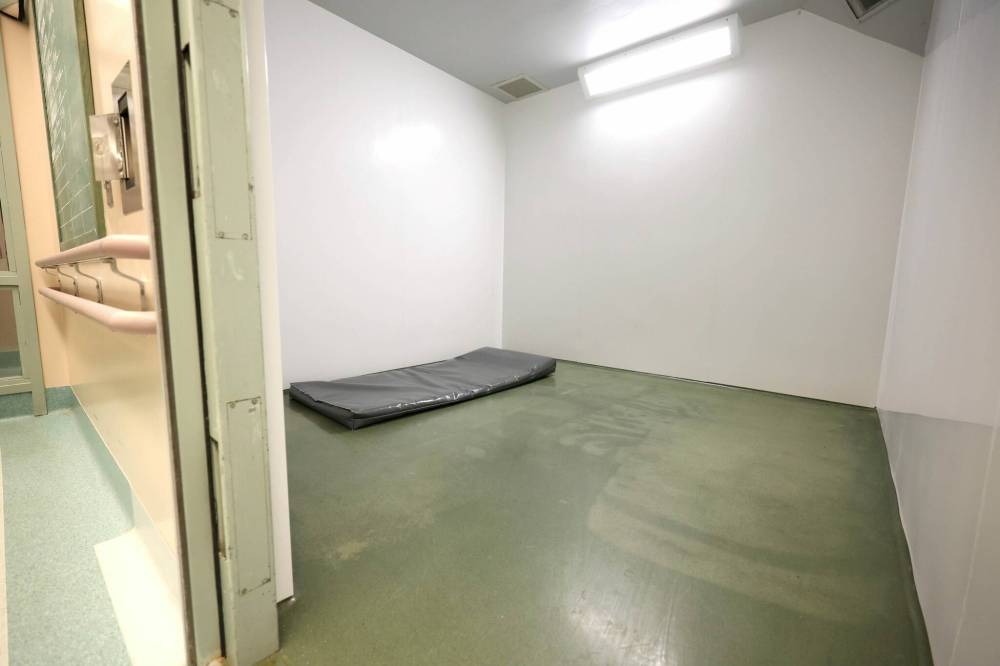
Julian Somers, a professor in the Faculty of Health Sciences at Simon Fraser University, said provinces resort to using involuntary forms of intervention more than needed because of the deficiencies in community-based supports, which help to prevent people from experiencing a mental health or addictions-related crisis.
Somers has studied the effectiveness of providing recovery-oriented support for people who were homeless, struggling with mental illness and addiction. Housing and social services are the most common tools used in a recovery-oriented approach to helping vulnerable people.
The trials showed a decreased need for involuntary intervention, which includes the use of seclusion in health-care and mental health settings.
“If all it is we’re doing is using (seclusion) as an increasingly frequently used emergency response, it merely signifies to me that the proverbial kind of revolving door of crisis and crisis responding is turning faster. That’s all it means,” he said. “It doesn’t signify any improvement at the system level.”
Unions representing health-care employees say the system needs better staff-to-patient ratios in order to decrease the reliance on seclusion rooms.
Long wait times in emergency rooms can flare tempers and increase the likelihood of violent outbursts from patients waiting to be seen, said Manitoba Nurses Union president Darlene Jackson.
“If you can actually spend time with the patient and de-escalate the situation, then often you don’t need to use them,” Jackson said. “But it’s about having the time to do that, and having the support to actually spend time with your patients. And right now, in health care, we just don’t have that.”
Jason Linklater, president of the Manitoba Association of Health Care Professionals, agrees.
“When you’re understaffed, because you cannot manage the patients… it’s not safe for the public. It’s not safe for the patients, and it’s not safe for the staff either,” Linklater said.
Godee, too, thinks better staffing ratios would improve safety at hospitals, but countered that having constant care is not necessarily the solution to dealing with those in crisis.
“When you’re understaffed, because you cannot manage the patients… it’s not safe for the public. It’s not safe for the patients, and it’s not safe for the staff either.”
“Sometimes it actually puts that (caregiver) in harm’s way if that patient is at risk of becoming violent,” she said.
Goddee would, however, like to see more seclusion rooms in HSC’s emergency department.
“We have larger volumes of patients coming in who are requiring that level of care,” she said. “We don’t have a lot of room when it comes to our building. We’ve expanded as much as we probably can expand in the space that we have, but more individual patient rooms would be very nice to have, and I think that it would make an impact.”
A spokesperson for Manitoba’s health minister Uzoma Asagwara said in an emailed statement that Shared Health is “continually reviewing what additional measures or spaces may be needed to strengthen safety.”
A Shared Health spokesperson said discussions regarding safety within the emergency department are ongoing, but nothing is set in stone at this time.
nicole.buffie@freepress.mb.ca

Nicole Buffie
Multimedia producer
Nicole Buffie is a reporter for the Free Press city desk. Born and bred in Winnipeg, Nicole graduated from Red River College’s Creative Communications program in 2020 and worked as a reporter throughout Manitoba before joining the Free Press newsroom as a multimedia producer in 2023. Read more about Nicole.
Every piece of reporting Nicole produces is reviewed by an editing team before it is posted online or published in print — part of the Free Press‘s tradition, since 1872, of producing reliable independent journalism. Read more about Free Press’s history and mandate, and learn how our newsroom operates.
Our newsroom depends on a growing audience of readers to power our journalism. If you are not a paid reader, please consider becoming a subscriber.
Our newsroom depends on its audience of readers to power our journalism. Thank you for your support.