

Verdict is in, Manitobans are generous
Province has highest percentage of donors to charity in study of Canadian tax filers

Advertisement
Read this article for free:
or
Already have an account? Log in here »
To continue reading, please subscribe:

Digital Subscription
One year of digital access for only $205*
- Enjoy unlimited reading on winnipegfreepress.com
- Read the E-Edition, our digital replica newspaper
- Access News Break, our award-winning app
- Play interactive puzzles
*First annual payment billed as $205.00 + GST for one year. This annual subscription will automatically renew at $233.00 + GST every 52 weeks (10% off the regular annual price of $259.35). Offer available to new and qualified returning subscribers only. Cancel any time.
To continue reading, please subscribe:
Add Free Press access to your Brandon Sun subscription for only an additional
$1 for the first 4 weeks*
- Enjoy unlimited reading on winnipegfreepress.com
- Read the E-Edition, our digital replica newspaper
- Access News Break, our award-winning app
- Play interactive puzzles
*Your next Brandon Sun subscription payment will increase by $1.00 and you will be charged $17.95 plus GST for four weeks. After four weeks, your payment will increase to $24.95 plus GST every four weeks.
Read unlimited articles for free today:
or
Already have an account? Log in here »
Hey there, time traveller!
This article was published 11/12/2025 (296 days ago), so information in it may no longer be current.
Manitobans aren’t just friendly, they have a big heart.
The “keystone province” has maintained its reputation as having the highest rate of charitable donors across the country.
That’s the finding of “Generosity in Canada: The 2025 Generosity Index,” complied by the Fraser Institute and released on Thursday.
The report does highlight the trend of a drop in donations across the country.

Co-author Grady Munro, a policy analyst at the research organization, said while they know the number of charitable donors has gone down, they just don’t know why.
“Manitoba has long led the way with charitable giving, but there has been a long steady decline for not just Manitoba, but Canada,” he said.
“We can’t say specifically what is causing the decline, but we know the reasons and factors which influence giving to charities.”
Munro said it’s possible fewer people can afford to give to charity, that many baby boomers who made donations have died, and the number of people attending church has declined.
“Digging into the why is a role for different researchers,” he said, adding the report is a snapshot only.
“This decline in generosity in Canada undoubtedly limits the ability of Canadian charities to improve the quality of life in their communities and beyond.”
The report, based on Statistics Canada information on tax filings to the Canada Revenue Agency, shows 18.7 per cent of Manitobans who filed a tax return listed a charitable donation in 2023.
That’s a drop from 2013, when Manitoba was also the top donating province in the country. At that time, 25.3 per cent of tax filers gave to a charity.
In terms of 2023, Ontario had the second-highest number of tax filers who gave to a charity, at 17.2 per cent, followed by Quebec (17.1) and Alberta (17). At the bottom is Nunavut at 5.1 per cent and Northwest Territories at 10.2 per cent.
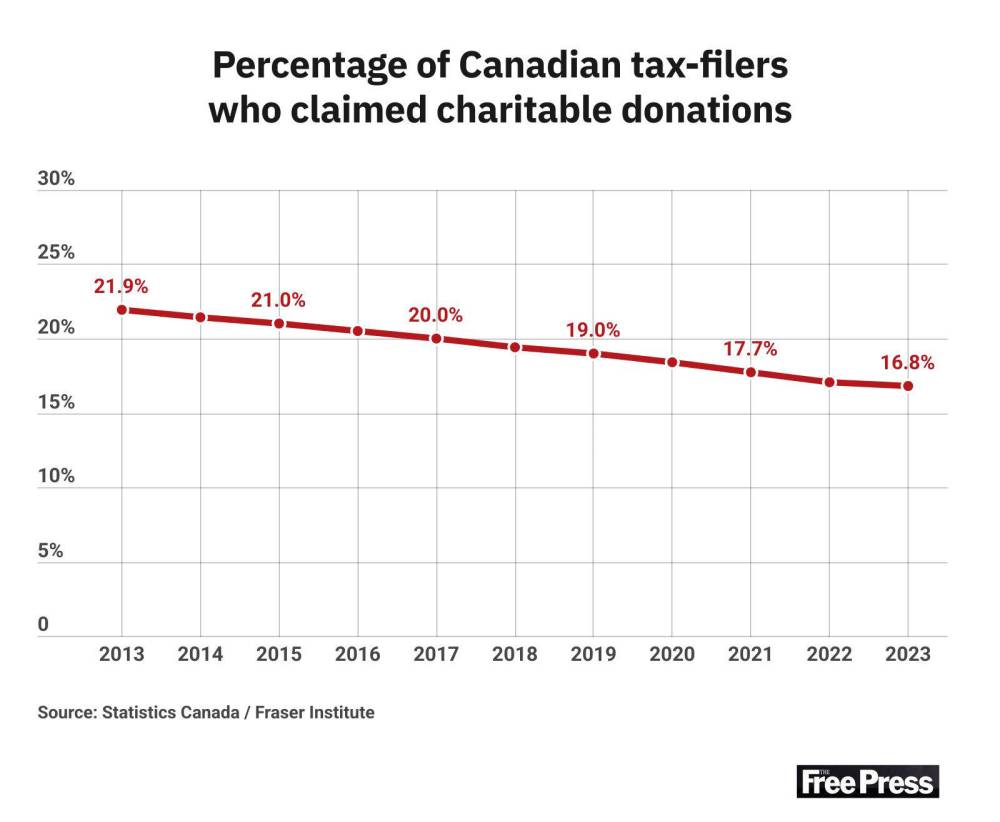
Nationally, 16.8 per cent of tax filers — the lowest proportion since 2003 — donated money to a charity in 2023.
The report states the high point of Canadian generosity was in 2004, when 25.4 per cent of tax filers supported a charitable cause.
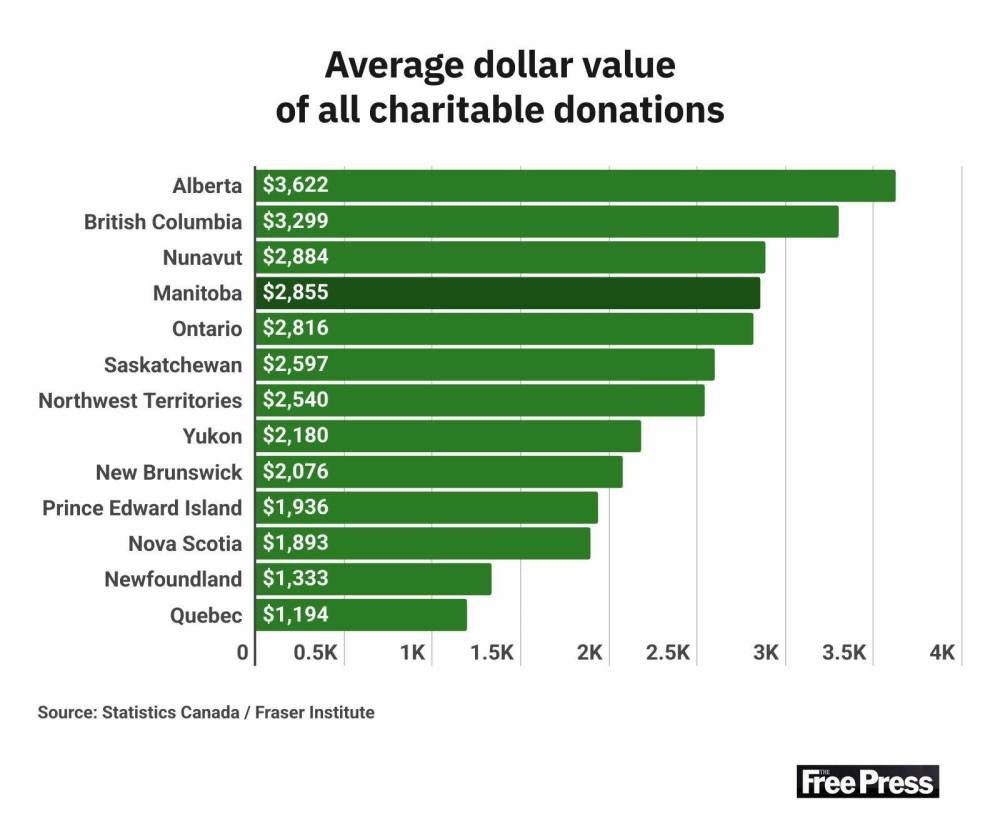
The study also found Manitobans donated the highest amount of their income to charity in 2023, giving an average of .71 per cent of their annual income, ahead of Alberta at .68 and British Columbia at .61.

Bruce MacDonald, president and CEO of Imagine Canada, which has a mission to strengthen Canadian charities and nonprofits, said its statistics show the decline in the number of charitable tax filers has been happening for decades.
“In the last 30 years, the percentage of Canadians who have donated has been declining. It is now 16.8 per cent,” MacDonald said. “But, at the same time, the number of dollars being donated has been growing.”
MacDonald said they have found that as Canadians age, they donate more.
“There was $12 billion given in 2021, and well over half was from people over the age of 60, and half of that given was from people over 70,” he said.
“The general trend is older and more affluent Canadians are driving it.”
MacDonald was quick to point out that doesn’t mean younger people are tightwads. He said because of the increasing gig economy, many of them hold contract positions.
“Young people are generous at their core, but are not at the same financial point as their parents and grandparents were at their age,” he said.
“It is hard to be a regular donor when you don’t know when your next paycheque is.”
Shawna Bell, executive director of the Christmas Cheer Board of Winnipeg, said the seasonal charity is on track this year to receive the monetary donations it needs to cover the cost of food hampers and presents for children for needy families in Winnipeg.

“I’ve also seen some new donors coming to us who have never donated to us before,” Bell said. “That is fantastic news.”
People who don’t have cash are giving in other way to the more than century-old organization.
“We have seen an exponential number of donations of food and toys this year,” Bell said.
“I think a lot of people are looking at hard goods as being a legitimate donation and it is much appreciated.”
kevin.rollason@freepress.mb.ca
Kevin Rollason
Reporter
Kevin Rollason was a general assignment reporter at the Free Press.
Our newsroom depends on a growing audience of readers to power our journalism. If you are not a paid reader, please consider becoming a subscriber.
Our newsroom depends on its audience of readers to power our journalism. Thank you for your support.
Kevin Rollason
Reporter
Kevin Rollason was a general assignment reporter at the Free Press.
Our newsroom depends on a growing audience of readers to power our journalism. If you are not a paid reader, please consider becoming a subscriber.
Our newsroom depends on its audience of readers to power our journalism. Thank you for your support.
Related Articles
Work experience and much more at the Christmas Cheer Board

Advertisement Advertise With Us
Advertisement Advertise With Us