

Culinary program marks first anniversary
Red River Polytech project focuses on inner-city high school students

Advertisement
Read this article for free:
or
Already have an account? Log in here »
To continue reading, please subscribe:

Digital Subscription
One year of digital access for only $205*
- Enjoy unlimited reading on winnipegfreepress.com
- Read the E-Edition, our digital replica newspaper
- Access News Break, our award-winning app
- Play interactive puzzles
*First annual payment billed as $205.00 + GST for one year. This annual subscription will automatically renew at $233.00 + GST every 52 weeks (10% off the regular annual price of $259.35). Offer available to new and qualified returning subscribers only. Cancel any time.
To continue reading, please subscribe:
Add Free Press access to your Brandon Sun subscription for only an additional
$1 for the first 4 weeks*
- Enjoy unlimited reading on winnipegfreepress.com
- Read the E-Edition, our digital replica newspaper
- Access News Break, our award-winning app
- Play interactive puzzles
*Your next Brandon Sun subscription payment will increase by $1.00 and you will be charged $17.95 plus GST for four weeks. After four weeks, your payment will increase to $24.95 plus GST every four weeks.
Read unlimited articles for free today:
or
Already have an account? Log in here »
Hey there, time traveller!
This article was published 15/12/2025 (263 days ago), so information in it may no longer be current.
Donning chef hats and wide smiles, Winnipeg high schoolers showed off their culinary skills, such as making demi-glace — or, as one teenager put it, “a fancy gravy” — at a first-of-its-kind banquet on Thursday.
The feast was to celebrate the one-year anniversary of Culinary Connections, an after-school program organized by Red River College Polytechnic and the Winnipeg School Division designed to expose inner-city students to new recipes, skills and post-secondary training.
Students ages 12 and up cook alongside Red Seal chefs and peer-mentors on RRC Polytech’s Exchange District campus.
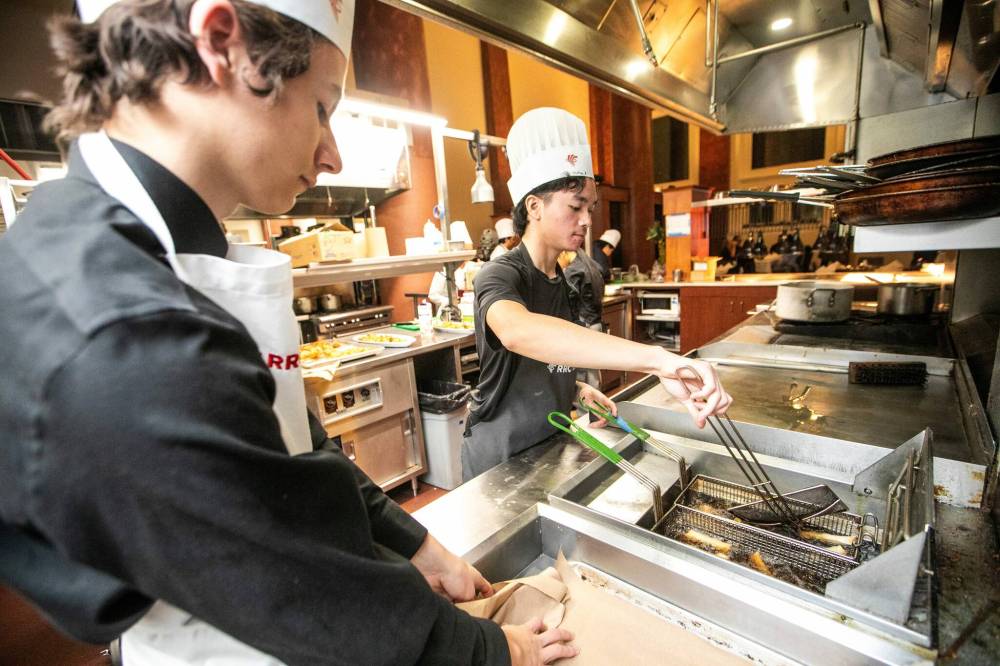
“My biggest dream is to become a cook, to work in a kitchen,” said Mihret Teklebirhan Measho, a Grade 11 student at St. John’s High School who put on a fine dining experience with classmates last week.
Mihret is among 150 students who’ve completed the 10-week program to date.
Previously, she had limited knowledge of cooking anything other than injera and Ethiopian sauces — staples in her house.
The 16-year-old said one of the most memorable moments this fall was learning to use a knife properly. She was able to share that lesson, among others, with her younger sister.
Culinary Connections was set up to build high school students’ basic skills and confidence on campus for three weeks before leaving their high school.
Each group spends the remaining seven weeks inside a commercial kitchen at RRC Polytech.
Participants are provided with bus tickets to get to and from Jane’s, RRC’s training restaurant. Following every three-hour class, each student leaves with a fresh-cooked meal and groceries to replicate it at home.
“Some actually cook a whole different meal later in the week, using those ingredients,” said Candace Rea, an experienced school leader who designed the program.
“We tell our students: that’s the resourcefulness we want to see. That’s applied learning.”
Rea left the kindergarten-to-Grade 12 system in 2023 to run community, education and youth initiatives at RRC Polytech.
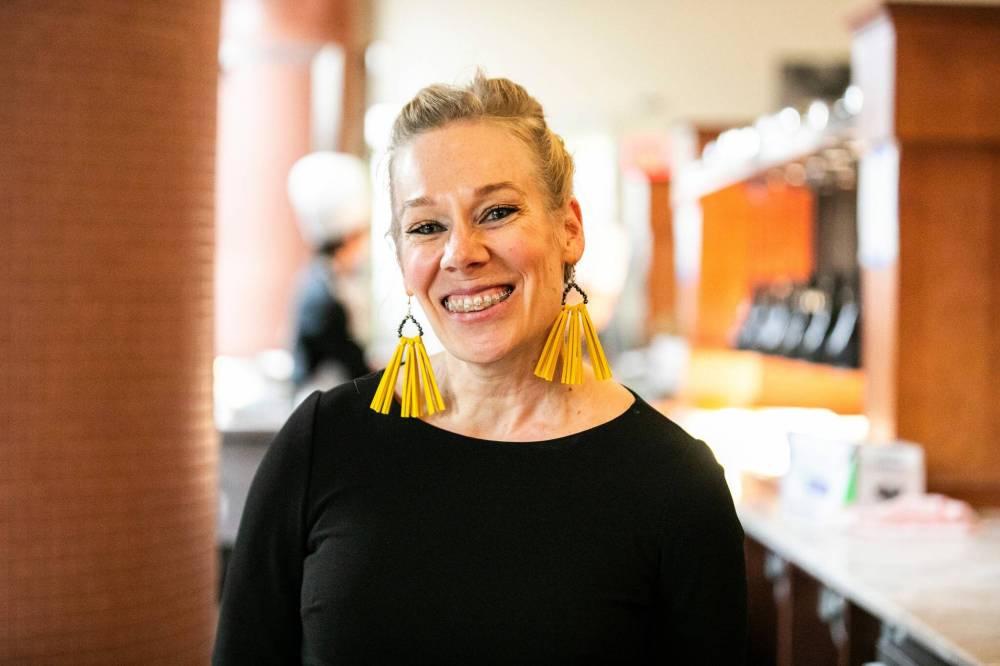
MIKAELA MACKENZIE / FREE PRESS
Candace Rea, chair of community, education and youth at RRC Polytech, says some students have demonstrated the resourcefulness the program encourages by taking ingredients meant for one recipe and using them to create a completely different meal.A former adult education director, she has seen first-hand how missing meals can negatively affect student engagement and well-being.
Culinary Connections purposefully targets school communities where households are at a higher risk of experiencing food insecurity, she said.
Dozens of students from St. John’s and R.B. Russell Vocational School have taken part in the program since its inception.
Sweetpea Starr said he felt proud seeing his daughter, Ein, serving guests at Jane’s in a tall white chef’s hat Thursday.
His 16-year-old has prepared butter chicken at home in recent weeks, Starr said, noting that, thanks to RRC Polytech, she’s learned how to take apart a full raw chicken.
Despite a burnt caramel-related mishap, Ein said she’s thoroughly enjoyed herself.
“I’ve learned how to work with other people in the kitchen and work collaboratively… You have to keep an eye on things,” she said.
Mihret, Ein and their peers’ makeshift restaurant served mocktails, garden salads, alfredo pasta with grilled chicken and mushrooms, pork marinated with truffle potatoes and no-bake strawberry cheesecake.
Danier Audy insisted the sauces — including a pea purée and the demi-glace — were the highlights of the menu.
“We pour the demi-glace onto the meat — think of it like a fancy gravy,” the 17-year-old said.
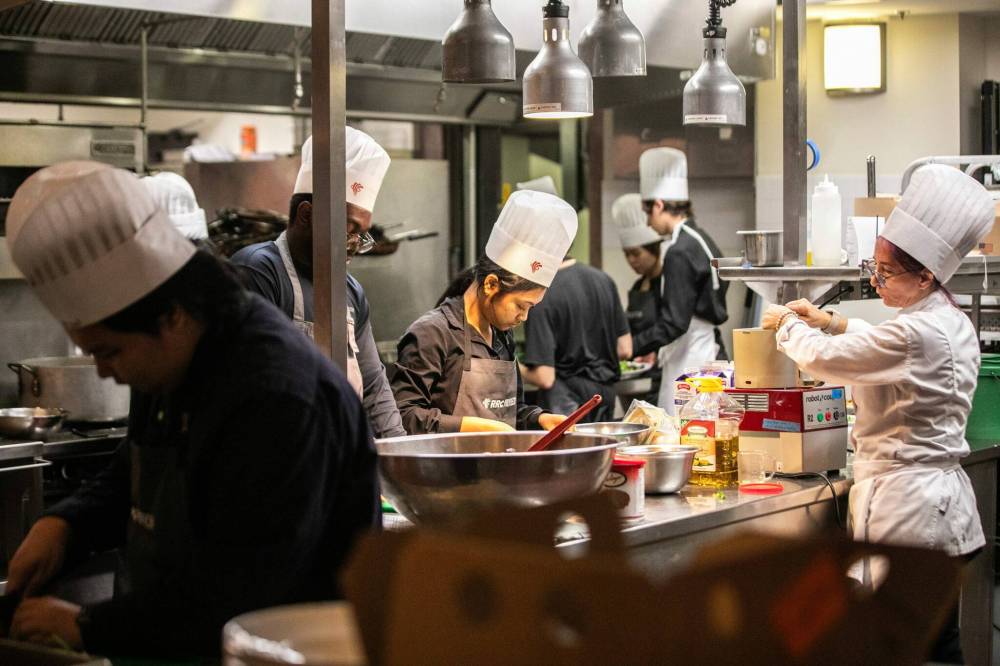
MIKAELA MACKENZIE / FREE PRESS
Culinary Connections purposefully targets school communities where households are at a higher risk of experiencing food insecurity, said Candace Rea.Danier is in his final year at Sturgeon Heights Collegiate, where he takes vocational classes, but he’s been volunteering to help other students polish their chef skills.

Rea said the initiative, made possible through funding from Manitoba’s school nutrition program, relies heavily on in-kind donations.
The province earmarked $50,000 for its operations this year. In 2024-25, RRC Polytech and WSD received $30,000 to get the program up and running.
Advanced Education Minister Renée Cable was among roughly 50 diners who received both kitchen tours — students acted as guides as well as restaurant hosts and servers — and a multi-course meal.
In her brief remarks to the dining room at Jane’s, Cable told students and guardians that “post-secondary education is for you,” regardless of age and schooling level.
maggie.macintosh@freepress.mb.ca
Maggie Macintosh
Education reporter
Maggie Macintosh reports on education for the Free Press. Originally from Hamilton, Ont., she first reported for the Free Press in 2017. Read more about Maggie.
Funding for the Free Press education reporter comes from the Government of Canada through the Local Journalism Initiative.
Every piece of reporting Maggie produces is reviewed by an editing team before it is posted online or published in print — part of the Free Press‘s tradition, since 1872, of producing reliable independent journalism. Read more about Free Press’s history and mandate, and learn how our newsroom operates.
Our newsroom depends on a growing audience of readers to power our journalism. If you are not a paid reader, please consider becoming a subscriber.
Our newsroom depends on its audience of readers to power our journalism. Thank you for your support.
Maggie Macintosh
Education reporter
Maggie Macintosh reports on education for the Free Press. Originally from Hamilton, Ont., she first reported for the Free Press in 2017. Read more about Maggie.
Funding for the Free Press education reporter comes from the Government of Canada through the Local Journalism Initiative.
Every piece of reporting Maggie produces is reviewed by an editing team before it is posted online or published in print — part of the Free Press‘s tradition, since 1872, of producing reliable independent journalism. Read more about Free Press’s history and mandate, and learn how our newsroom operates.
Our newsroom depends on a growing audience of readers to power our journalism. If you are not a paid reader, please consider becoming a subscriber.
Our newsroom depends on its audience of readers to power our journalism. Thank you for your support.
Related Articles
Union would like to see further expansion of bereavement rules
Advertisement Advertise With Us
Advertisement Advertise With Us