

Manitoba deficit projections double to $1.6 billion
Finance minister blames ‘historic’ wildfires, drought for bleak economic report

Advertisement
Read this article for free:
or
Already have an account? Log in here »
To continue reading, please subscribe:

Digital Subscription
One year of digital access for only $205*
- Enjoy unlimited reading on winnipegfreepress.com
- Read the E-Edition, our digital replica newspaper
- Access News Break, our award-winning app
- Play interactive puzzles
*First annual payment billed as $205.00 + GST for one year. This annual subscription will automatically renew at $233.00 + GST every 52 weeks (10% off the regular annual price of $259.35). Offer available to new and qualified returning subscribers only. Cancel any time.
To continue reading, please subscribe:
Add Free Press access to your Brandon Sun subscription for only an additional
$1 for the first 4 weeks*
- Enjoy unlimited reading on winnipegfreepress.com
- Read the E-Edition, our digital replica newspaper
- Access News Break, our award-winning app
- Play interactive puzzles
*Your next Brandon Sun subscription payment will increase by $1.00 and you will be charged $17.95 plus GST for four weeks. After four weeks, your payment will increase to $24.95 plus GST every four weeks.
Read unlimited articles for free today:
or
Already have an account? Log in here »
Hey there, time traveller!
This article was published 15/12/2025 (272 days ago), so information in it may no longer be current.
The Kinew government is blaming droughts, wildfires and U.S. tariffs for a soaring deficit that is more than double its original budget projections.
Come spring, Manitoba is expected to be $1.6 billion in the red, according to a mid-year fiscal and economic report released Monday.
Finance Minister Adrien Sala said the updated forecast reflects unexpected costs that were “largely outside of government’s control.”
“We are on track this year — if it were not for a historic wildfire year and a historic drought,” Sala told a news conference at the legislature on Monday afternoon.
The 14-page document detailed projections and what-could-have-beens if Manitoba did not experience the worst wildfire season on record in 30 years.
Ruth Bonneville / Free Press Finance Minister Adrien Sala presents Manitoba’s second quarter financial report to the media at the Legislative Building in Winnipeg, Monday.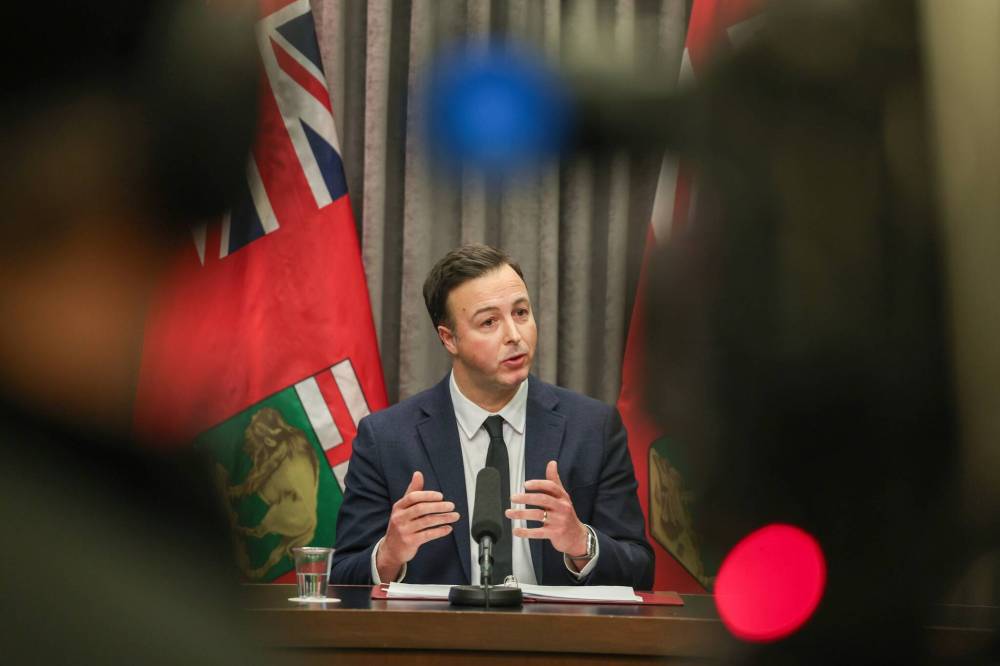
Budget 2025, which projected a $794-million deficit in the spring, earmarked $50 million for wildfire-related expenses.
The new report suggests fighting fires and evacuating northerners, among related expenses, has cost the province roughly $224 million between April 1 and Sept. 30.
It also shows that, as of the end of the second quarter, water flows mirrored 1988-89 — the second-worst year in Manitoba Hydro’s recorded history.
The utility is projected to be in a net-loss position, with its operations now slated to cost $684 million more than budgeted.
Government of Manitoba handout The Leaf Rapids wildfire in July. The Kinew government is blaming droughts, wildfires and U.S. tariffs for a soaring deficit that is expected to be $1.6 billion.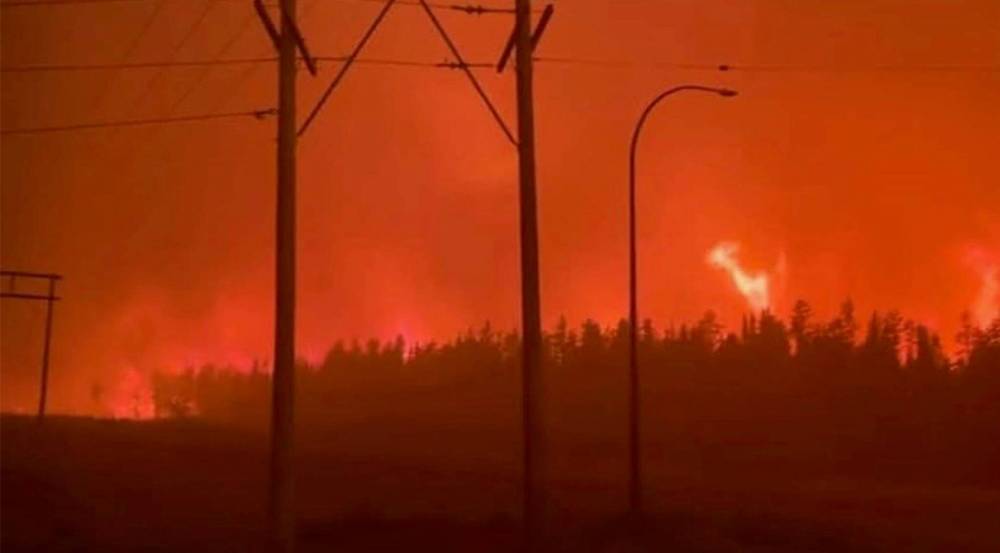
These line items — which the finance minister said are tied to climate change — should be “in the rear-view” in the new year, he said.
Notably, the figures do not include the price tag of the NDP’s promised review of its 2025 wildfire season response.
Asked about how recent climate crisis-related expenses will inform future budget planning, Sala indicated the province will consider its contingency funding.
Budget 2025 set aside $200 million for unexpected revenue changes. That fund has already been fully drained to address Hydro’s losses.
Progressive Conservative Leader Obby Khan accused Premier Wab Kinew and the NDP caucus of blaming a “disastrous” financial situation on “everyone but themselves.”
“They are missing every single projection that they have laid out, and not by a little bit — by a lot,” Khan said during an afternoon scrum in the rotunda.
Manitoba’s overall revenue is estimated to be $24.5 billion, down $556 million from what was forecast.
Mike Deal/Free Press files Tory Leader Obby Khan.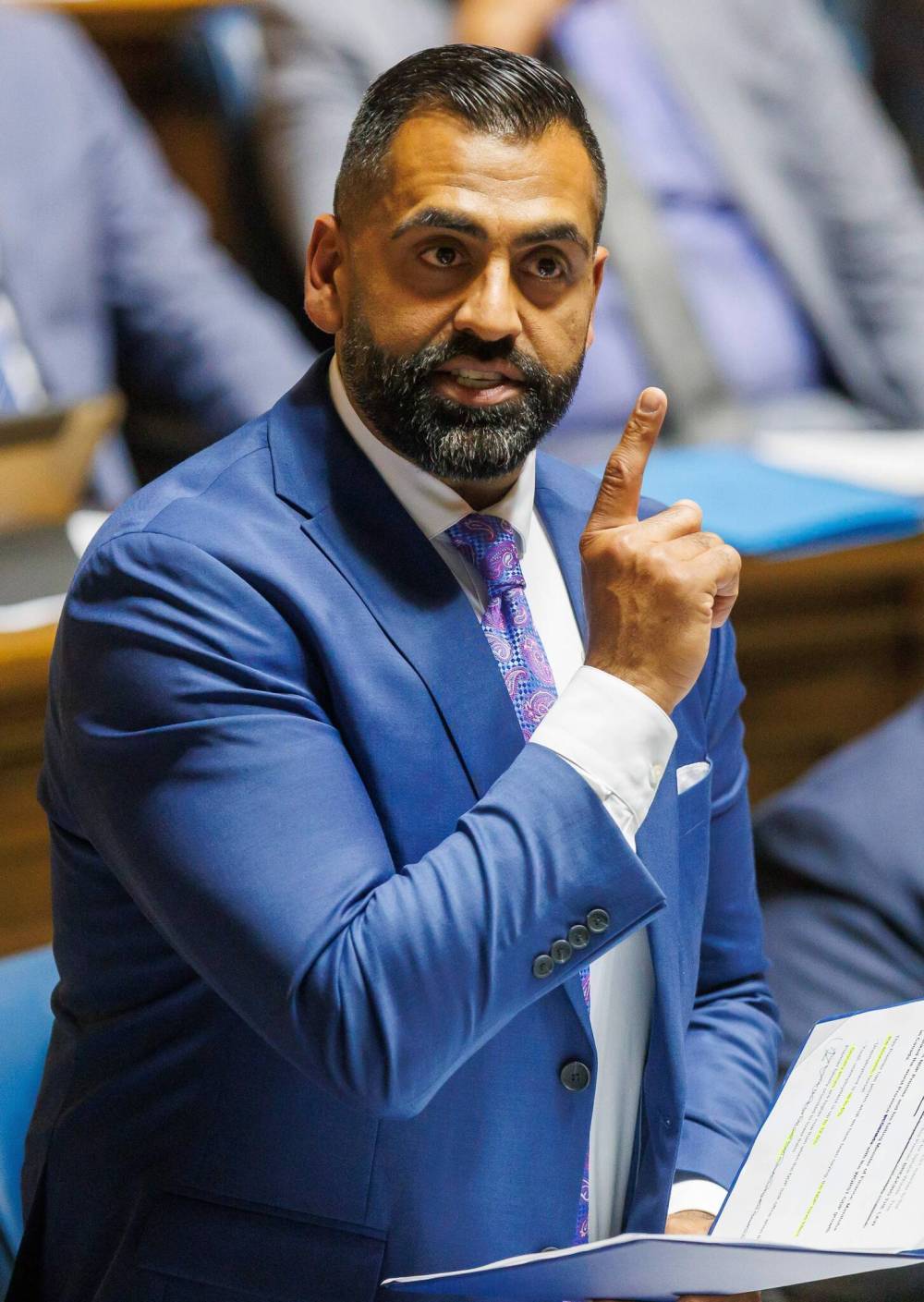
Its gross domestic product is expected to grow 0.6 per cent less than what was forecast in the spring.
Monday’s fiscal update attributed the decline to “tariffs, trade uncertainty and economic risks associated with the wildfires.”
Despite lower-than-anticipated revenue and soaring debt, Sala reiterated the NDP’s commitment to balancing the budget by the end of its first term.
“This is not a time to cut programs or to look at making significant changes that might further slow down the economy,” the minister added.
Political expert Christopher Adams said the new projections do not come as a surprise.
“Many commitments were made two years ago during the provincial election. To the premier’s credit, he’s been working to fulfill those commitments, but at the same time, the downside to commitments is that you have to pay for them,” said Adams, an adjunct professor in political science at the University of Manitoba.
He noted the NDP has pledged huge spending on health-care initiatives, such as recruiting and retaining nurses. At the same time, it’s grappling with the fallout of its 2024 gas-tax holiday and related revenue losses, Adams said.
The Canadian Taxpayers Federation called on Kinew to find savings instead of borrowing $1.6 billion.
“This is not a time to cut programs or to look at making significant changes that might further slow down the economy.”
PC finance critic Lauren Stone said her longtime concerns about the budget being “too rosy,” as well as the impact of double-digit education property tax increases on residents’ pocketbooks, have proven to be true.
Stone urged the province to reverse its decision to implement a flat property education tax credit and do away with 50 per cent rebates for all homeowners.
“When Manitobans have more money in their pockets, then they can spend it,” she said, adding that “taking $400 million out of (their) pockets” is not a solution during a cost-of-living crisis.
The province’s newest figures reveal it will bring in upwards of one billion dollars in education property tax revenue this year.
Manitoba’s consumer price index climbed three per cent in October, year-over-year, while the Canadian average was 2.4 per cent. A 19.5 per cent hike in property taxes and other special charges was cited as a driving factor.

Sala defended those numbers, saying various municipal fees, such as an increase to garbage pick up across Winnipeg, have contributed to them.
Manitoba’s summary net debt is expected to balloon to $38 billion while the net-debt-to-GDP ratio is on track to climb 1.3 percentage points higher than planned.
The health and justice departments are expected to be over budget by $50 million and $20 million, respectively.
Manitoba Agriculture is an outlier in that it is forecasting $83 million in savings, owing to a reduction in insurance claims and indemnity payments due to favourable growing conditions.
— with files from Tyler Searle
maggie.macintosh@freepress.mb.ca
Maggie Macintosh
Education reporter
Maggie Macintosh reports on education for the Free Press. Originally from Hamilton, Ont., she first reported for the Free Press in 2017. Read more about Maggie.
Funding for the Free Press education reporter comes from the Government of Canada through the Local Journalism Initiative.
Every piece of reporting Maggie produces is reviewed by an editing team before it is posted online or published in print — part of the Free Press‘s tradition, since 1872, of producing reliable independent journalism. Read more about Free Press’s history and mandate, and learn how our newsroom operates.
Our newsroom depends on a growing audience of readers to power our journalism. If you are not a paid reader, please consider becoming a subscriber.
Our newsroom depends on its audience of readers to power our journalism. Thank you for your support.
Maggie Macintosh
Education reporter
Maggie Macintosh reports on education for the Free Press. Originally from Hamilton, Ont., she first reported for the Free Press in 2017. Read more about Maggie.
Funding for the Free Press education reporter comes from the Government of Canada through the Local Journalism Initiative.
Every piece of reporting Maggie produces is reviewed by an editing team before it is posted online or published in print — part of the Free Press‘s tradition, since 1872, of producing reliable independent journalism. Read more about Free Press’s history and mandate, and learn how our newsroom operates.
Our newsroom depends on a growing audience of readers to power our journalism. If you are not a paid reader, please consider becoming a subscriber.
Our newsroom depends on its audience of readers to power our journalism. Thank you for your support.

Advertisement Advertise With Us
Advertisement Advertise With Us
History
Updated on Tuesday, December 16, 2025 9:48 AM CST: Copy edit