

Hundreds evacuated amid power outage in Pimicikamak

Advertisement
Read this article for free:
or
Already have an account? Log in here »
To continue reading, please subscribe:

Digital Subscription
One year of digital access for only $205*
- Enjoy unlimited reading on winnipegfreepress.com
- Read the E-Edition, our digital replica newspaper
- Access News Break, our award-winning app
- Play interactive puzzles
*First annual payment billed as $205.00 + GST for one year. This annual subscription will automatically renew at $233.00 + GST every 52 weeks (10% off the regular annual price of $259.35). Offer available to new and qualified returning subscribers only. Cancel any time.
To continue reading, please subscribe:
Add Free Press access to your Brandon Sun subscription for only an additional
$1 for the first 4 weeks*
- Enjoy unlimited reading on winnipegfreepress.com
- Read the E-Edition, our digital replica newspaper
- Access News Break, our award-winning app
- Play interactive puzzles
*Your next Brandon Sun subscription payment will increase by $1.00 and you will be charged $17.95 plus GST for four weeks. After four weeks, your payment will increase to $24.95 plus GST every four weeks.
Read unlimited articles for free today:
or
Already have an account? Log in here »
Hey there, time traveller!
This article was published 30/12/2025 (260 days ago), so information in it may no longer be current.
More than 300 Pimicikamak Cree Nation residents have been moved to other communities in Manitoba amid a power outage that is now not expected to be resolved until 6 p.m. on New Year’s Day.
The evacuation to Thompson, Whiskey Jack Landing and Norway House Cree Nation involved elders, people with certain health conditions and families with babies, Chief David Monias said.
“The problems we are having keep on piling up the longer we go (without power),” Monias said Tuesday morning. “People are frustrated, and people are angry that this is happening. We have people at risk.”
The outage affected 1,300 customers as of Monday afternoon. (Supplied)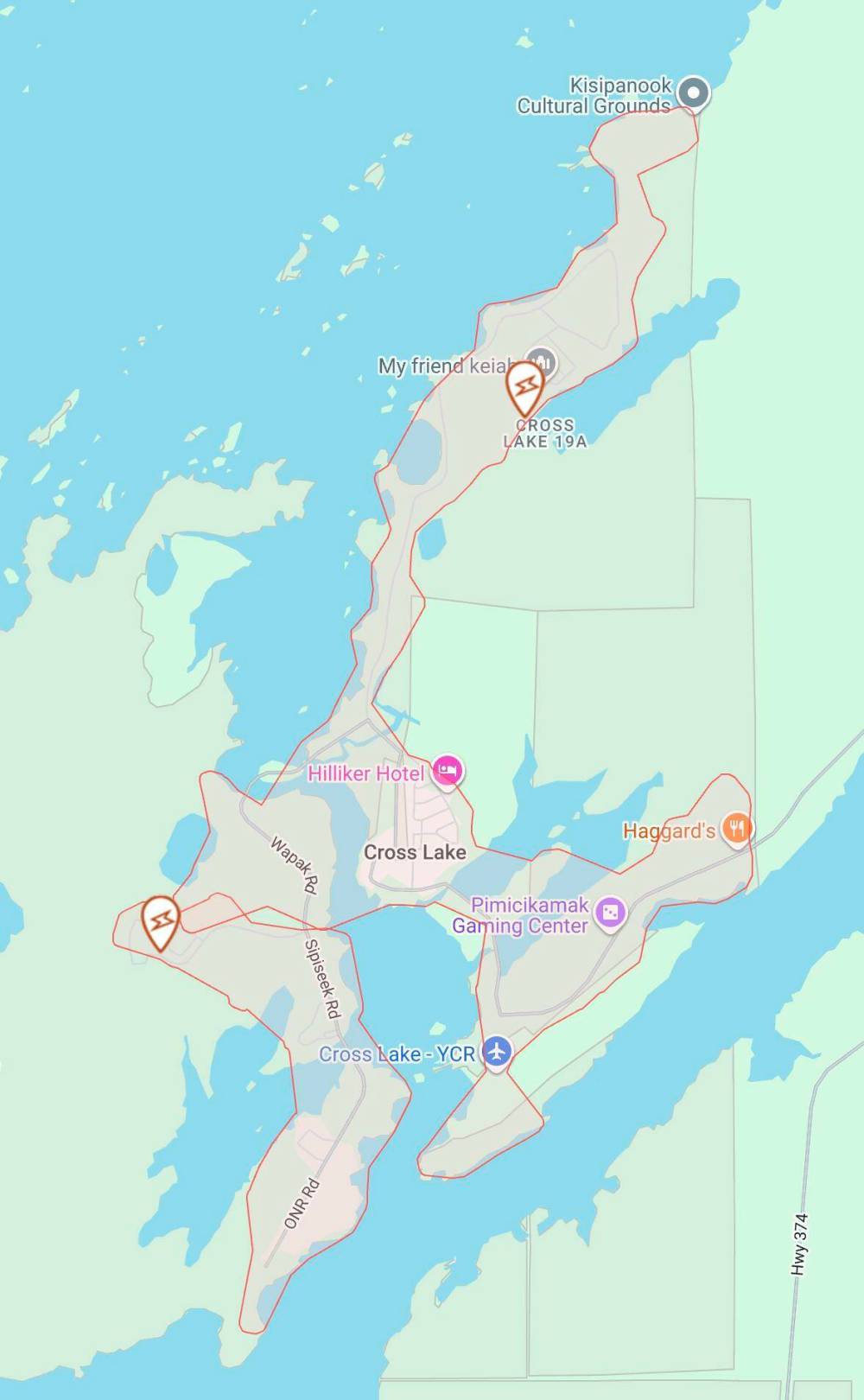
Hotel space in Thompson was limited, he said. Buses were scheduled to transport dozens of residents to Winnipeg starting Tuesday afternoon.
Monias said residents who remain in Pimicikamak are gathering in homes or buildings that have a gas-powered generator or wood stove, while some used candles to generate heat or they slept inside running vehicles.
The outage, which has affected the entire community since about 11:30 p.m. Sunday, has made it difficult for residents to cook or preserve food, access clean water and communicate, he said.
The chief said bottled water supplies were running low Tuesday morning, and food had to be brought in from Norway House.
In a Facebook post Tuesday afternoon, he said the outage had reached a critical stage, with water and sewage holding tanks starting to freeze, creating a public health and sanitation emergency.
Pimicikamak declared a state of emergency Monday after it became clear the power loss would be a lengthy one amid freezing temperatures.
Environment and Climate Change Canada predicted a high of -19 C on Tuesday and an overnight low of -30 C (a wind chill of -39 is expected).
Pimicikamak lost power when a transmission line snapped over the Nelson River in a remote, forested area about 10 kilometres north of the First Nation.
Manitoba Hydro originally estimated power would be restored by 6 p.m. Wednesday, based on an earlier aerial survey. The estimate was pushed back to 6 p.m. Thursday after crews assessed the site Tuesday.
Repairs will take more time due to the difficult location and terrain, Hydro said.
Manitoba Hydro workers spotted a downed line over the Nelson River about 10 kilometres from Pimicikamak Cree Nation, while flying over in a helicopter Monday morning. (Supplied)
Eva Muswagon said 11 people, including her grandchildren as young as two, and three dogs were staying in her home, which has a wood stove. They’ve been wearing extra layers and sleeping in the living room, where the stove is located.
After running out of fire wood, Muswagon went to Norway House, a three-hour round trip, to buy more supplies, including bottled water and food.
The grandmother melted snow after running out of drinking water earlier. She used the wood stove to cook food, including spaghetti, porridge and waffles.
“It is very exhausting,” she said of the experience. “Hopefully, the power will be restored soon.”
Muswagon said her home’s water line will likely freeze.
Hydro spokesman Scott Powell said the cause of the downed line has not yet been confirmed. Downed lines are not an unheard of issue, he added.
“Unfortunately, the location of this line and the weather conditions make this a significant issue for the community,” Powell wrote in an email.
The poles involved in the repairs are located on two separate islands.
“We already have access to the nearest shore site and are stockpiling the required materials there, and are now working to safely access the two islands,” Powell wrote.
“It is very exhausting… Hopefully, the power will be restored soon.”
River ice was about five centimetres thick, preventing safe access, Monias said.
About 13 Hydro staff are involved in the repairs, plus contractors.
For the restoration to be completed Wednesday, crews will need a full day of daylight and weather conditions that are safe for a helicopter to fly, Hydro said.
Pimicikamak has about 7,500 residents and is about 750 kilometres north of Winnipeg. The unincorporated community of Cross Lake is located next to the First Nation.
It’s been a taxing year for the communities, which were surrounded by wildfires over the summer. Wildfire evacuees Shane Castel, 40, and his six-year-old daughter, Kaia Rose, spent almost a month in a Winnipeg hotel.
They were in a Thompson hotel room Tuesday. When Hydro pushed its estimated restoration time to Wednesday evening, Castel, who has health conditions, decided to play it safe and drive roughly three hours to Thompson.
“I don’t know which one is worse now… the fire or the power outage.”
“I don’t know which one is worse now — the fire or the power outage,” he said of the evacuations.
Castel, 40, was watching a movie at home when the power went out. He stayed up most of the night to keep a fire going in his wood stove.
He cooked bacon, eggs and potatoes, and made tea on the stove’s flat top Monday before deciding to leave.
On his way to Thompson, he waited more than two hours in a “tremendously long lineup” at a gas station, where residents filled their vehicles and jerry cans.
Indigenous Services Canada spokesperson Maryéva Métellus said the community’s nursing station is open for emergencies only due to the outage.
Hydro continued to send workers and equipment to the area Tuesday. Heavy equipment was used to build a temporary winter road to access the repair site.

Pimicikamak is using gas-powered generators that were provided during a previous power outage, Monias said. Some needed repairs or new parts to get them working again.
He said about 600 additional generators were on their way to the community via the Canadian Red Cross on behalf of Indigenous Services Canada. The organization is also sending heaters.
The Red Cross is helping evacuees with emergency accommodation and meals at hotels.
Monias said changes or new measures are needed to prevent another lengthy outage in the future.
He suggested large industrial generators be sent to Pimicikamak to use as a backup, if and when needed. The chief also questioned whether it’s possible to improve road access to the power line or move the line.
Powell said it is faster to make permanent repairs than it is to ship and energize large generators.
Moving a transmission line is a significant and expensive undertaking, and there is no guarantee that moving a line closer to a road would prevent a lengthy outage from occurring, he said.
— With files from Erik Pindera
chris.kitching@freepress.mb.ca
Chris Kitching is a general assignment reporter at the Free Press. He began his newspaper career in 2001, with stops in Winnipeg, Toronto and London, England, along the way. After returning to Winnipeg, he joined the Free Press in 2021, and now covers a little bit of everything for the newspaper. Read more about Chris.
Every piece of reporting Chris produces is reviewed by an editing team before it is posted online or published in print — part of the Free Press‘s tradition, since 1872, of producing reliable independent journalism. Read more about Free Press’s history and mandate, and learn how our newsroom operates.
Our newsroom depends on a growing audience of readers to power our journalism. If you are not a paid reader, please consider becoming a subscriber.
Our newsroom depends on its audience of readers to power our journalism. Thank you for your support.
Chris Kitching is a general assignment reporter at the Free Press. He began his newspaper career in 2001, with stops in Winnipeg, Toronto and London, England, along the way. After returning to Winnipeg, he joined the Free Press in 2021, and now covers a little bit of everything for the newspaper. Read more about Chris.
Every piece of reporting Chris produces is reviewed by an editing team before it is posted online or published in print — part of the Free Press‘s tradition, since 1872, of producing reliable independent journalism. Read more about Free Press’s history and mandate, and learn how our newsroom operates.
Our newsroom depends on a growing audience of readers to power our journalism. If you are not a paid reader, please consider becoming a subscriber.
Our newsroom depends on its audience of readers to power our journalism. Thank you for your support.
Related Articles
Hydro races to restore power to northern First Nation amid frigid temps






Advertisement Advertise With Us
Advertisement Advertise With Us
History
Updated on Tuesday, December 30, 2025 1:47 PM CST: Adds details, photo.
Updated on Tuesday, December 30, 2025 3:52 PM CST: Adds details
Updated on Tuesday, December 30, 2025 4:46 PM CST: Adds updates.