

Damage estimates spiral as Pimicikamak tries to recover from power outage, deep freeze


Advertisement
Read this article for free:
or
Already have an account? Log in here »
To continue reading, please subscribe:
Digital Subscription
One year of digital access for only $1.44 a week*
- Enjoy unlimited reading on winnipegfreepress.com
- Read the E-Edition, our digital replica newspaper
- Access News Break, our award-winning app
- Play interactive puzzles
*Billed as $5.77 plus GST every four weeks. After 52 weeks, price increases to the regular rate of $19.95 plus GST every four weeks. Offer available to new and qualified returning subscribers only. Cancel any time.
To continue reading, please subscribe:
Add Free Press access to your Brandon Sun subscription for only an additional
$1 for the first 4 weeks*
- Enjoy unlimited reading on winnipegfreepress.com
- Read the E-Edition, our digital replica newspaper
- Access News Break, our award-winning app
- Play interactive puzzles
*Your next Brandon Sun subscription payment will increase by $1.00 and you will be charged $17.95 plus GST for four weeks. After four weeks, your payment will increase to $24.95 plus GST every four weeks.
Read unlimited articles for free today:
or
Already have an account? Log in here »
Hey there, time traveller!
This article was published 03/01/2026 (291 days ago), so information in it may no longer be current.
The power is back on, but the damage has been done. Water leaks. Burst pipes. Burned houses. And still, more than 4,000 residents of Pimicikamak Cree Nation are forced out of their homes, with no clear timeline of when they’ll be able to return.
On Saturday, six days after a downed power line left the remote Northern First Nation without electricity for over four days, Pimicikamak Chief David Monias spoke to reporters by Zoom to give an update on the crisis — and emphasize the expertise and supports the community still needs to recover.
Although power has been restored to the community, which is located roughly 100 km south of Thompson, over four days without electricity caused major damage, Monias said. The water treatment plant is “pretty much ready to explode” due to leaks and is unable to draw water into its reservoir, leaving the community without potable water.
MIKAELA MACKENZIE / FREE PRESS FILES Pimicikamak Chief David Monias estimates the minimum cost of recovery from the damage caused to his community to be around $45 million.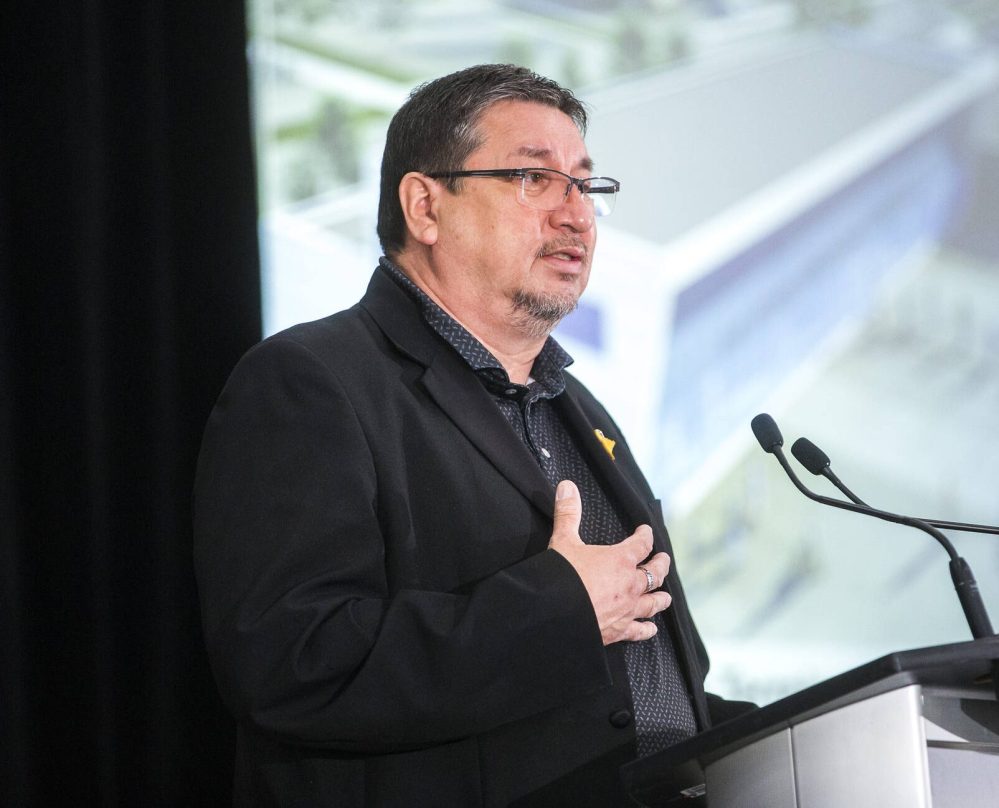
Houses too suffered in the deep freeze, including damage to pipes and cracked floors. So far, of the 1,335 houses on the community, which is also known as Cross Lake, at least 200 are severely compromised and not yet safe for residents to return. That number may grow as officials continue their inspections.
Four houses burned down during the crisis, in part due to electrical shortages. One fire occurred due to a short in a heating device while residents were sleeping. With water sources out of operation, firefighters were able to rescue the residents, but could not save the house.
“The water plants are frozen, the water tanks are frozen, the water pumps are frozen, and there’s actually water seeping into the electrical parts, for instance electrical sockets, as well as light fixtures,” Monias said. “We have sewers that froze, and we have toilets that are actually tilted sideways, and some have toppled over because the water underneath it is frozen.”
That means that not only is it not clear when many of the 4,000 evacuees spread between Thompson, Winnipeg, Flin Flon and The Pas will be able to return, but evacuations are continuing: another 150 people were expected to be flown out of the community on Saturday afternoon.
In total, Monias estimates the minimum cost of recovery to be around $45 million.
Money isn’t the only thing needed. Pimicikamak has also put out a call for tradespeople and engineers to come work on the community, fixing damaged infrastructure and performing inspections.
“We need engineers, plumbers, electricians, carpenters, we don’t have enough in the community.”
“We had called for assistance, we had called for Canadian Armed Forces to come and help us out,” Monias said. “We need engineers, plumbers, electricians, carpenters, we don’t have enough in the community. We were told that if we exhaust all local resources, according to the Canadian government, then they would send in the army.
“Well, local resources for us means our community, our nation, and we have done that.”
In order to obtain military assistance, Monias said, the province would need to step in and back the call. Reserve leadership has been in touch with multiple provincial departments throughout the crisis, he added, though he expressed frustration at the amount of bureaucracy some of those calls entailed.
“Right now we’re trying to mitigate safety, and we’re putting out fires, literally, and trying to clean up as much as we can to make sure people are taken care of, feeding them,” Monias said. “Then they’re trying to get us to come up with this massive recovery plan and the budget. And it’s hard to do when you’re in the middle of doing all that stuff.”
While the focus now is on short-term emergency management and recovery, the community must also look to longer-term fixes. The power transmission line, which runs through a remote area of the bush, has been a known source of vulnerability for years; three years ago, a similar problem left Cross Lake without electricity for over 24 hours.
In addition to the frigid temperatures of below -30 C, one of the biggest problems facing Hydro repair crews last week was that the line runs between islands in the Nelson River, and the ice was too thin for vehicle access. That required Manitoba Hydro to contract two helicopters to assist in replacing the downed line.
MANITOBA HYDRO Hydro workers spotted a downed line over the Nelson River about 10 kilometres from Pimicikamak Cree Nation, while flying over in a helicopter Monday morning.
Over the years, Pimicikamak has been in talks with Manitoba Hydro to install a new line into the reserve along Highway 374, which would be easier to service. The community has also asked for a permanent large backup emergency generator. (Hydro provided one large and a number of smaller generators to the community last week.)
“We’ve brought them to the table time and time again to try and address this problem, because it’s not the first time this has happened and it’s certainly not going to be the last,” Pimicikamak councillor Shirley Robinson said. “So I’m hoping that this can be addressed now than not addressing it at all.
“This is way too much this time, and has caused tremendous damage to our nation.”
In addition to the vulnerability in the line itself, the crisis was made worse due to aging infrastructure and insufficient pipe insulation, Monias said. The community’s regular funding is not enough to pay for those upgrades, he said.
For now, the chief said, what is getting the First Nation through is the hard work of its people.
“We’ve gone through about five to six major evacuations in the last five years, and unfortunately, we’ve become very good at it.”
“Our people are really stepping up,” Monias said. “We have our local firefighters, our public works people, our executive council members just working around the clock trying to help people. We have our staff that step up.
“We’ve gone through about five to six major evacuations in the last five years, and unfortunately, we’ve become very good at it, in terms of trying to help the people,” he continued. “Again, the bureaucracy is slow in coming to help us out, and we’ve been asking for governments to try and help out.”
Churchill-Keewatinook Aski MP Rebecca Chartrand said in a Facebook video post that she held an emergency meeting with Pimicikamak leaders and other federal agencies on Sunday.
“The situation in the community is serious and urgent,” Chartrand said. “People are dealing with power outages and extreme cold. Homes are flooding. There is a lot of food spoilage, and some real safety risks in the community.”
Chartrand said the meeting wasn’t about reports or updates, but action. They heard directly from leadership about what is happening on the ground.
“As a result, we put together a plan,” Chartrand said, adding they will be having daily emergency co-ordination meetings that the federal government will be a part of.”
“This is about accountability, it’s about dignity… We will continue to stay engaged until real solutions are delivered for the community.”
Chartrand also said they are co-ordinating a trip to Pimicikamak for federal and provincial counterparts by Thursday to ensuring proper emergency supports are in place, including skilled trades workers, along with adequate generators.
She said they also want to ensure there is funding for a new water treatment plant.
“This is about accountability, it’s about dignity,” she said. “We will continue to stay engaged until real solutions are delivered for the community,” Chartrand said.
Monais said Sunday that there is still no word on help from the Canadian Armed Forces.
He said the federal government wants the province to ask for it, and that Premier Wab Kinew “disagrees” with that. Monias and Kinew, he said, believe that Monias’s emergency declaration should be enough.
melissa.martin@freepress.mb.ca
scott.billeck@freepress.mb.ca
Several wise folks — ok, ok, journalism types — once told Scott he better make sure he can report on news before he learns to write about sports. In what can only be described as a minor miracle, he listened.
Our newsroom depends on a growing audience of readers to power our journalism. If you are not a paid reader, please consider becoming a subscriber.
Our newsroom depends on its audience of readers to power our journalism. Thank you for your support.
Several wise folks — ok, ok, journalism types — once told Scott he better make sure he can report on news before he learns to write about sports. In what can only be described as a minor miracle, he listened.
Our newsroom depends on a growing audience of readers to power our journalism. If you are not a paid reader, please consider becoming a subscriber.
Our newsroom depends on its audience of readers to power our journalism. Thank you for your support.
Related Articles
Power outage left Pimicikamak in dark, cold since Sunday






Advertisement Advertise With Us
Advertisement Advertise With Us
History
Updated on Sunday, January 4, 2026 5:32 PM CST: Adds comments from Churchill-Keewatinook Aski MP Rebecca Chartrand.