

Finding housing for encampment residents remains challenge: city
Twelve camps cleared since new protocol enacted

Advertisement
Read this article for free:
or
Already have an account? Log in here »
To continue reading, please subscribe:

Digital Subscription
One year of digital access for only $205*
- Enjoy unlimited reading on winnipegfreepress.com
- Read the E-Edition, our digital replica newspaper
- Access News Break, our award-winning app
- Play interactive puzzles
*First annual payment billed as $205.00 + GST for one year. This annual subscription will automatically renew at $233.00 + GST every 52 weeks (10% off the regular annual price of $259.35). Offer available to new and qualified returning subscribers only. Cancel any time.
To continue reading, please subscribe:
Add Free Press access to your Brandon Sun subscription for only an additional
$1 for the first 4 weeks*
- Enjoy unlimited reading on winnipegfreepress.com
- Read the E-Edition, our digital replica newspaper
- Access News Break, our award-winning app
- Play interactive puzzles
*Your next Brandon Sun subscription payment will increase by $1.00 and you will be charged $17.95 plus GST for four weeks. After four weeks, your payment will increase to $24.95 plus GST every four weeks.
Read unlimited articles for free today:
or
Already have an account? Log in here »
Hey there, time traveller!
This article was published 09/01/2026 (263 days ago), so information in it may no longer be current.
There have been 12 encampments cleared by city staff since the implementation of new protocols in November, but finding housing or shelter for people staying in them remains a “key struggle,” councillors heard Friday.
Winnipeg’s encampment response protocol, which brings enforcement officers, Winnipeg Fire and Paramedic Service staff, outreach organizations and other groups together to clear out people and connect them to housing and other supports, was put in place Nov. 17.
Since then, the city has inspected 72 sites and enforcement officers have put up 117 signs warning of bylaw violations.
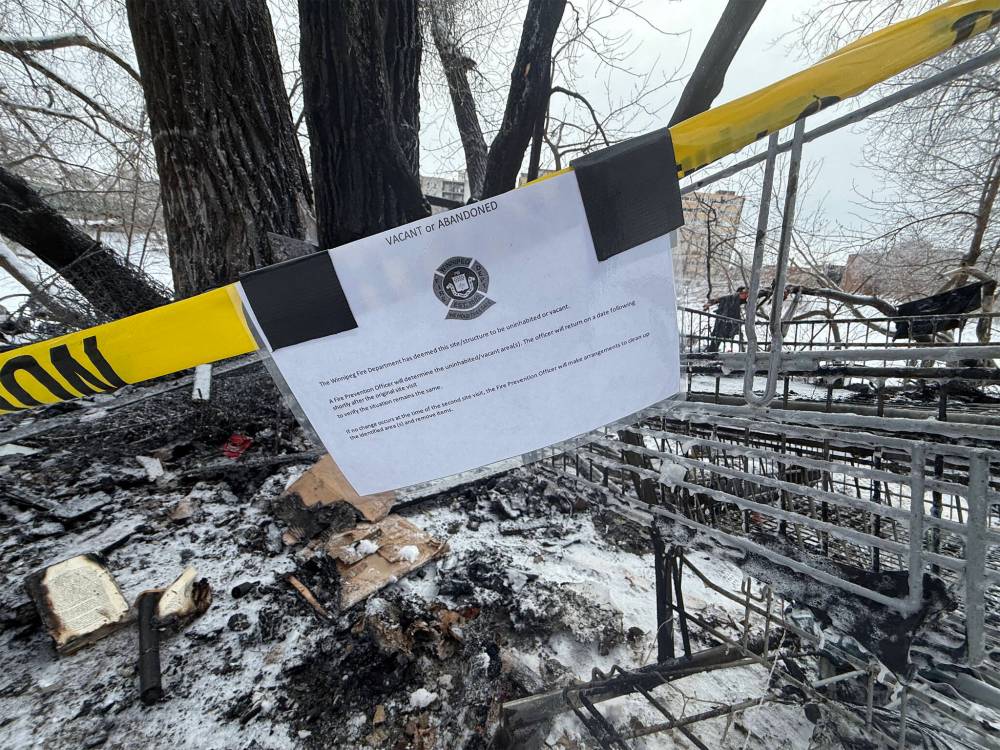
SCOTT BILLECK / FREE PRESS
A former encampment by the Riverwalk near 356 Assiniboine Avenue. Twelve encampments have been cleared by city staff since the implementation of new protocols in November.
“We have quite a large number of sites we’re working on presently, just monitoring and working with outreach teams to make contact and, hopefully, find housing for people at those sites,” Greg MacPherson, he city’s acting manager of community development, told councillors at Friday’s community services committee meeting.
Including the 12 cleared encampments on public property, garbage cleanup efforts have been dispatched to 30 locations.
A city spokesperson said Friday the locations where encampments have been cleared would not be published.
”We don’t have a count of relocated individuals as we rely on our partners to link people with services and housing,” communications officer Kalen Qually said in an email.
MacPherson said clearing the sites involves city staff informing the people staying there that they are in violation of city bylaws, connecting affected people with supports, and cleaning up the areas.
“We could do more if we had more access to space.”
He noted while the city is working with outreach teams and provincial staff through its Your Way Home strategy, finding housing options for encampment residents has been difficult.
“At present, that’s one of our key struggles, and that hasn’t changed at all over the past year. We’re in a shortage, we have a housing shortage, and similarly, with the shelter spaces, they’re quite tight,” he said.
“We could do more if we had more access to space, certainly, we’d be able to ask people to leave encampments and place them in housing that was appropriate to them if we had more options.”
Housing, Addictions and Homelessness Minister Bernadette Smith said 156 people have been housed through the Your Way Home strategy as of Dec. 31.
“Housing is a challenge right across the country, and we as a government are committed to bringing more supply online, and more importantly, remain committed to supporting Manitobans to stay successfully housed,” she said in an emailed statement.

There are currently three bylaw officers working on the encampment protocol, but that number could increase when the weather gets warmer.
In September, city council voted to ban encampments from a number of locations, including transit shelters, playgrounds, schools, daycares, bridges, docks, rail lines, and anywhere where a camp would obstruct traffic or pose a “life safety issue.”
Community services committee chair Coun. Vivian Santos said she’s heard from staff at shelters in her ward that available space continues to be an issue, exacerbated by cold temperatures.
“I think shelters are doing the best that they can with a complex issue,” Santos (Point Douglas) said.
“We’ve heard even from delegates they don’t even want to stay in shelters because of certain issues that are happening there, and some places are not safe for them. It’s not an easy thing to deal with.”
“I think shelters are doing the best that they can with a complex issue.”
Marion Willis, who leads St. Boniface Street Links, which connects people living in encampments to housing and other supports, said city staff have brought around half a dozen people to them since the encampment strategy began, and they were able to get them all housed.
She said St. Boniface Street Links tries to access housing through the private market, rather than social housing, and has not had an issue finding spots. She’d like to see the province and the city do the same.
“We didn’t house a single person in social housing, it was all private,” she said. “The private sector is willing to step up and help, it’s just that they haven’t been invited to help.”
Smith said the province has brought 2,024 Manitoba Housing units that needed significant repairs back into use, and purchased around 300 transitional housing units. About 100 of those units are occupied, while the rest are being repaired.
malak.abas@freepress.mb.ca
Malak Abas is a city reporter at the Free Press. Born and raised in Winnipeg’s North End, she led the campus paper at the University of Manitoba before joining the Free Press in 2020. Read more about Malak.
Every piece of reporting Malak produces is reviewed by an editing team before it is posted online or published in print — part of the Free Press‘s tradition, since 1872, of producing reliable independent journalism. Read more about Free Press’s history and mandate, and learn how our newsroom operates.
Our newsroom depends on a growing audience of readers to power our journalism. If you are not a paid reader, please consider becoming a subscriber.
Our newsroom depends on its audience of readers to power our journalism. Thank you for your support.
Malak Abas is a city reporter at the Free Press. Born and raised in Winnipeg’s North End, she led the campus paper at the University of Manitoba before joining the Free Press in 2020. Read more about Malak.
Every piece of reporting Malak produces is reviewed by an editing team before it is posted online or published in print — part of the Free Press‘s tradition, since 1872, of producing reliable independent journalism. Read more about Free Press’s history and mandate, and learn how our newsroom operates.
Our newsroom depends on a growing audience of readers to power our journalism. If you are not a paid reader, please consider becoming a subscriber.
Our newsroom depends on its audience of readers to power our journalism. Thank you for your support.
Related Articles
Mostyn Park quiet a month after homeless encampment vacated, cleaned up







Advertisement Advertise With Us
Advertisement Advertise With Us