

Province says 170 moved from encampments into housing

Advertisement
Read this article for free:
or
Already have an account? Log in here »
To continue reading, please subscribe:

Digital Subscription
One year of digital access for only $205*
- Enjoy unlimited reading on winnipegfreepress.com
- Read the E-Edition, our digital replica newspaper
- Access News Break, our award-winning app
- Play interactive puzzles
*First annual payment billed as $205.00 + GST for one year. This annual subscription will automatically renew at $233.00 + GST every 52 weeks (10% off the regular annual price of $259.35). Offer available to new and qualified returning subscribers only. Cancel any time.
To continue reading, please subscribe:
Add Free Press access to your Brandon Sun subscription for only an additional
$1 for the first 4 weeks*
- Enjoy unlimited reading on winnipegfreepress.com
- Read the E-Edition, our digital replica newspaper
- Access News Break, our award-winning app
- Play interactive puzzles
*Your next Brandon Sun subscription payment will increase by $1.00 and you will be charged $17.95 plus GST for four weeks. After four weeks, your payment will increase to $24.95 plus GST every four weeks.
Read unlimited articles for free today:
or
Already have an account? Log in here »
Hey there, time traveller!
This article was published 02/02/2026 (247 days ago), so information in it may no longer be current.
Over the past year, 170 people living in encampments have been housed through the province’s strategy to end homelessness, Manitoba’s housing minister says.
The province has taken down 100 encampments to date through a partnership with the City of Winnipeg, Bernadette Smith said.
“This is huge for our folks,” Smith said.
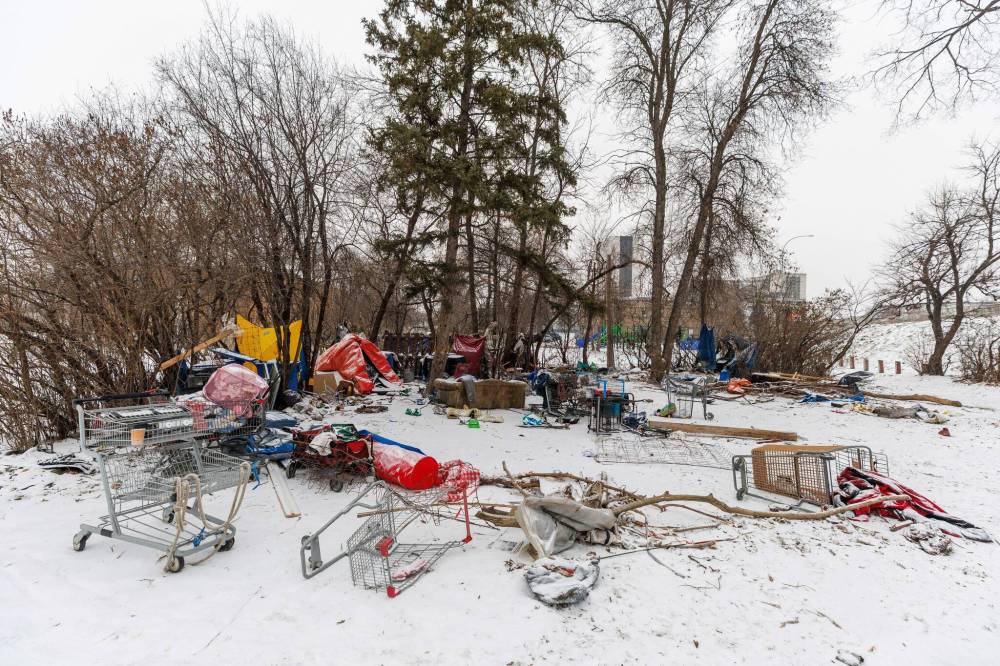
MIKE DEAL / FREE PRESS FILES
An encampment on Mayfair Avenue sits empty after being dismantled in early December. The province and the city have taken down 100 encampments to date.
Manitoba’s Your Way Home strategy was launched last January with a goal to end chronic homelessness by 2031. At the time, it estimated 700 Manitobans were living in encampments.
By Smith’s numbers, the province is on track to reach its target. Most people have been placed in transitional housing, a government spokesperson said.
Another 80 Manitobans — not included in the 170 — have been shifted from living in shelters to social housing.
In some cases, the province has let encampments, which can mean a single tent, stand as it waits for social housing to come available.
Last summer, Coun. Ross Eadie used about $60,000 from the Mynarski Ward Community Fund to hire St. Boniface Street Links for encampment removal.
“I knew that St. Boniface Street Links was getting results,” Eadie said.
The councillor said the province’s strategy could be expanded to house people in privately owned units — like Street Links does. The current plan doesn’t incorporate private housing until people are able to rent.
Street Links housed at least 100 people in the Mynarski ward last year. Eadie said he may hire the organization again this summer.
“I support Your Way Home, don’t get me wrong,” Eadie said, adding he’s satisfied with the strategy’s housing numbers thus far. “We’re all working for the same goal.”
Smith said housing is the “biggest barrier” to Your Way Home’s success. Encampment dwellers are moved into Manitoba Housing units, where the wait list for the subsidized housing recently exceeded 7,400.
“We’re having to play years of catch-up,” Smith said, criticizing the former government for not investing in Manitoba Housing buildings. “We’re committed to that, but it’s going to take us years to build.”
The province’s 2025 budget included $73.47 million for the housing strategy, including $16 million for transitional housing construction in downtown Winnipeg (for 118 people) and $5.6 million for Manitoba Housing renovations (affecting 270 units).
The province didn’t provide a construction update; a spokesperson said details should be announced later this month.
In January, a resident set fire to a Manitoba Housing apartment complex. Concerned tenants said the perpetrator had been homeless and had moved in via the Your Way Home program.
“Sometimes there’s a tension between the support and the landlord… in terms of, do we prioritize this one person, or do we prioritize the whole building?” said Christina Maes Nino, executive director of the Manitoba Non-Profit Housing Association.
There’s a need to build housing faster and hire more supports, Maes Nino said, noting many people in encampments face addictions and mental illness.
In 2023, the Manitoba Non-Profit Housing Association called for 10,000 new units of community housing built over 10 years.
“This is the first time that the province has really taken a leadership role in planning and actively leading in addressing homelessness,” Maes Nino said. “That part is really powerful and important.”
Of the 170 people transitioned into housing, only three haven’t stayed housed, Smith said. She credited wraparound supports provided by groups, such as the West Central Women’s Resource Centre and Main Street Project, who have been contracted by the province and city.
Tory housing critic Jeff Bereza questioned the government’s encampment removal count, saying the party is “clearly taking credit” for work the City of Winnipeg has done with its encampment bylaw enforcement team.
Encampments removed by the city’s bylaw enforcement team are not counted under the strategy, a provincial government spokesperson said.
Last November, the city announced staff would visit encampments to ensure tents are not in prohibited places, such as within 50 metres of a school or playground.
The province’s homelessness strategy continues to operate without a senior adviser. Tessa Blaikie Whitecloud left the role last November; she’s now president of the Collaborative Housing Alliance Real Estate Investment Trust.
“Right now we’re really focused on — it’s winter — getting people out of encampments, getting people into shelters, working on getting housing stood up,” Smith said. “We’ll look at (hiring) in the future.”
John Giavedoni, head of the group Residents of the Exchange District, hopes encampments will be prevented from sprouting come springtime. Locals feel unsafe with them, he said, adding there have been car break-ins and public overdoses.
“You want… people to have someplace proper to live,” he said.

Both Keith Horn, owner of the Northern Hotel on Main Street, and North Point Douglas activist Sel Burrows have noticed fewer encampments in the areas they frequent. They credited St. Boniface Street Links.
The charity said it housed 389 people in 2025.
“I think the province is doing a great job,” Burrows said. “So is Street Links… we need a multitude of approaches to be successful.”
Marion Willis, Street Links’s founder, said different organizations are playing to their “strengths” — including using social and private housing — to reach the shared goal.
gabrielle.piche@winnipegfreepress.com
Gabrielle Piché reports on business for the Free Press. She interned at the Free Press and worked for its sister outlet, Canstar Community News, before entering the business beat in 2021. Read more about Gabrielle.
Every piece of reporting Gabrielle produces is reviewed by an editing team before it is posted online or published in print — part of the Free Press‘s tradition, since 1872, of producing reliable independent journalism. Read more about Free Press’s history and mandate, and learn how our newsroom operates.
Our newsroom depends on a growing audience of readers to power our journalism. If you are not a paid reader, please consider becoming a subscriber.
Our newsroom depends on its audience of readers to power our journalism. Thank you for your support.
Gabrielle Piché reports on business for the Free Press. She interned at the Free Press and worked for its sister outlet, Canstar Community News, before entering the business beat in 2021. Read more about Gabrielle.
Every piece of reporting Gabrielle produces is reviewed by an editing team before it is posted online or published in print — part of the Free Press‘s tradition, since 1872, of producing reliable independent journalism. Read more about Free Press’s history and mandate, and learn how our newsroom operates.
Our newsroom depends on a growing audience of readers to power our journalism. If you are not a paid reader, please consider becoming a subscriber.
Our newsroom depends on its audience of readers to power our journalism. Thank you for your support.
Related Articles
Homeless encampment fire calls keep WFPS busy in 2025









Advertisement Advertise With Us
Advertisement Advertise With Us