

Another erased piece of the Winnipeg that was

Advertisement
Read this article for free:
or
Already have an account? Log in here »
To continue reading, please subscribe:
Digital Subscription
One year of digital access for only $1.44 a week*
- Enjoy unlimited reading on winnipegfreepress.com
- Read the E-Edition, our digital replica newspaper
- Access News Break, our award-winning app
- Play interactive puzzles
*Billed as $5.77 plus GST every four weeks. After 52 weeks, price increases to the regular rate of $19.95 plus GST every four weeks. Offer available to new and qualified returning subscribers only. Cancel any time.
To continue reading, please subscribe:
Add Free Press access to your Brandon Sun subscription for only an additional
$1 for the first 4 weeks*
- Enjoy unlimited reading on winnipegfreepress.com
- Read the E-Edition, our digital replica newspaper
- Access News Break, our award-winning app
- Play interactive puzzles
*Your next Brandon Sun subscription payment will increase by $1.00 and you will be charged $17.95 plus GST for four weeks. After four weeks, your payment will increase to $24.95 plus GST every four weeks.
Read unlimited articles for free today:
or
Already have an account? Log in here »
Hey there, time traveller!
This article was published 15/01/2026 (283 days ago), so information in it may no longer be current.
The rubble was still smoking a little on Wednesday afternoon, though by then, all that remained of the place were its bones.
Even these gave little hint of what they had been: a jumble of wood and metal charred, splintered, collapsed into a formless black heap, over which the tracks of an emergency bulldozer lurched and crawled.
That is the last we will see of the Manwin Hotel.

The truth is, nobody will truly miss it. For decades, the Manwin had existed as a scar of the Winnipeg that was, festered into a wound of the city that is. Still, in that troubled arc, it had a story to tell.
After the blaze that devoured it in the early hours of Wednesday morning, its sudden and unceremonious demise reflects that journey too.
Of all the things you could say about the old hotel, the best, perhaps, is that it was a survivor. Since 1889, it had stood squat in its spot at 655 Main Street: crumbling, neglected and multiple times shuttered, but still stubbornly refusing to disappear to the flames or wrecking balls that claimed many of its neighbours.
It was prettier when it was young (weren’t we all), though still modest, with a brick facade and a triangular pediment over the entrance. Even then, in 1889, it was a far cry from the grander hotels on the strip; it offered affordable rooming for the railway workers and labourers that were spilling into Winnipeg.
Of all the things you could say about the old hotel, the best, perhaps, is that it was a survivor.
In that way, the hotel suited the energy of a city that was growing, building, becoming. It was a place of hope, then, a place where people came looking to at least find a new foothold in life, if not make a fortune, which some did. In archival photos, the hotel forms a humble backdrop to a bustling street, busy with horse carts or military parades.
Yet nearly from the time it was built — with great thanks to local historian Christian Cassidy for collecting this information on his indispensable blog, Winnipeg Places — the building attracted a certain seedy reputation.
It had gone by many names before it was the Manwin: the Walker House, the Britannia Hotel, The Windsor, the Maple Leaf, the National. It had passed through the hands of many owners. All seemed to tolerate a certain amount of shenanigans.
Within its first 30 years of life, the hotel had been in the news for fights, stabbings, illegal booze sales and one instance, in 1910, of three women and two men scandalously carousing in the window in full view of passersby. (It’s a bit unclear what exactly that carousing entailed; what qualified as shocking behaviour was different at the time.)
In 1950, a woman named Martha Perrault, a widow with six children, was brutally murdered in one of the rooms, hacked to death with a pickaxe by a man who admitted killing her because he thought she was trying to poison him. He was sentenced to death by hanging. From there, things at the hotel never got better: the ensuing decades saw much more violence.
Yet the hotel persisted, and the fact that it did traces Winnipeg’s story too.
Because despite the hotel’s troubles and its consistently bad reputation, we have to remember that for many in the city, it was a refuge of last resort.
In its cheap rooms they found at least a bed, and a roof over their head, and perhaps some camaraderie with others who were just trying to survive the struggles of life on society’s edge.
One of the last times the hotel hit the news was in the summer of 2024, when a woman was found dead in the stairwell. Foul play was not suspected, and it took over a year for her to be reunited with her identity: she was Melanie McKay, a mother of five children from Garden Hill First Nation.
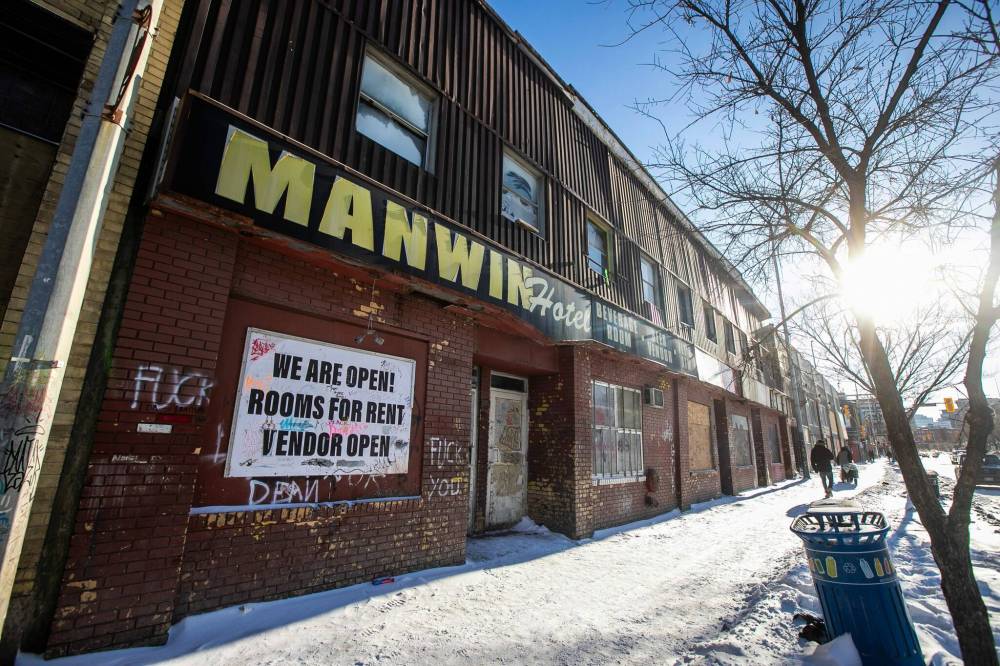
MIKAELA MACKENZIE / FREE PRESS FILES
The hotel occupied its spot on Main Street since 1889.Her death, lonely, unknown, further calcified the sadness that hung over the Manwin for so much of its life. It was a visual testament to a city that cannot safely hold all who live in it; a city with too much suffering, and too many gaps in the safety net, to catch those most at risk before they tumble towards oblivion.
Probably, there was no salvaging a place that sat under such heavy shadow. The hotel had been up for sale recently, but it was in bad shape; the building may have been a survivor of history, but it was also too much a testament to the worst arcs that history had taken to generate any sympathy.
So now the Manwin is gone, and nobody will truly miss it. It’s been over a year since its last three-dozen residents were evicted when the city shut it down for health violations, though community members had seen signs of people entering through the open back door, searching for shelter.
Hopefully, none were there at the time of the blaze. As of Thursday morning, rescue crews believe nobody was injured. But that makes it all the more bitter that, when the Manwin finally succumbed, the most painful consequence was that Main Street Project was forced to evacuate its shelter next door, leaving more vulnerable people scrambling to find a safe space from the cold.
Another void in the visual record of our history

We’ll leave it to inspectors to determine the cause of the fire. There have been so many like it, recently.
Maybe something will rise in its place. Something healthier, something restorative, something that helps build a stable life on that stretch of Main.
For now it’s just another wound on a street that long-ago bustled, another void in the visual record of our history.
Another missing piece of the Winnipeg that was: a city that had hope, a city people believed was the sort of place where you could build a life. A scar of those times, left to rot and at last, when no one could or would heal it, gone up in flames.
melissa.martin@freepress.mb.ca
Melissa Martin
Reporter-at-large
Melissa Martin reports and opines for the Winnipeg Free Press.
Every piece of reporting Melissa produces is reviewed by an editing team before it is posted online or published in print — part of the Free Press‘s tradition, since 1872, of producing reliable independent journalism. Read more about Free Press’s history and mandate, and learn how our newsroom operates.
Our newsroom depends on a growing audience of readers to power our journalism. If you are not a paid reader, please consider becoming a subscriber.
Our newsroom depends on its audience of readers to power our journalism. Thank you for your support.
Melissa Martin
Reporter-at-large
Melissa Martin reports and opines for the Winnipeg Free Press.
Every piece of reporting Melissa produces is reviewed by an editing team before it is posted online or published in print — part of the Free Press‘s tradition, since 1872, of producing reliable independent journalism. Read more about Free Press’s history and mandate, and learn how our newsroom operates.
Our newsroom depends on a growing audience of readers to power our journalism. If you are not a paid reader, please consider becoming a subscriber.
Our newsroom depends on its audience of readers to power our journalism. Thank you for your support.
Related Articles
Main Street Project’s buildings on either side of fire-destroyed Manwin Hotel ‘mostly intact,’ grateful agency director says


Advertisement Advertise With Us
Advertisement Advertise With Us