

Manitoba Grade 8 scores up but remain below national average

Advertisement
Read this article for free:
or
Already have an account? Log in here »
To continue reading, please subscribe:

Digital Subscription
One year of digital access for only $205*
- Enjoy unlimited reading on winnipegfreepress.com
- Read the E-Edition, our digital replica newspaper
- Access News Break, our award-winning app
- Play interactive puzzles
*First annual payment billed as $205.00 + GST for one year. This annual subscription will automatically renew at $233.00 + GST every 52 weeks (10% off the regular annual price of $259.35). Offer available to new and qualified returning subscribers only. Cancel any time.
To continue reading, please subscribe:
Add Free Press access to your Brandon Sun subscription for only an additional
$1 for the first 4 weeks*
- Enjoy unlimited reading on winnipegfreepress.com
- Read the E-Edition, our digital replica newspaper
- Access News Break, our award-winning app
- Play interactive puzzles
*Your next Brandon Sun subscription payment will increase by $1.00 and you will be charged $17.95 plus GST for four weeks. After four weeks, your payment will increase to $24.95 plus GST every four weeks.
Read unlimited articles for free today:
or
Already have an account? Log in here »
Hey there, time traveller!
This article was published 15/01/2026 (229 days ago), so information in it may no longer be current.
MANITOBA science scores are still lagging behind national averages, but local boys and girls have logged improvements over the last decade.
The latest results of the Pan-Canadian Assessment Program, a national initiative that tests real-world understanding of science, math and literacy at the end of Grade 8, was released this week.
The 2023 test focused on science, and students were assessed based on their ability to undertake scientific inquiry, problem solve and engage in scientific reasoning.
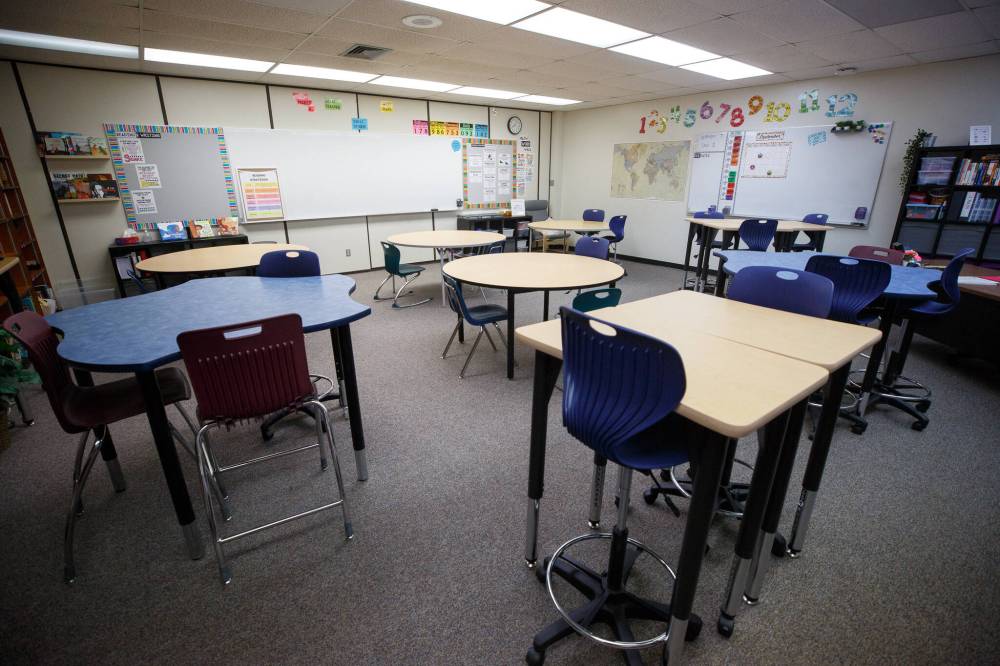
Free Press Files
Despite improved test results over the last decade, Manitoba boys’ and girls’ science scores are still lagging behind national averages.
“It’s about application — how you’re interpreting data, how you’re explaining information and how you’re utilizing whatever you’re learning in the classroom,” said Anju Bajaj, a Grade 7 and 8 science teacher at Holy Cross School in Winnipeg.
Roughly 31,500 youth from more than 1,400 schools in Canada took part in the online assessment at the end of the 2022-23 school year.
The Council of Ministers of Education develops and administers the tests, which yielded an average score of 501 in science.
In Manitoba, the average was 476 — up from 465 in 2013. The average boys’ score was up 11 points, while the average girls score was up 10 points during that period.
While Bajaj said things appear to be moving in the right direction, she was hesitant to celebrate the results.
The results showed students are struggling with problem solving compared to inquiry and reasoning. The trend signals challenges in students’ ability to apply scientific knowledge in unfamiliar and real-world contexts, Bajaj said.
Bajaj said she’d like to see the province mandate participation in science fairs and renew an emphasis on experimentation to cultivate curiosity, resilience and critical thinking.
Manitoba students performed the best in the nature of sciences area, followed by life sciences, earth sciences and physical sciences.
The Pan-Canadian Assessment Program is scheduled every three years with a rotating subject. The 2023 test was delayed one year, owing to COVID-19 disruptions.
The participants were sorted into four levels depending on their scores, with Level 2 the equivalent of grade-level expectations.
On a national scale, 89 per cent of test-takers were meeting baseline benchmarks, meaning they understand the steps involved in a valid experiment and basic data collection.
The percentage of Manitoba participants at Level 2 or above was 83 per cent.
Alberta, Ontario, Quebec, B.C., Prince Edward Island and Nova Scotia all outperformed Manitoba, with at or above grade-level averages ranging from 91 per cent to 85 per cent.
Eight per cent of Manitoba students attained the highest level, compared to 12 per cent of Canadian students.
There were also more students below grade-level in Manitoba — 17 per cent were sorted into Level 1 — versus Canada at large. Overall, 11 per cent of students were not meeting expectations for Grade 8 in 2023.
Anna Stokke, a professor of mathematics at the University of Winnipeg, suggested more attention needs to be placed on helping struggling students get up to speed.
“Once you start decreasing the share of struggling learners, it should really lift everybody up because then teachers can focus on higher levels of knowledge of whatever they’re teaching,” Stokke said.

The education department is reviewing the results.
As far as Education Minister Tracy Schmidt is concerned, the test’s findings highlight students’ ongoing hard work and resilience.
“Reflecting on those results, I’m glad to see that Manitoba students are starting to rebound after the effects of the pandemic,” Schmidt said.
Manitoba is in the process of overhauling its kindergarten-to-Grade 10 science curriculum.
maggie.macintosh@freepress.mb.ca
Maggie Macintosh
Education reporter
Maggie Macintosh reports on education for the Free Press. Originally from Hamilton, Ont., she first reported for the Free Press in 2017. Read more about Maggie.
Funding for the Free Press education reporter comes from the Government of Canada through the Local Journalism Initiative.
Every piece of reporting Maggie produces is reviewed by an editing team before it is posted online or published in print — part of the Free Press‘s tradition, since 1872, of producing reliable independent journalism. Read more about Free Press’s history and mandate, and learn how our newsroom operates.
Our newsroom depends on a growing audience of readers to power our journalism. If you are not a paid reader, please consider becoming a subscriber.
Our newsroom depends on its audience of readers to power our journalism. Thank you for your support.
Maggie Macintosh
Education reporter
Maggie Macintosh reports on education for the Free Press. Originally from Hamilton, Ont., she first reported for the Free Press in 2017. Read more about Maggie.
Funding for the Free Press education reporter comes from the Government of Canada through the Local Journalism Initiative.
Every piece of reporting Maggie produces is reviewed by an editing team before it is posted online or published in print — part of the Free Press‘s tradition, since 1872, of producing reliable independent journalism. Read more about Free Press’s history and mandate, and learn how our newsroom operates.
Our newsroom depends on a growing audience of readers to power our journalism. If you are not a paid reader, please consider becoming a subscriber.
Our newsroom depends on its audience of readers to power our journalism. Thank you for your support.
Related Articles
Manitoba needs ‘scientific talent strategy’: open letter
Advertisement Advertise With Us
Advertisement Advertise With Us