

Building blocks: the history behind four historic downtown buildings set for redevelopment

Advertisement
Read this article for free:
or
Already have an account? Log in here »
To continue reading, please subscribe:

Digital Subscription
One year of digital access for only $205*
- Enjoy unlimited reading on winnipegfreepress.com
- Read the E-Edition, our digital replica newspaper
- Access News Break, our award-winning app
- Play interactive puzzles
*First annual payment billed as $205.00 + GST for one year. This annual subscription will automatically renew at $233.00 + GST every 52 weeks (10% off the regular annual price of $259.35). Offer available to new and qualified returning subscribers only. Cancel any time.
To continue reading, please subscribe:
Add Free Press access to your Brandon Sun subscription for only an additional
$1 for the first 4 weeks*
- Enjoy unlimited reading on winnipegfreepress.com
- Read the E-Edition, our digital replica newspaper
- Access News Break, our award-winning app
- Play interactive puzzles
*Your next Brandon Sun subscription payment will increase by $1.00 and you will be charged $17.95 plus GST for four weeks. After four weeks, your payment will increase to $24.95 plus GST every four weeks.
Read unlimited articles for free today:
or
Already have an account? Log in here »
Hey there, time traveller!
This article was published 27/01/2026 (245 days ago), so information in it may no longer be current.
As city and industry leaders prepare for a massive revitalization effort in downtown Winnipeg, the Free Press looked back on the histories of four vacant and underutilized historical properties now slated for residential development.
The following information was compiled through conversations with Manitoba Historical Society head researcher and acting executive director Gordon Goldsborough, Heritage Winnipeg executive director Cindy Tugwell and a review of historical records prepared by the City of Winnipeg’s Historical Buildings Committee.
The St. Charles Hotel, 235 Notre Dame Ave.
Opening in 1913 at the corner of Albert Street and Notre Dame Avenue, the St. Charles Hotel stood in what was then a bustling commercial district, surging with businesses and warehouses that made it a central hub on the Canadian Prairies.
Its location made it a premier landing spot for travelling salespeople and industry leaders eyeing Winnipeg as a potential home for development and trade, Manitoba Historical Society head researcher and acting executive director Gordon Goldsborough said.
“It would have been a very busy place given its location — a very strategic spot,” he said.
“It is symptomatic of a time in Winnipeg’s history when it was just buzzing. When people were coming and going, staying in hotels because they were here for some purpose or other, so that’s an exciting example of what was going on in Winnipeg a little over 100 years ago.”
MIKE DEAL / FREE PRESS The St. Charles Hotel at 235 Notre Dame Ave. has sat vacant since 2008.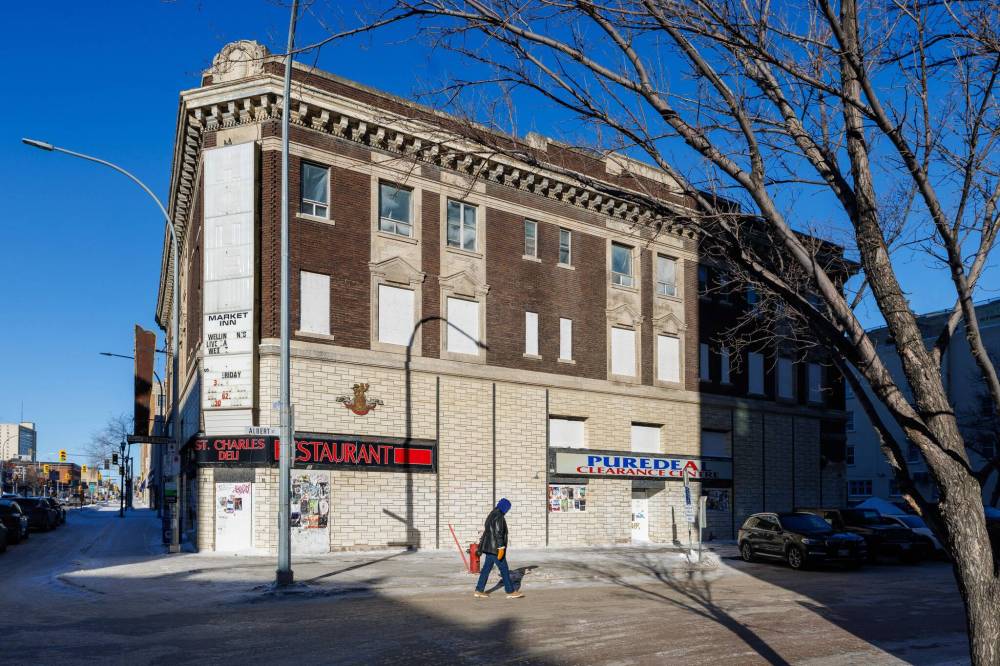
A 1985 Historical Buildings Committee report notes the building was erected at a cost of $122,000 by Charles McCarrey, who also owned the former St. Regis Hotel, which once stood on Smith Street. Construction took place over a three-month period, and featured reinforced concrete with masonry cladding.
In the early days, the hotel included a rotunda, office, kitchens and an elegant dining room on the first floor. For years, it served lunches and dinners from a restaurant known as the Empire Grill, which rivaled dining rooms in the Fort Garry and Marlborough hotels, the report notes.
Ownership changed hands several times throughout the decades and the St. Charles underwent a major renovation in 1965, when the dining room was eliminated and replaced with a beer parlour. A coffee shop was also introduced, and the rotunda was diminished.
The beverage room became the principal feature of the building, “thereby shifting the function and the clientele of the hotel,” the report notes.
The exterior facade was updated in 1967 to cover much of the ground floor with white tile sheeting. The property’s upper stories remain largely untouched on the outside.
The building has sat vacant since 2008. Over the years, plans to refurbish the property into a boutique hotel or affordable housing have surfaced, but never materialized, said owner Ken Zaifman.
Maw’s Garage and the Sanford Building, 291 Bannatyne Ave.
It’s difficult to imagine a time before cars, trucks and SUVs dominated Winnipeg roadways, but when Joseph Maw began construction of his namesake garage in 1906, automobiles were just beginning to proliferate the Manitoba capital.
Maw, who made his living as a carriage retailer, was one of the forefathers of the city’s automotive industry, and built the garage and showroom on Bannatyne Avenue in response to the growing demand for auto sales and services, said Goldsborough.
MIKAELA MACKENZIE / FREE PRESS The MAWS Garage and the Sanford building features a steel truss design that allowed for a large, open space.
Nearly 120 years later, the single-storey concrete, brick and steel building stands as a testament to Maw’s foresight.
“Today we live in car culture, and it seems that nobody wants to consider anything as a means of transportation except a vehicle with four wheels… but the reality is that culture wasn’t always the case,” Goldsborough said.
“Having a building that symbolizes that transition is, I think, an interesting statement.”
The former garage features a steel truss design, that allowed for a large, open space.
It is connected to the Sanford Building, which faces Princess Street.
NORTHERN SKY ARCHITECTURE A rendering of MAWS Garage and Sanford Building redevelopment at 291 Bannatyne Ave. 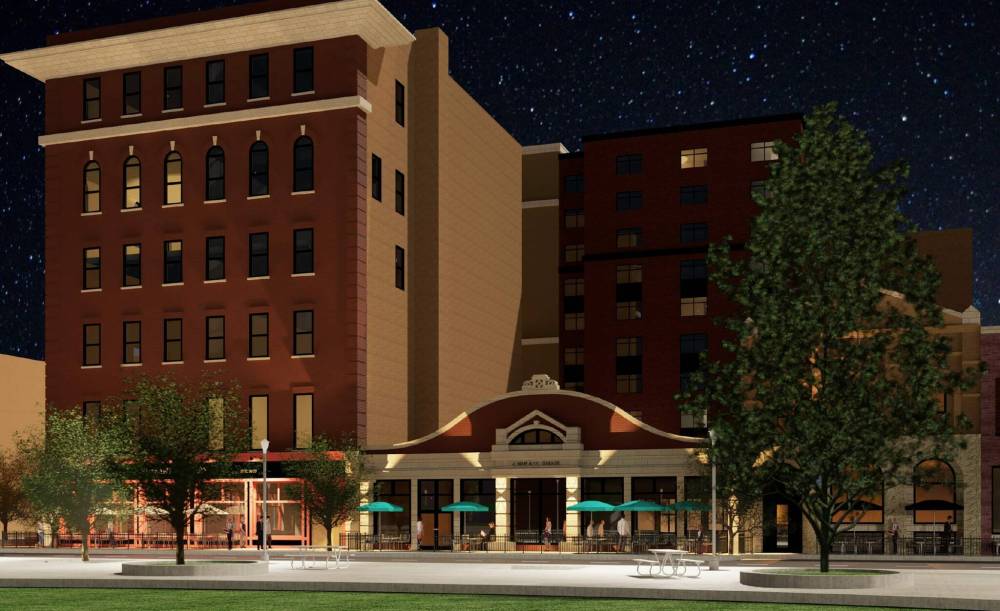
The building was constructed for clothing manufacturer W.E. Sanford Manufacturing Co. in 1890. It stood as a four-storey warehouse and office space until 1941, when a fire destroyed the building’s upper levels, according to a Historical Buildings Committee report from 1979.
After the fire, the building was restored to a single storey. It became home to the Old Spaghetti Factory Restaurant in 1970, and numerous other businesses later occupied the space.
Most recently, it operated as the Exchange Event Centre, which was severely damaged in a pair of arsons last summer.
Alloway Building, 179 McDermot Ave.
Built in 1898 by Winnipeg banker William Forbes Alloway, the Alloway building is “an integral part of the historical, social and cultural fabric of our great city,” said Cindy Tugwell, executive director of Heritage Winnipeg.
Alloway, who was co-founder of a private bank, built the three-storey, brick and stone building as a revenue property. It was home to the C. S. Richardson Stationery and Manufacturing Company for a decade, and later occupied by a commission agency, a kitchen equipment store and a tea blending company, the Manitoba Historical Society said.
MIKAELA MACKENZIE / FREE PRESS The Alloway Building at 179 McDermot Ave. was built by banker William Forbes Alloway as a revenue property.
A report prepared by the Historical Buildings Committee in 1985 notes the property suffered fires in 1907 and 1919, and later housed the Star Electric Company, an electrical wholesaler, in the 1920s and 1930s. Several smaller warehouses operated from the building until the early 1970s, when each floor was renovated into office space.
Alloway, who became a millionaire, used a portion of his fortune to create the Winnipeg Foundation in 1921.
The foundation was the first of its kind in Canada. It has supported many charitable organizations and initiatives over the past century, and put Winnipeg on the map as a national bastion of philanthropy, Tugwell said.
Garry Block, 290 Garry St.
Garry Block, formerly known as the Belgica Block, was raised on the west side of Garry Street on behalf of the Mortgage Company of Canada in 1911.
Construction of the four-storey office building cost $7,200, and it is situated between Portage and Graham avenues. The concrete-steel design is based on classical architecture and features pedestals, columns and entablatures.
MIKAELA MACKENZIE / FREE PRESS The Gary Block's concrete-steel design is based on classical architecture and features pedestals, columns and entablatures.
Like many of Winnipeg’s heritage buildings, Garry Block was built to the highest standards, said Tugwell.
“A large misconception is that a heritage building is just an old building, but what people have to understand these buildings were built with stone foundations, concrete walls, massive timbers and decorative facades that we will never see again in anyone’s lifetime,” she said.
Numerous tenants occupied the building alongside the Mortgage Company over the decades, including financial institutions, real estate and insurance companies, lawyers and the Belgian Consulate. The Mortgage Company remained at the building until 1955. It underwent renovations in the 1960s, ‘70s and ’80s, including in 1981 by the Winnipeg Sun.
It was later owned by a pair of surgeons, who practised medicine and converted the building into offices, a Historical Buildings Committee report from 1988 says.
tyler.searle@freepress.mb.ca

Tyler Searle is a multimedia producer who writes for the Free Press’s city desk. A graduate of Red River College Polytechnic’s creative communications program, he wrote for the Stonewall Teulon Tribune, Selkirk Record and Express Weekly News before joining the paper in 2022. Read more about Tyler.
Every piece of reporting Tyler produces is reviewed by an editing team before it is posted online or published in print — part of the Free Press‘s tradition, since 1872, of producing reliable independent journalism. Read more about Free Press’s history and mandate, and learn how our newsroom operates.
Our newsroom depends on a growing audience of readers to power our journalism. If you are not a paid reader, please consider becoming a subscriber.
Our newsroom depends on its audience of readers to power our journalism. Thank you for your support.
Tyler Searle is a multimedia producer who writes for the Free Press’s city desk. A graduate of Red River College Polytechnic’s creative communications program, he wrote for the Stonewall Teulon Tribune, Selkirk Record and Express Weekly News before joining the paper in 2022. Read more about Tyler.
Every piece of reporting Tyler produces is reviewed by an editing team before it is posted online or published in print — part of the Free Press‘s tradition, since 1872, of producing reliable independent journalism. Read more about Free Press’s history and mandate, and learn how our newsroom operates.
Our newsroom depends on a growing audience of readers to power our journalism. If you are not a paid reader, please consider becoming a subscriber.
Our newsroom depends on its audience of readers to power our journalism. Thank you for your support.
Related Articles
‘Investment we need’: mayor announces proposal to turn Marlborough Hotel into housing

Advertisement Advertise With Us
Advertisement Advertise With Us
History
Updated on Wednesday, January 28, 2026 9:09 AM CST: Corrects building cost to $7,200
Updated on Wednesday, January 28, 2026 10:50 AM CST: Corrects title of Gordon Goldsborough