

RRC to grant staff bereavement leave for non-blood relations

Advertisement
Read this article for free:
or
Already have an account? Log in here »
To continue reading, please subscribe:

Digital Subscription
One year of digital access for only $205*
- Enjoy unlimited reading on winnipegfreepress.com
- Read the E-Edition, our digital replica newspaper
- Access News Break, our award-winning app
- Play interactive puzzles
*First annual payment billed as $205.00 + GST for one year. This annual subscription will automatically renew at $233.00 + GST every 52 weeks (10% off the regular annual price of $259.35). Offer available to new and qualified returning subscribers only. Cancel any time.
To continue reading, please subscribe:
Add Free Press access to your Brandon Sun subscription for only an additional
$1 for the first 4 weeks*
- Enjoy unlimited reading on winnipegfreepress.com
- Read the E-Edition, our digital replica newspaper
- Access News Break, our award-winning app
- Play interactive puzzles
*Your next Brandon Sun subscription payment will increase by $1.00 and you will be charged $17.95 plus GST for four weeks. After four weeks, your payment will increase to $24.95 plus GST every four weeks.
Read unlimited articles for free today:
or
Already have an account? Log in here »
Hey there, time traveller!
This article was published 27/01/2026 (257 days ago), so information in it may no longer be current.
Red River College Polytechnic employees can now take paid time off to mourn a non-blood relative who is akin to family to them.
Union and post-secondary leaders celebrated that change, among others that came out of their new, reconciliation-forward approach to contract talks, on Monday.
“There’s a Western view that your family is who you’re related to by blood and that’s all — and that’s not how it works, at least not in my community,” said Monica Lytwyn, co-chair of RRC Polytech’s truth and reconciliation working group.

WAYNE GLOWACKI / FREE PRESS FILES
Recent contract talks have gained Red River College Polytechnic employees the ability to take paid time off to mourn a non-blood relative who is akin to family to them.
“Your relatives aren’t always blood relatives and sometimes, your cousin is raised as a sibling or someone who lives next door to you might become like a sibling.”
Lytwyn, a member of Norway House Cree Nation, said her workplace’s broadened definition of “family” is a huge point of pride.
She helped draft it, as a member of a committee formed in 2023 to advance truth and reconciliation in labour relations.
The group’s contribution to a newly ratified deal was celebrated with drumming and a midday feast at Manitou a bi Bii daziigae in the Exchange District.
The Manitoba Government and General Employees’ Union Local 73 represents about 1,800 staff members at RRC Polytech.
MGEU and RRC Polytech came to an agreement in 2021-25 that included a written land acknowledgement for the first time.
It outlined their commitment “to a renewed relationship and dialogue with First Nations, Métis, and Inuit peoples based on the principles of mutual trust, respect and reciprocity.”
Acting on that pledge, the parties approached an elder to guide a comprehensive review of the agreement.
“The inclusion of Indigenous worldview brought about changes in our thought processes and changes to wording and you know what? It benefits all. It benefits everyone,” Barbara Bruce told a crowd on Monday.
Bruce shared teachings with a working group that brought forward 21 recommendations to the bargaining teams, nearly all of which were adopted, last year.
At their suggestion, the new agreement, which spans 2025-28, removes binary pronouns and parental language, introduces an inclusive definition of family and reframes health as a more holistic concept.
Employees have earned two days per year to participate in ceremonial, cultural, religious or spiritual events. Another new bonus for members is two new days of “wellness leave.”
Bruce said she’s confident the inclusive language in this document will allow more workers to see themselves reflected in it.
Members could previously only access five days of paid leave to mourn the death of a parent, spouse or child.
That support has been expanded for anyone who loses a sibling, someone they live with, or a legal guardian or ward.
The eligibility for a three-day leave was also broadened to include the loss of a parent’s sibling or a sibling’s child, as well as grandparent or grandchild deaths.
If an employee loses someone they consider to be a “comparable” figure in their life, they are now eligible for up to three days of bereavement leave.
Labour studies researcher Adam King has been reviewing union contracts across Canada to better understand how unions are embracing Indigenous rights provisions.
MAGGIE MACINTOSH / FREE PRESS
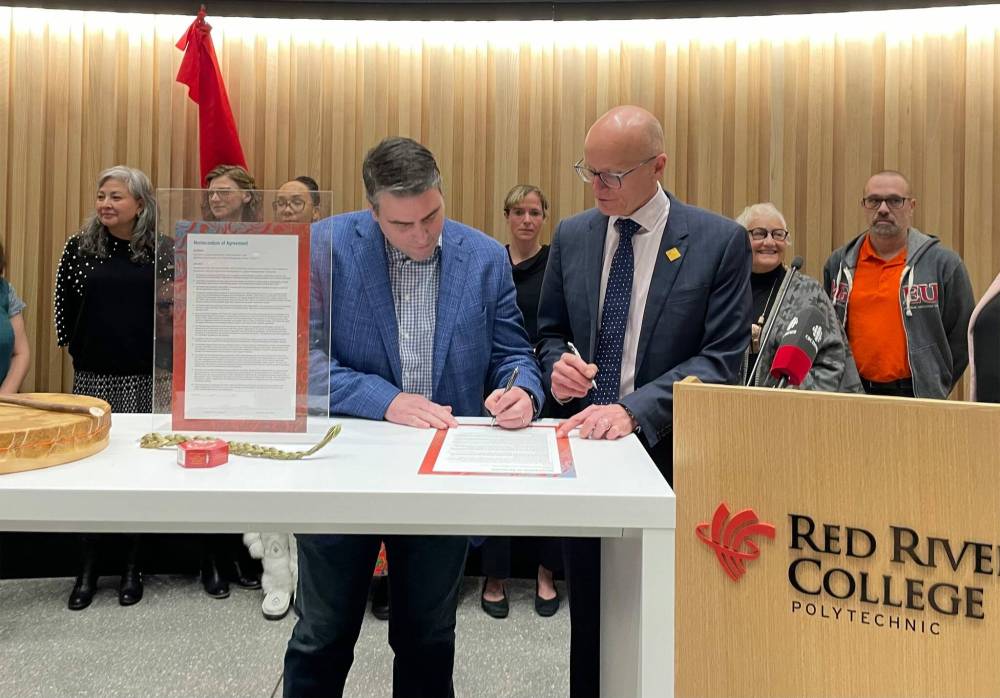
Union leader Kyle Ross and Fred Meier, president of Red River College Polytechnic, signed a memorandum of agreement to carry out a new bargaining tradition on Monday.
There’s growing interest in expanding access to paid leaves, recognizing cultural practises and including elders in grievance processes, said King, an assistant professor at the University of Manitoba.
He applauded RRC Polytech’s approach to embrace “relationality” in the new agreement.
“These changes around leaves are taking a more relational approach — it’s very important to Indigenous culture, but also to many other workers who are not in your standard, normative, nuclear family-style relationship,” the academic said.
The new contract states that bereavement leave of all kinds applies to foster and step-relationships, as well as in-laws. Married and common-law employees are both eligible.
Lytwyn recalled how disheartening it was to be required to take vacation time to attend the funeral of her husband’s grandmother earlier in her career.
It’s hard enough to be grappling with grief, she said, noting that she felt misunderstood and undervalued by her then-employer.
“(These changes) will lessen some stress between management and employees, and open people up to be able to recognize special relationships that aren’t blood (related),” said Amy Brown, a staff negotiator at MGEU.
Brown said she’s hopeful these “really significant” changes will set a precedent for other unions in Manitoba.
MGEU president Kyle Ross and Fred Meier, chief executive officer of the post-secondary institute, reaffirmed their shared commitment to bargaining differently on Monday.

The duo signed a memorandum of agreement to continue to be guided by an Indigenous elder and reflect on the contents of the new contract.
“Truth and reconciliation can find its way into processes that we normally don’t think truth and reconciliation fit,” Meier said.
The school leader said his hope is these changes and new processes make his campus a more welcoming and attractive employer.
Roughly nine per cent of RRC Polytech’s workforce self-identifies as Indigenous. Its leadership has set a target of hiring 50 Indigenous employees per year over the next five years.
maggie.macintosh@freepress.mb.ca
Maggie Macintosh
Education reporter
Maggie Macintosh reports on education for the Free Press. Originally from Hamilton, Ont., she first reported for the Free Press in 2017. Read more about Maggie.
Funding for the Free Press education reporter comes from the Government of Canada through the Local Journalism Initiative.
Every piece of reporting Maggie produces is reviewed by an editing team before it is posted online or published in print — part of the Free Press‘s tradition, since 1872, of producing reliable independent journalism. Read more about Free Press’s history and mandate, and learn how our newsroom operates.
Our newsroom depends on a growing audience of readers to power our journalism. If you are not a paid reader, please consider becoming a subscriber.
Our newsroom depends on its audience of readers to power our journalism. Thank you for your support.
Maggie Macintosh
Education reporter
Maggie Macintosh reports on education for the Free Press. Originally from Hamilton, Ont., she first reported for the Free Press in 2017. Read more about Maggie.
Funding for the Free Press education reporter comes from the Government of Canada through the Local Journalism Initiative.
Every piece of reporting Maggie produces is reviewed by an editing team before it is posted online or published in print — part of the Free Press‘s tradition, since 1872, of producing reliable independent journalism. Read more about Free Press’s history and mandate, and learn how our newsroom operates.
Our newsroom depends on a growing audience of readers to power our journalism. If you are not a paid reader, please consider becoming a subscriber.
Our newsroom depends on its audience of readers to power our journalism. Thank you for your support.
Related Articles
Union would like to see further expansion of bereavement rules
Advertisement Advertise With Us
Advertisement Advertise With Us