

‘It’s the gift of time,’ teacher says
Full-day kindergarten returning to city’s largest school division in the fall

Advertisement
Read this article for free:
or
Already have an account? Log in here »
To continue reading, please subscribe:

Digital Subscription
One year of digital access for only $205*
- Enjoy unlimited reading on winnipegfreepress.com
- Read the E-Edition, our digital replica newspaper
- Access News Break, our award-winning app
- Play interactive puzzles
*First annual payment billed as $205.00 + GST for one year. This annual subscription will automatically renew at $233.00 + GST every 52 weeks (10% off the regular annual price of $259.35). Offer available to new and qualified returning subscribers only. Cancel any time.
To continue reading, please subscribe:
Add Free Press access to your Brandon Sun subscription for only an additional
$1 for the first 4 weeks*
- Enjoy unlimited reading on winnipegfreepress.com
- Read the E-Edition, our digital replica newspaper
- Access News Break, our award-winning app
- Play interactive puzzles
*Your next Brandon Sun subscription payment will increase by $1.00 and you will be charged $17.95 plus GST for four weeks. After four weeks, your payment will increase to $24.95 plus GST every four weeks.
Read unlimited articles for free today:
or
Already have an account? Log in here »
Hey there, time traveller!
This article was published 06/02/2026 (227 days ago), so information in it may no longer be current.
Manitoba’s largest school division is bringing back full day, every day kindergarten in the fall.
Four years after scaling back early years options, the Winnipeg School Division — now under new leadership — has confirmed the U-turn.
Chief superintendent Matt Henderson said he’s “not convinced” an internal study used to justify cuts in 2022 was afforded the time or energy it required to be conclusive.
Ruth Bonneville / Free Press
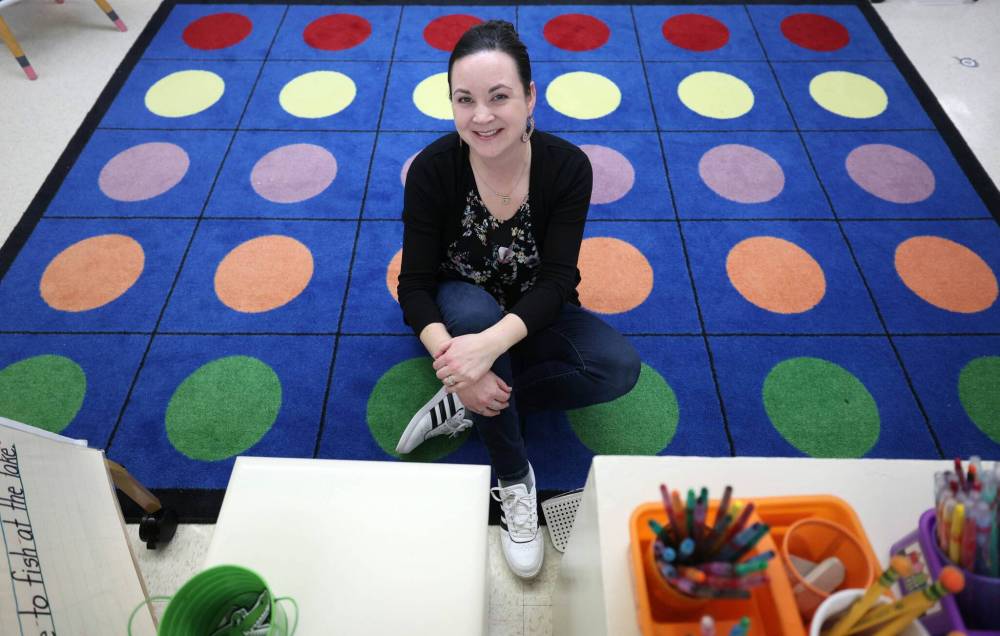
Kindergarten teacher Tashina Broughton, in her classroom at Frontenac, switched to the Louis Riel School Division job when the Winnipeg School Division switched from full to half-days.
The results zoned in on academics rather than holistic benefits, such as how full-time instruction builds a young student’s confidence and gives parents more flexibility to work, he said.
“Full-day kindergarten will better prepare learners moving forward, particularly those children who are negatively impacted by poverty,” said Henderson, who oversees 30,000 students, roughly 2,000 of whom are kindergartners.
All inner-city and central schools currently offer the introductory level in morning or afternoon slots.
Starting in 2026-27, the division will host kindergartners at six sites for the entire instructional week.
Henderson declined to release a list of names, owing to the fact that families have yet to be notified.
Formal announcements are expected before registration opens to new students on Feb. 17.
The superintendent said schools were selected based on socioeconomic factors and available space, as well as support from on-site childcare partners.
One of the goals is to improve attendance rates, given absenteeism is highest in kindergarten and Grade 12 classrooms, he said.
“When it’s -30 C out, it’s very difficult to bundle up a number of children to go just for a two-hour experience. We’ve heard that loud and clear,” Henderson added.
The cost of the rollout is estimated at $300,000. Certified teachers and clinicians will support its delivery.
The changes will increase kindergarten, where play-based education is at the core of the curriculum, from 21/2 hours to 51/2 hours per day.
The announcement mirrors one the division made in 2013.
Prior to June 2022, it was running full-time kindergarten at 11 sites — John M. King, Norquay, Strathcona, Wellington, Harrow, Fort Rouge, Earl Grey, Mulvey, Shaughnessy Park, Lord Selkirk and William Whyte.
At the time, senior administration defended its decision to wind down operations, citing research showing part-time and full-time kindergarten students were achieving similar outcomes by the end of Grade 2.
Kaplan Research Associates was tapped to evaluate student report cards, social and emotional development indicators and attendance rates.
The firm followed groups of children from similar demographic groups, between 2015-16 and 2018-19. Grade 3 statistics were deemed unusable due to high attrition.
A summary indicates full-timers made “early gains,” on their report cards and were attending classes more regularly in 2015. However, the differences between the groups were essentially nonexistent two years later.
In addition to data analysis, researchers sought school staffers’ feedback and polled parents on their satisfaction levels.
While 89 per cent of parents of full-timers reported being “very satisfied” with the program, 66 per cent of guardians in the other group answered the same way.
Teachers focus groups revealed staff felt students with low self-esteem, behavioural challenges and newcomers benefited most from the full-time option. Administrators reported that students who spent more time in class were demonstrating “more positive school behaviours.”
Kindergarten teacher Tashina Broughton said she was elated to learn her former employer is revisiting full-time kindergarten.
“I believe so strongly in it that I left,” said Broughton, who currently teaches at Frontenac School in the Louis Riel School Division.
Her current employer is the only one in Winnipeg, aside from the francophone division, that offers universal full-day kindergarten.
“It’s a gift of time. Because you’re with students, all day, every day, you get to know them more and you can change your programming around their specific needs,” Broughton said.
Teachers are far less rushed to squeeze in curriculum and have more time to do in-depth inquiry projects, she said.
At the same time, Broughton said students benefit from lots of one-on-one time with their teacher by establishing school routines and interacting with other children.
Broughton touted the ability to spend extensive time doing land-based learning with her students.
Following the first year of universal full-time kindergarten, her division surveyed 375 parents about their experiences.
Eight in 10 indicated they had “very positive” feelings about the program last year. About 68 per cent of respondents indicated the model made scheduling easier for them.
“This is going to provide a lot of stress relief for the families in (the chosen) schools,” said Tracy Rose-Laporte, a grandmother in the Winnipeg School Division.

Rose-Laporte recalled how challenging it was to co-ordinate childcare coverage when she was juggling kindergarten and Grade 1 schedules at Inkster School several years ago.
She urged the division to make full-day kindergarten universal in the future.
Henderson said his office’s plan is to expand “slowly and responsibly.”
Kindergarten remains optional for all five-year-olds — students can register to begin this fall if their fifth birthday is before Dec. 31 — in Manitoba.
maggie.macintosh@freepress.mb.ca
Maggie Macintosh
Education reporter
Maggie Macintosh reports on education for the Free Press. Originally from Hamilton, Ont., she first reported for the Free Press in 2017. Read more about Maggie.
Funding for the Free Press education reporter comes from the Government of Canada through the Local Journalism Initiative.
Every piece of reporting Maggie produces is reviewed by an editing team before it is posted online or published in print — part of the Free Press‘s tradition, since 1872, of producing reliable independent journalism. Read more about Free Press’s history and mandate, and learn how our newsroom operates.
Our newsroom depends on a growing audience of readers to power our journalism. If you are not a paid reader, please consider becoming a subscriber.
Our newsroom depends on its audience of readers to power our journalism. Thank you for your support.
Maggie Macintosh
Education reporter
Maggie Macintosh reports on education for the Free Press. Originally from Hamilton, Ont., she first reported for the Free Press in 2017. Read more about Maggie.
Funding for the Free Press education reporter comes from the Government of Canada through the Local Journalism Initiative.
Every piece of reporting Maggie produces is reviewed by an editing team before it is posted online or published in print — part of the Free Press‘s tradition, since 1872, of producing reliable independent journalism. Read more about Free Press’s history and mandate, and learn how our newsroom operates.
Our newsroom depends on a growing audience of readers to power our journalism. If you are not a paid reader, please consider becoming a subscriber.
Our newsroom depends on its audience of readers to power our journalism. Thank you for your support.
Related Articles
Full-time kindergarten backed by Manitoba trustees



Advertisement Advertise With Us
Advertisement Advertise With Us