

Report sheds light on critical incidents in Manitoba health care

Advertisement
Read this article for free:
or
Already have an account? Log in here »
To continue reading, please subscribe:

Digital Subscription
One year of digital access for only $205*
- Enjoy unlimited reading on winnipegfreepress.com
- Read the E-Edition, our digital replica newspaper
- Access News Break, our award-winning app
- Play interactive puzzles
*First annual payment billed as $205.00 + GST for one year. This annual subscription will automatically renew at $233.00 + GST every 52 weeks (10% off the regular annual price of $259.35). Offer available to new and qualified returning subscribers only. Cancel any time.
To continue reading, please subscribe:
Add Free Press access to your Brandon Sun subscription for only an additional
$1 for the first 4 weeks*
- Enjoy unlimited reading on winnipegfreepress.com
- Read the E-Edition, our digital replica newspaper
- Access News Break, our award-winning app
- Play interactive puzzles
*Your next Brandon Sun subscription payment will increase by $1.00 and you will be charged $17.95 plus GST for four weeks. After four weeks, your payment will increase to $24.95 plus GST every four weeks.
Read unlimited articles for free today:
or
Already have an account? Log in here »
Hey there, time traveller!
This article was published 06/02/2026 (247 days ago), so information in it may no longer be current.
The failure to recognize and intervene when a patient’s health has deteriorated continues to be a leading cause of death and injury in Manitoba’s health-care system.
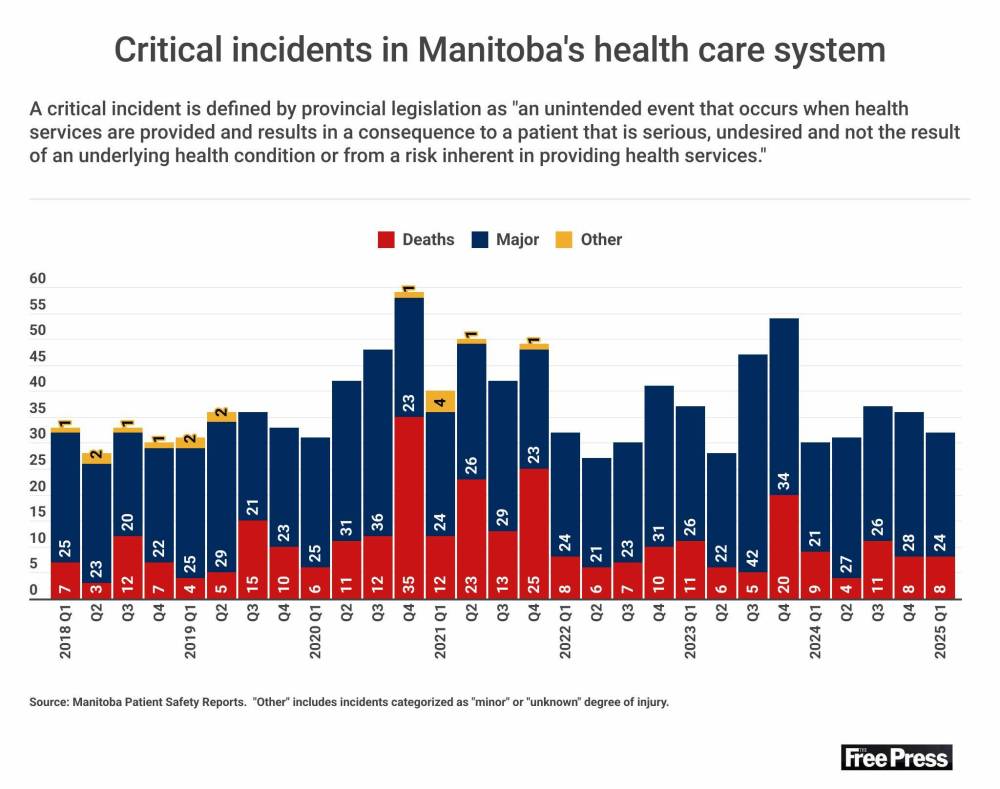
Eight people died and 24 others suffered major medical consequences between Jan. 1 and March 31 of 2025, says the province’s latest critical incident report. That’s a slight decline in the number of critical incidents compared to the final quarter of 2024, when Manitoba logged 28 major incidents and eight deaths.
The provincial nurses union said the chronic staffing shortage is a factor.

Mikaela MacKenzie / Free Press files
Manitoba Nurses Union president, Darlene Jackson: “One critical incident a year is too many.”
“One critical incident a year is too many, but I am just seeing more and more incidents that have to do with issues that are preventable, which tells me loud and clear that we do not have enough nurses to monitor and oversee our patients,” Manitoba Nurses Union president Darlene Jackson said.
“It’s all about having the adequate staff to be able to do those things that need to be done to ensure that patients are not deteriorating. Unfortunately, with staffing the way it is, that just doesn’t work.”
Manitoba legislation defines a critical incident as an unintended event that occurs when health services provided to a person result in a “serious and undesired” consequences, such as death, disability or injury, and does not result from the person’s underlying health condition or “from a risk inherent in providing the health services.”
Incidents in health-care settings, such as hospitals and personal care homes, lead to reviews that are intended to prevent similar incidents. The resulting quarterly reports provide brief or vague descriptions of each incident. They do not include details that could identify patients, staff or locations.
Health Minister Uzoma Asagwara said a critical incident can be attributed to “any number of variables” and it is important to keep that in mind when reading the report. In addition, the incident descriptions do not necessarily reflect all of the care provided to affected patients, the minister said.
“We just want to make sure that we encourage staff to participate in critical incident reviews. These are opportunities for them to share openly and safely, and confidently that what they have to say is going to be taken seriously and everybody in the system has the benefit of learning from that,” Asagwara said.
“Every single one of these critical incidents represents a family, a person who was affected, and we have to do right by them by making sure that we learn how to prevent that.”
The latest report says six patients died and six others were injured after staff failed to quickly identify and treat changes to their health status.
In other cases, “gaps in monitoring” led to a fatal fall, and a patient died after suffering a “clinical deterioration” following a delay in diagnostic evaluations, the report said.
Other injuries resulted from patients receiving the wrong medication or incorrect doses, suffering complications from medical procedures, and developing skin breakdowns or bedsores while in care.
One person sustained a serious burn from a baseboard heater, the report says.
Jackson said nurses are trained to keep a close eye on their patients and act quickly if their health takes a turn for the worse. However, high patient loads can limit their ability to provide the necessary oversight.
The union is advocating for minimum nurse-to-patient ratios — which would limit how many patients each nurse is be responsible for, based on the facility and unit in which they work, and their individual patient needs.
Some provinces have such ratios in place, and Asagwara has formed a committee to explore the potential of similar limits in Manitoba.
Jackson said the committee includes representatives from her union, Shared Health and the government. They spent 18 months developing recommendations for nurse-to-patient ratios and delivered a report to Asagwara’s office at the beginning of this year.
“We are just awaiting the minister’s review and response to it,” Jackson said. “We’ve developed those ratios, they’re out there, now we just need government approval and… resourcing and funding to ensure this happens.”
In addition to improving patient safety, minimum nurse-to-patient staffing ratios could improve recruitment and retention in the health system, Jackson said.

“Nurses will actually stay in a facility where they are providing safe, quality patient care without fear that a critical incident is going to occur,” she said.
Asagwara said the NDP government has committed to legislating the ratios and plans to introduce legislation in the next session.
The minister stressed health care vacancy rates have improved under the NDP government, but recruitment and retention remain a priority.
“It’s been made very, very clear to me that our effort to staff is having a positive impact,” Asagwara said. “We have to keep going, we cannot slow down.”
tyler.searle@freepress.mb.ca
Tyler Searle is a multimedia producer who writes for the Free Press’s city desk. A graduate of Red River College Polytechnic’s creative communications program, he wrote for the Stonewall Teulon Tribune, Selkirk Record and Express Weekly News before joining the paper in 2022. Read more about Tyler.
Every piece of reporting Tyler produces is reviewed by an editing team before it is posted online or published in print — part of the Free Press‘s tradition, since 1872, of producing reliable independent journalism. Read more about Free Press’s history and mandate, and learn how our newsroom operates.
Our newsroom depends on a growing audience of readers to power our journalism. If you are not a paid reader, please consider becoming a subscriber.
Our newsroom depends on its audience of readers to power our journalism. Thank you for your support.
Tyler Searle is a multimedia producer who writes for the Free Press’s city desk. A graduate of Red River College Polytechnic’s creative communications program, he wrote for the Stonewall Teulon Tribune, Selkirk Record and Express Weekly News before joining the paper in 2022. Read more about Tyler.
Every piece of reporting Tyler produces is reviewed by an editing team before it is posted online or published in print — part of the Free Press‘s tradition, since 1872, of producing reliable independent journalism. Read more about Free Press’s history and mandate, and learn how our newsroom operates.
Our newsroom depends on a growing audience of readers to power our journalism. If you are not a paid reader, please consider becoming a subscriber.
Our newsroom depends on its audience of readers to power our journalism. Thank you for your support.
Related Articles
Health-care ‘frustration’ keeps Manitoba nurse away
Advertisement Advertise With Us
Advertisement Advertise With Us