

Province eyes nurse-to-patient ratios
Plan key to retention but not enough nurses to meet demand: union

Advertisement
Read this article for free:
or
Already have an account? Log in here »
To continue reading, please subscribe:

Digital Subscription
One year of digital access for only $205*
- Enjoy unlimited reading on winnipegfreepress.com
- Read the E-Edition, our digital replica newspaper
- Access News Break, our award-winning app
- Play interactive puzzles
*First annual payment billed as $205.00 + GST for one year. This annual subscription will automatically renew at $233.00 + GST every 52 weeks (10% off the regular annual price of $259.35). Offer available to new and qualified returning subscribers only. Cancel any time.
To continue reading, please subscribe:
Add Free Press access to your Brandon Sun subscription for only an additional
$1 for the first 4 weeks*
- Enjoy unlimited reading on winnipegfreepress.com
- Read the E-Edition, our digital replica newspaper
- Access News Break, our award-winning app
- Play interactive puzzles
*Your next Brandon Sun subscription payment will increase by $1.00 and you will be charged $17.95 plus GST for four weeks. After four weeks, your payment will increase to $24.95 plus GST every four weeks.
Read unlimited articles for free today:
or
Already have an account? Log in here »
Hey there, time traveller!
This article was published 14/02/2026 (232 days ago), so information in it may no longer be current.
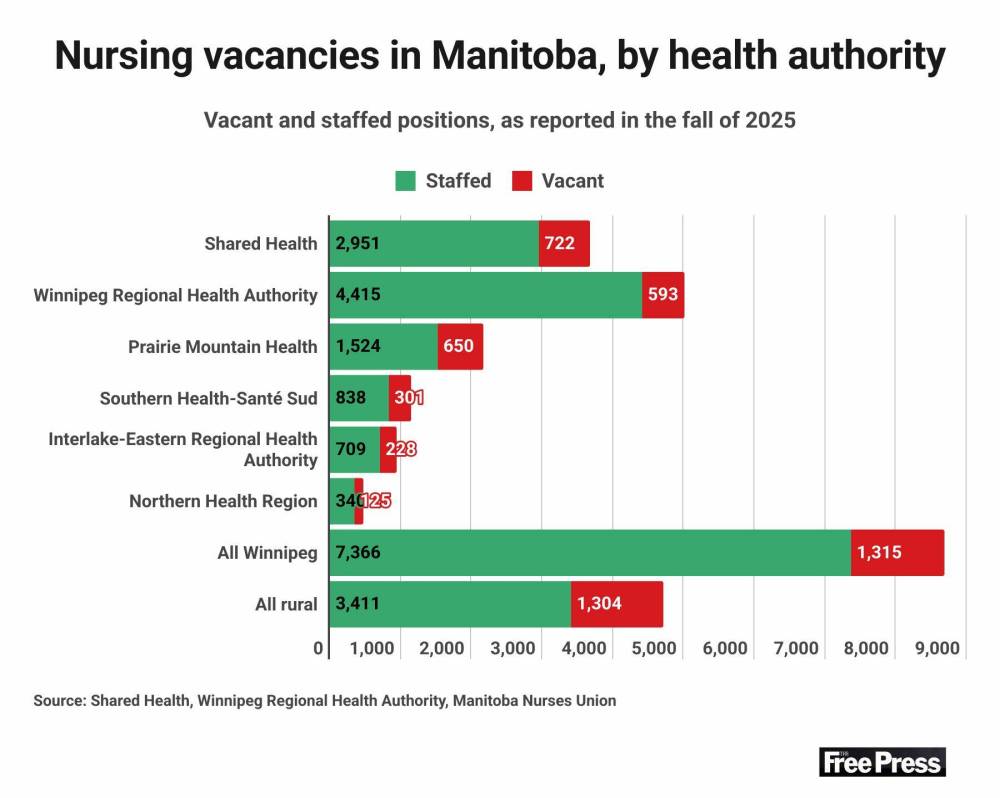
AS Manitoba ponders a plan to establish nurse-to-patient ratios to make staffing levels safer, the province is plagued by nurse vacancy rates as high as 50 per cent at some sites.
“How are we going to meet nurse-patient ratios when we don’t have enough nurses?” Manitoba Nurses Union president Darlene Jackson said as she paraphrased what members at one rural health care facility told her this week. They support the initiative to limit the number of patients per nurse, but doubt it is achievable given the staffing crunch.
“That’s where we are right now,” said Jackson.

MIKAELA MACKENZIE / FREE PRESS FILES
Manitoba is plagued by nurse vacancy rates as high as 50 per cent at some sites.
She shared nurse vacancy data from the fall, which was obtained from provincial health regions, that show vacancies as low at 11.8 per cent in the Winnipeg health region and as high as 29.9 per cent in Prairie Mountain, and 26.9 per cent in Northern Health.
At some sites in rural health regions, more than half of the nursing positions are vacant, including at hospitals in Dauphin and Thompson, Jackson said.
Prairie Mountain Health Region, which includes Dauphin, said it’s lowering its nurse vacancy rate, which was 28 per cent as of Friday.
“While PMH continues to experience vacancies across the region, we regularly review and adjust operations to support safe and reliable service delivery,” a spokesman for the region said in an email Friday. The region that’s relied on private agency nurses to fill the gaps is working with Shared Health and the provincial travel nurse team as an alternative to for-profit agency resources, he said.
As part of its recruitment strategy, PMH connects with agency nurses working in its facilities about the benefits of working within the public system and it encourages them to transition into permanent roles within the region, he said.
“Recruitment efforts to fill permanent positions continues, which will reduce the need for agency staffing over time.”
Prairie Mountain spent nearly $17.75 million on agency nursing from April 1 to Oct. 30, 2025.

MIKAELA MACKENZIE / FREE PRESS FILES
Manitoba Nurses Union president Darlene Jackson: “How are we going to meet nurse-patient ratios when we don’t have enough nurses?”
The region, which includes Brandon, Neepawa and Swan River, spent $28.6 million in 2023-24 and $25.1 million in 2022-23.
In January 2025, Health Minister Uzoma Asagwara ordered the region to reduce its spending on for-profit nurses by 15 per cent by March of 2026.
It is on target to meet that goal, the health region spokesman said Friday.
The province has relied on nurses from private agencies to fill the staffing gaps created across the province as over-worked, burned-out nurses left the public system during and after the COVID-19 pandemic. Many went to work for private agencies where there was no mandatory overtime and they could pick and choose when and where they wanted to work.
For the last four years, the province has moved toward building up a travel team of its own nurses in a public-system float pool to cover vacancies. It has hired 1,200 more nurses into the system.
Jackson said close to 730 nurses have joined the provincial travel team that has offered incentives and flexibility similar to that of the private agencies. Many who’ve joined the team had worked for private agencies, said Jackson, although she couldn’t provide a number.

The nurses advocated for shifting resources from for-profit agencies towards beefing up the public system. The union also called for nurse-to-patient ratios, and its latest collective agreement included the formation of a committee to recommend staffing levels that ensure patients receive safe care and enable nurses to deliver it.
“There’s only one province that really has established nurse-patient ratios, and that’s B.C.,” said Jackson.
The committee spent 18 months working on a plan that was presented to Health Minister Uzoma Asagwara on Dec. 22. Another meeting is set for March.
“We’re waiting for the ministry of health to review it and then hopefully we’re going to start rolling out nurse patient-ratios in this province,” Jackson said. It will help the public system attract and keep nurses, she said.
“I truly believe that once we start to implement nurse-patient ratios, it will be a big recruitment and retention tool. If you’re happy with your job and the care you can provide, there’s less chance you’ll pack up and move,” Jackson said.

Ratios are a practical step toward safer staffing levels, improved working conditions, and stronger retention, Asagwara said in an email Friday. The report is being reviewed and implementation planning is underway with system partners. More details on timelines will be shared as the work progresses, the minister said.
“Nurse-to-patient ratios are being developed as part of Manitoba’s broader strategy to strengthen and rebuild the nursing workforce after years of cuts and instability under the previous government, which created an over-reliance on private agencies to expand unchecked, driving bidding wars for shifts, increasing costs, and undermining workforce sustainability and patient safety,” Asagwara said.
The goal is to establish evidence-based and frontline-informed staffing standards that support safe, consistent care while helping to retain and attract nurses in the public system, the minister said.
“We are seeing measurable momentum back into the public system alongside early signs of improving vacancy trends,” they said. “In (Prairie Mountain Health region), nurse vacancy rates have begun trending downward as targeted recruitment, retention and travel team strategies take hold.”
carol.sanders@freepress.mb.ca
Carol Sanders
Legislature reporter
Carol Sanders is a reporter at the Free Press legislature bureau. The former general assignment reporter and copy editor joined the paper in 1997. Read more about Carol.
Every piece of reporting Carol produces is reviewed by an editing team before it is posted online or published in print — part of the Free Press‘s tradition, since 1872, of producing reliable independent journalism. Read more about Free Press’s history and mandate, and learn how our newsroom operates.
Our newsroom depends on a growing audience of readers to power our journalism. If you are not a paid reader, please consider becoming a subscriber.
Our newsroom depends on its audience of readers to power our journalism. Thank you for your support.
Carol Sanders
Legislature reporter
Carol Sanders is a reporter at the Free Press legislature bureau. The former general assignment reporter and copy editor joined the paper in 1997. Read more about Carol.
Every piece of reporting Carol produces is reviewed by an editing team before it is posted online or published in print — part of the Free Press‘s tradition, since 1872, of producing reliable independent journalism. Read more about Free Press’s history and mandate, and learn how our newsroom operates.
Our newsroom depends on a growing audience of readers to power our journalism. If you are not a paid reader, please consider becoming a subscriber.
Our newsroom depends on its audience of readers to power our journalism. Thank you for your support.
Related Articles
Unpredictable health-care costs a given, redundant health-system bureaucracy an unaffordable burden
Advertisement Advertise With Us
Advertisement Advertise With Us