

Unpredictable health-care costs a given, redundant health-system bureaucracy an unaffordable burden

Advertisement
Read this article for free:
or
Already have an account? Log in here »
To continue reading, please subscribe:

Digital Subscription
One year of digital access for only $205*
- Enjoy unlimited reading on winnipegfreepress.com
- Read the E-Edition, our digital replica newspaper
- Access News Break, our award-winning app
- Play interactive puzzles
*First annual payment billed as $205.00 + GST for one year. This annual subscription will automatically renew at $233.00 + GST every 52 weeks (10% off the regular annual price of $259.35). Offer available to new and qualified returning subscribers only. Cancel any time.
To continue reading, please subscribe:
Add Free Press access to your Brandon Sun subscription for only an additional
$1 for the first 4 weeks*
- Enjoy unlimited reading on winnipegfreepress.com
- Read the E-Edition, our digital replica newspaper
- Access News Break, our award-winning app
- Play interactive puzzles
*Your next Brandon Sun subscription payment will increase by $1.00 and you will be charged $17.95 plus GST for four weeks. After four weeks, your payment will increase to $24.95 plus GST every four weeks.
Read unlimited articles for free today:
or
Already have an account? Log in here »
Hey there, time traveller!
This article was published 24/02/2026 (204 days ago), so information in it may no longer be current.
It’s an annual ritual in Manitoba politics: the provincial government blows past its health-care budget, critics cry mismanagement and the government responds that the spending was unavoidable because people got sick, needed care and deserved treatment.
This year is no different. The NDP government last week approved an unbudgeted $200 million to cover health-care costs in the 2025-26 fiscal year. The province signed off on a special warrant declaring the spending is “required for the public good.”
That language sounds dramatic, but the reality is far less scandalous than critics would have people believe.
It’s not unusual for governments to exceed their health-care budgets. In fact, it happens virtually every year, no matter who’s in government.
Health care is the single largest and most complex item in the provincial budget. Demand fluctuates constantly.
You cannot precisely predict how many people will need surgery, cancer treatment, dialysis, mental-health care or complex diagnostics in any given year — nor should you try to cap that demand with an accountant’s pencil.
This year’s overrun is largely driven by physician services. About $150 million of the unbudgeted spending will go to doctors’ fees for tests, office visits and other insured services. Another $20 million is earmarked for pharmacare and drug programs. And $30 million is for capital projects.
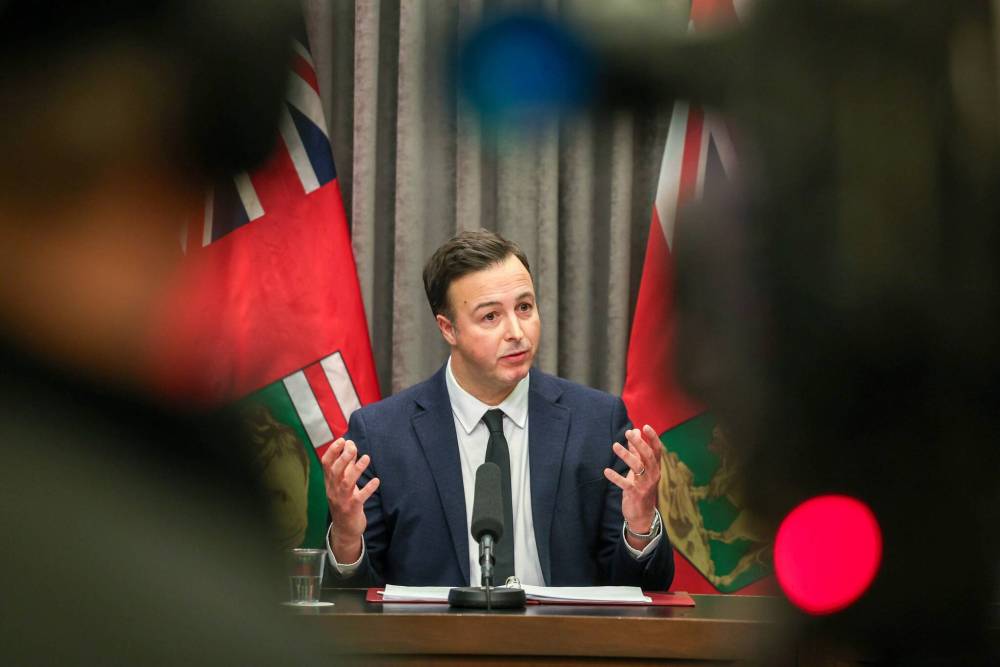
Finance Minister Adrien Sala says the costs reflect a system that is finally being “staffed up” after years of neglect. Since 2023, Manitoba has added roughly 3,500 net new health-care workers.
Health care is the single largest and most complex item in the provincial budget. Demand fluctuates constantly.
So, no, the sky is not falling because the province had to authorize extra health spending. If anything, the bigger risk would be underspending and pretending the numbers on a spreadsheet matter more than the people in hospital beds.
But acknowledging that reality does not mean the NDP gets a free pass.
Where this government remains stubbornly timid is in tackling the bloated bureaucracy that sits on top of the health-care system — a problem it inherited, yes, but has done remarkably little to fix.
Manitoba’s health-care administration is spread across multiple layers: Manitoba Health, Shared Health and five regional health authorities, including the Winnipeg Regional Health Authority. Each layer has its own executives, managers, communications teams, policy shops and reporting structures. Each layer costs money. A lot of it.
Consider the numbers.
Administrative costs across all health authorities, including Shared Health, were $300.2 million in 2022-23. They dipped to $286.2 million in 2023-24 and edged up slightly to $286.7 million in 2024-25.
Shared Health, the provincewide agency created to centralize services and supposedly reduce duplication, spent $94.5 million alone on administration in 2023-24 and $97.4 million in 2024-25.
To be fair, administration is not inherently evil. You need planners, schedulers, payroll staff, data analysts and managers in a system that employs tens of thousands of people. No serious person is arguing for zero administration.
You need planners, schedulers, payroll staff, data analysts and managers in a system that employs tens of thousands of people. No serious person is arguing for zero administration.
But what is hard to defend is the persistence of overlapping bureaucracies that were supposed to streamline the system but instead seem to have entrenched themselves.
Shared Health was sold as a way to reduce duplication and rein in costs. Yet its administrative spending continues to climb. Regional health authority administrative costs, after a modest dip, have essentially flattened out. Manitoba Health remains a powerful department with its own layers of oversight.
If the government is serious about sustainability, this is where the scalpel should be applied — not at the bedside.
The NDP has shown it is willing to spend political capital to hire front-line workers and restore services. That deserves credit. But it has been far more cautious about confronting the bureaucratic structures that consume hundreds of millions of dollars every year and deliver little visible benefit to patients.
That caution is understandable. Bureaucracies fight back. Job cuts are politically risky. Reorganizations are messy and rarely produce instant savings. Governments get blamed when anything goes wrong.
Still, if you are going to argue — correctly — that health-care demand is unpredictable and budgets will sometimes be exceeded, you also have to show you are doing everything possible to ensure the money is flowing to care, not paper.
That is something the NDP argued while in opposition and reiterated on the campaign trail during the 2023 provincial election. They promised to drastically cut administrative costs, saying more health-care resources should flow to patient care, not to bureaucrats.
Exceeding the health-care budget is not, by itself, a scandal. It’s often the price of running a humane system in an unpredictable world.

And they were right. But they’ve done very little to act on that after nearly 2 1/2 years in government.
The province budgeted $9.4 billion for health, seniors and long-term care in 2025-26. That is an enormous sum. Manitobans are entitled to ask not only whether enough is being spent, but how efficiently it is being spent.
Exceeding the health-care budget is not, by itself, a scandal. It’s often the price of running a humane system in an unpredictable world. But continuing to tolerate a multi-layered bureaucracy that resists meaningful reduction — year after year — is a choice.
And it’s one the NDP can no longer blame solely on its predecessors.
tom.brodbeck@freepress.mb.ca
Tom Brodbeck is an award-winning author and columnist with over 30 years experience in print media. He joined the Free Press in 2019. Born and raised in Montreal, Tom graduated from the University of Manitoba in 1993 with a Bachelor of Arts degree in economics and commerce. Read more about Tom.
Tom provides commentary and analysis on political and related issues at the municipal, provincial and federal level. His columns are built on research and coverage of local events. The Free Press’s editing team reviews Tom’s columns before they are posted online or published in print – part of the Free Press’s tradition, since 1872, of producing reliable independent journalism. Read more about Free Press’s history and mandate, and learn how our newsroom operates.
Our newsroom depends on a growing audience of readers to power our journalism. If you are not a paid reader, please consider becoming a subscriber.
Our newsroom depends on its audience of readers to power our journalism. Thank you for your support.
Tom Brodbeck is an award-winning author and columnist with over 30 years experience in print media. He joined the Free Press in 2019. Born and raised in Montreal, Tom graduated from the University of Manitoba in 1993 with a Bachelor of Arts degree in economics and commerce. Read more about Tom.
Tom provides commentary and analysis on political and related issues at the municipal, provincial and federal level. His columns are built on research and coverage of local events. The Free Press’s editing team reviews Tom’s columns before they are posted online or published in print – part of the Free Press’s tradition, since 1872, of producing reliable independent journalism. Read more about Free Press’s history and mandate, and learn how our newsroom operates.
Our newsroom depends on a growing audience of readers to power our journalism. If you are not a paid reader, please consider becoming a subscriber.
Our newsroom depends on its audience of readers to power our journalism. Thank you for your support.
Related Articles
When it comes to fixing health care, province must follow doctors’ orders


Advertisement Advertise With Us
Advertisement Advertise With Us