

‘I just want to spread this art’
Drumming program connects Southeast Asian students with traditional instrument, heritage

Advertisement
Read this article for free:
or
Already have an account? Log in here »
To continue reading, please subscribe:
Digital Subscription
One year of digital access for only $1.44 a week*
- Enjoy unlimited reading on winnipegfreepress.com
- Read the E-Edition, our digital replica newspaper
- Access News Break, our award-winning app
- Play interactive puzzles
*Billed as $5.77 plus GST every four weeks. After 52 weeks, price increases to the regular rate of $19.95 plus GST every four weeks. Offer available to new and qualified returning subscribers only. Cancel any time.
To continue reading, please subscribe:
Add Free Press access to your Brandon Sun subscription for only an additional
$1 for the first 4 weeks*
- Enjoy unlimited reading on winnipegfreepress.com
- Read the E-Edition, our digital replica newspaper
- Access News Break, our award-winning app
- Play interactive puzzles
*Your next Brandon Sun subscription payment will increase by $1.00 and you will be charged $17.95 plus GST for four weeks. After four weeks, your payment will increase to $24.95 plus GST every four weeks.
Read unlimited articles for free today:
or
Already have an account? Log in here »
Hey there, time traveller!
This article was published 02/03/2026 (230 days ago), so information in it may no longer be current.
For many young musicians at Arthur E. Wright School, tabla class begins with a bow and tapping their music teacher’s toes.
Amjad Sabir isn’t all that fussy about formalities, but he recognizes his students’ families have taught them these gestures are important to show respect towards their Indo-Canadian elders.
“I just want to spread this art,” said Sabir, who is affectionately known as “guruji” — meaning esteemed teacher in Hindi and Punjabi — inside the kindergarten-to-Grade 8 building in the Maples.
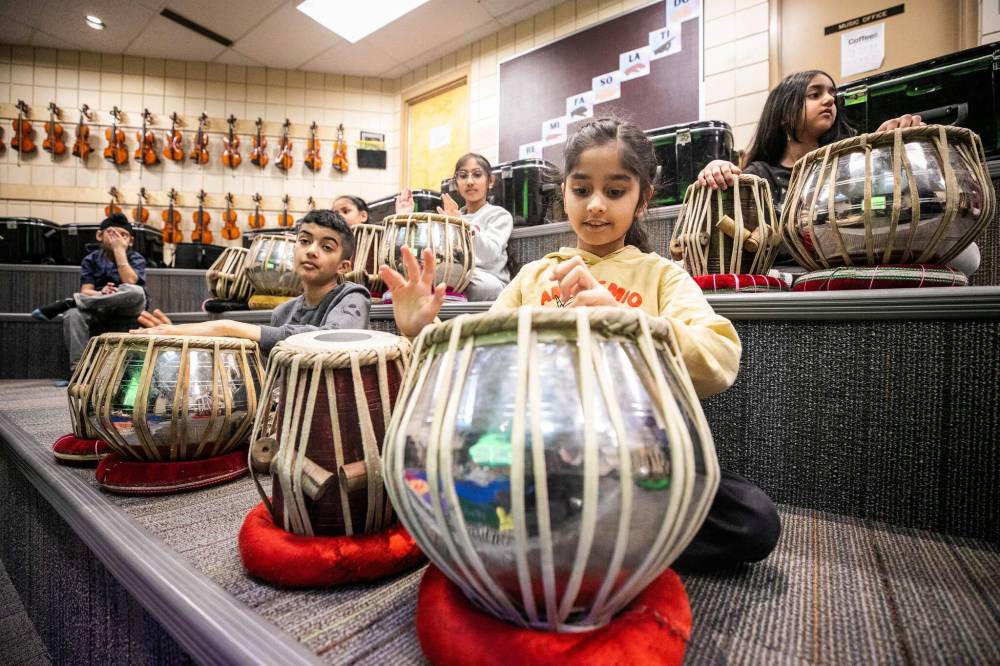
The art in question? A pair of hand drums, known as tabla, that create a wide range of tones.
The pitched percussion instrument is a staple in classical Indian music. It’s played while sitting cross-legged on the floor with both drums secured atop decorated cushions.
On Tuesday and Wednesday afternoons, a pulsating bass echoes throughout A. E. Wright hallways. Inside the band room, Sabir leads exercises using an Indian musical scale — sa-re-ga-ma-pa-dha-ni-sa. He can be heard urging a crowd of energetic children to play, “soft, soft.”
Sabir runs the only public school division program dedicated to the instrument in Manitoba.
“We’re really lucky. It’s just an opportunity of a lifetime,” said Jashanpreet Surdhar, a Grade 6 student.
Jashanpreet, 11, said his confidence has grown significantly since he joined the tabla program in Grade 1.
Another bonus is that he’s developed a strong grip, which has proven useful for dodgeball in phys-ed, he said.
The tabla program’s inception began more than a dozen years ago with informal discussions between Sabir, a university music instructor at the time, and school trustee Derek Dabee.
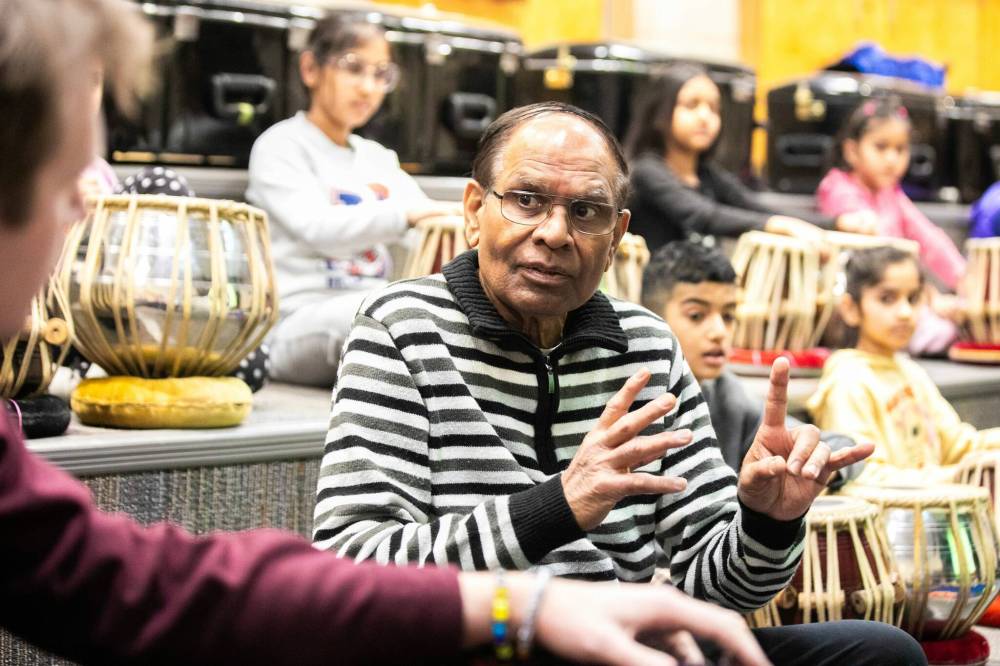
The duo decided the Seven Oaks School Division needed to diversify its music program to better reflect its multicultural student population.
“We know that students are immersed in other areas, whether it’s home or the community, with other types of music in their ear,’” said Tyler Yip, who oversees the division’s music and arts programming.
“Bringing that into schools is very important because that’s a reference to, ‘We see you. We know you. We value you — and we want to explore what you’re exploring.’”
Choir and band, as well as the guitar, recorder, ukelele, xylophone and fiddle, are staples in the division.
Since 2013, Sabir has been regularly teaching elementary students the tabla.
This year is unique because his program has expanded to incorporate both the sitar and harmonium.
A. E. Wright music teachers Jordan Laidlaw and Dale Thiessen have taken on new hobbies to jam with Sabir and students in the extracurricular.
“I like to model a growth mindset,” said Thiessen, who recently started learning the harmonium, a free-reed keyboard instrument, with Sabir’s help.

“I’m asking (my students) to try new things that are out of the box for them that they’ve never done before so I want to show them I’m open to doing that and I’m excited about doing that, too.”
There are 226 students learning the tabla, about 30 of whom are registered in the after-school offering, at A. E. Wright this year.
James Nisbet Community School is also hosting Sabir, whose lessons reach about 200 students on Thursdays throughout 2025-26.
Jashanpreet said the instrument is far more challenging to master than many beginners assume.
“At first, you will want to quit because it’s pretty hard. Your hands start to hurt,” he said. “Determination is the key to learning tabla.”
He’s been preaching that message as a mentor musician to his little brother and other young players at A.E. Wright.
“It feels good to share your teachings with others,” he said, following a recent afternoon practice.
The larger of the two drums, which is made out of a metal shell, can produce a pulsating bass. The higher-pitched one, whose body is carved out of wood, makes a ringing bell-like noise.

One of the pitched percussion’s signature features is a black dot that’s made of a dried tuning paste. It’s applied on top of multiple layers of goat skin, allowing players to access a range of clear tones.
Jashanpreet likens the instrument’s sounds to “a soothing voice.” It reminds him of family outings to his gurudwara, the Sikh Society of Manitoba, as well as his birth country.
His family moved to Canada from India in 2018.
The overwhelming majority of students at his elementary school — about 80 per cent of them — are of Southeast Asian descent. Four in 10 children are newcomers.
The most common countries of origin are India and the Philippines.
“(The tabla program) provides cultural connection and pride for our kids,” said Porie Pedrina, vice-president of A. E. Wright.
Principal Harpreet Panag echoed those comments.

The program helps students find belonging at school while reducing barriers to music education, Panag said, noting that private lessons can be costly.

It’s a great opportunity for children of all ages to work and learn together, said Manpreet Aujla, a mother of a Grade 2 student in the program.
Aujla said she’s proud of her daughter’s ability to play the traditional Indian instrument.
The elementary schooler keeps asking for “tabla at home,” she said.
maggie.macintosh@freepress.mb.ca
Maggie Macintosh
Education reporter
Maggie Macintosh reports on education for the Free Press. Originally from Hamilton, Ont., she first reported for the Free Press in 2017. Read more about Maggie.
Funding for the Free Press education reporter comes from the Government of Canada through the Local Journalism Initiative.
Every piece of reporting Maggie produces is reviewed by an editing team before it is posted online or published in print — part of the Free Press‘s tradition, since 1872, of producing reliable independent journalism. Read more about Free Press’s history and mandate, and learn how our newsroom operates.
Our newsroom depends on a growing audience of readers to power our journalism. If you are not a paid reader, please consider becoming a subscriber.
Our newsroom depends on its audience of readers to power our journalism. Thank you for your support.
Maggie Macintosh
Education reporter
Maggie Macintosh reports on education for the Free Press. Originally from Hamilton, Ont., she first reported for the Free Press in 2017. Read more about Maggie.
Funding for the Free Press education reporter comes from the Government of Canada through the Local Journalism Initiative.
Every piece of reporting Maggie produces is reviewed by an editing team before it is posted online or published in print — part of the Free Press‘s tradition, since 1872, of producing reliable independent journalism. Read more about Free Press’s history and mandate, and learn how our newsroom operates.
Our newsroom depends on a growing audience of readers to power our journalism. If you are not a paid reader, please consider becoming a subscriber.
Our newsroom depends on its audience of readers to power our journalism. Thank you for your support.
Advertisement Advertise With Us
Advertisement Advertise With Us