

Indigenous partnerships key to wildfire preparation

Advertisement
Read this article for free:
or
Already have an account? Log in here »
To continue reading, please subscribe:
Digital Subscription
One year of digital access for only $1.44 a week*
- Enjoy unlimited reading on winnipegfreepress.com
- Read the E-Edition, our digital replica newspaper
- Access News Break, our award-winning app
- Play interactive puzzles
*Billed as $5.77 plus GST every four weeks. After 52 weeks, price increases to the regular rate of $19.95 plus GST every four weeks. Offer available to new and qualified returning subscribers only. Cancel any time.
To continue reading, please subscribe:
Add Free Press access to your Brandon Sun subscription for only an additional
$1 for the first 4 weeks*
- Enjoy unlimited reading on winnipegfreepress.com
- Read the E-Edition, our digital replica newspaper
- Access News Break, our award-winning app
- Play interactive puzzles
*Your next Brandon Sun subscription payment will increase by $1.00 and you will be charged $17.95 plus GST for four weeks. After four weeks, your payment will increase to $24.95 plus GST every four weeks.
Read unlimited articles for free today:
or
Already have an account? Log in here »
Hey there, time traveller!
This article was published 16/03/2026 (219 days ago), so information in it may no longer be current.
More than 5.3 million acres in Manitoba burned — second only to Saskatchewan — as wildfires raged across Western Canada last summer, and 32,000-plus residents, most of whom were Indigenous, were evacuated from their communities.
In Winnipeg, air quality due to the smoke was so terrible that by August, the year’s poor conditions had broken a 65-year record.
In northern places such as Thompson, the smoke was life-threatening. For most of the summer the city was engulfed in smoke, causing wide-scale lung irritation. Anyone with respiratory conditions like asthma and heart disease was forced to stay indoors.
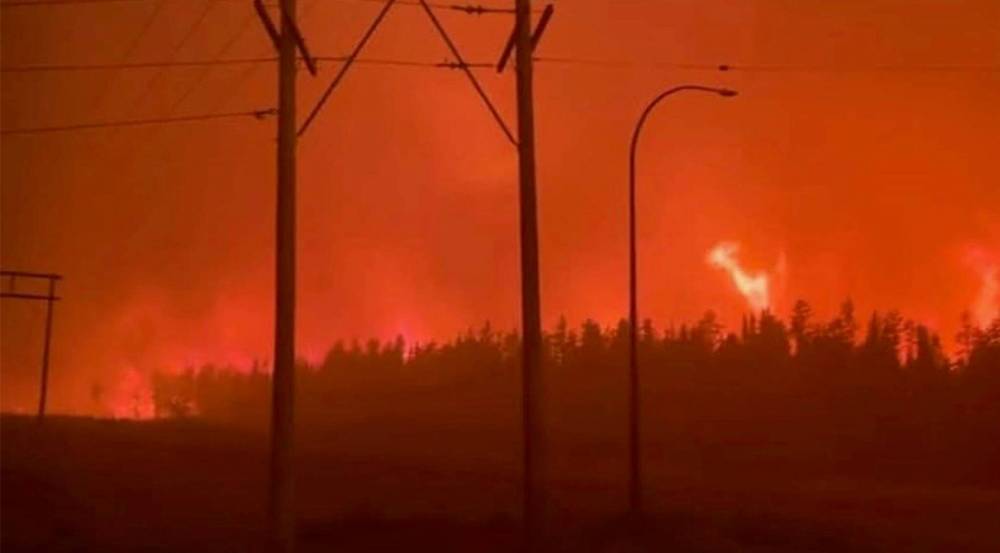
A wildfire burns near Leaf Rapids in July 2025. Overall, a total of 433 wildfires ravaged the province.
The fires began after the May 10-11 weekend, when temperatures rose above 35 C, drying the underbrush and creating dangerous conditions.
By the end of that weekend, five fires were classified as “out of control,” threatening Lac du Bonnet. The fire there claimed the lives of two people who couldn’t escape the flames.
Fires sprang up and threatened Whiteshell Provincial Park, Piney, Lynn Lake, Flin Flon, Cranberry Portage, Mathias Colomb First Nation and Pimicikamak Cree Nation.
On May 28, Premier Wab Kinew declared a state of emergency and the military was called in to help; 17,000 Manitobans were evacuated to emergency shelters, hockey arenas and hotel rooms. Some were even sent to Niagara Falls in Ontario.
In total, 433 wildfires ravaged in Manitoba in 2025.
By November, 66 fires continued to burn – all in northern Manitoba – and required human intervention to keep under control.
I could keep going, but readers will remember that the fires of 2025 affected all of Manitoba.
Over the winter, provincial officials have been warning that there may be a carry-over because of what are called “zombie” fires, which continue to smoulder underneath the snow. There’s a risk they’ll ignite in the spring.
This, combined with a provincial drought in the early months of 2026 and what is forecast by climatologists to be a dry spring, all point to a horrible repeat of 2025.
Things could change, of course, and wildfire prevention is key, but if I were advising provincial officials, I’d tell them: reserve the hockey arenas now.
The coalition is called the First Nations Wildfire Evacuation Partnership, which includes everyone it seems, but those in Manitoba.
The frustrating thing is, there is a better way.
For the past decade, researchers at the University of Alberta have been working with First Nations in Alberta, Saskatchewan and Ontario, and 16 provincial and federal departments and agencies, on how provinces should approach wildfire evacuations for Indigenous communities.
The coalition is called the First Nations Wildfire Evacuation Partnership, which includes everyone it seems, but those in Manitoba.
In Manitoba, emergencies are generally co-ordinated on an ad hoc basis by the provincial government, which partners with federal officials and organizations such as the Red Cross.
This system has worked for small crises but is most often reactionary, with these coalitions occurring after an emergency is declared.
This has led to complicated situations in which non-Indigenous organizations and leaders come into conflict with Indigenous evacuees over issues that often relate to culture, compassion, race and gender.
I could point to news stories from last year, but I’ll just point to my email inbox last summer.
From June onwards, I had dozens of messages from fire evacuees wanting me to pursue stories about how families were separated, how evacuees felt dehumanized and how a stressful situation for northern citizens was made worse by individuals who could use a little training in cultural understanding.
This is not a condemnation; note that I am not naming names.
I’m just saying there is a better way — and research to back it up.
According to the First Nations partnership, there are about a dozen challenges that complicate evacuations in First Nations communities ranging from: a historical mistrust of governments, jurisdictional confusion, poverty, poor housing, language issues, a lack of media and worries about reimbursement costs of evacuation – just to name a few.
The solution is to take the focus away from provincial leaders and build infrastructure in Indigenous communities where wildfires are expected, weeks and months ahead of time.
This, added with short warning times, inadequate information delivery systems, transportation challenges, culture shock and family separation during evacuation, leads to serious problems.
Simply put; it’s like dealing with an emergency by creating a series of new ones.
The solution is to take the focus away from provincial leaders and build infrastructure in Indigenous communities where wildfires are expected, weeks and months ahead of time.
In other words, now.

This means organizing Indigenous-led evacuation plans and routes, building semi-permanent evacuee centres, setting up online social media groups and anticipating needs of elders, children and mental-health care providers far before an emergency is declared.
Researchers at the First Nations partnership even produced a literal laundry list on what to do; publishing a book by the University of British Columbia Press in 2021 titled First Nations Wildfire Evacuation Experiences: A guide for communities and external agencies.
In other words, annual fire evacuations necessitate the creation of an ongoing, permanent partnership led by Indigenous leadership and followed by everyone else.
A partnership that not only would be effective but more efficient, inclusive and save money in the long run.
niigaan.sinclair@freepress.mb.ca
Niigaan Sinclair is Anishinaabe from Peguis First Nation and a professor in the Department of Indigenous Studies at the University of Manitoba. He’s been a columnist for the Free Press since 2018. Read more about Niigaan.
Every piece of writing Niigaan produces is reviewed by an editing team before it is posted online or published in print — part of the Free Press‘s tradition, since 1872, of producing reliable independent journalism. Read more about Free Press’s history and mandate, and learn how our newsroom operates.
Our newsroom depends on a growing audience of readers to power our journalism. If you are not a paid reader, please consider becoming a subscriber.
Our newsroom depends on its audience of readers to power our journalism. Thank you for your support.
Niigaan Sinclair is Anishinaabe from Peguis First Nation and a professor in the Department of Indigenous Studies at the University of Manitoba. He’s been a columnist for the Free Press since 2018. Read more about Niigaan.
Every piece of writing Niigaan produces is reviewed by an editing team before it is posted online or published in print — part of the Free Press‘s tradition, since 1872, of producing reliable independent journalism. Read more about Free Press’s history and mandate, and learn how our newsroom operates.
Our newsroom depends on a growing audience of readers to power our journalism. If you are not a paid reader, please consider becoming a subscriber.
Our newsroom depends on its audience of readers to power our journalism. Thank you for your support.
Related Articles
Tired of waiting, First Nation buys $8M worth of generators






Advertisement Advertise With Us
Advertisement Advertise With Us