

Accessible, inclusive sports giving elementary-age phys-ed students a lesson in empathy

Advertisement
Read this article for free:
or
Already have an account? Log in here »
To continue reading, please subscribe:

Digital Subscription
One year of digital access for only $205*
- Enjoy unlimited reading on winnipegfreepress.com
- Read the E-Edition, our digital replica newspaper
- Access News Break, our award-winning app
- Play interactive puzzles
*First annual payment billed as $205.00 + GST for one year. This annual subscription will automatically renew at $233.00 + GST every 52 weeks (10% off the regular annual price of $259.35). Offer available to new and qualified returning subscribers only. Cancel any time.
To continue reading, please subscribe:
Add Free Press access to your Brandon Sun subscription for only an additional
$1 for the first 4 weeks*
- Enjoy unlimited reading on winnipegfreepress.com
- Read the E-Edition, our digital replica newspaper
- Access News Break, our award-winning app
- Play interactive puzzles
*Your next Brandon Sun subscription payment will increase by $1.00 and you will be charged $17.95 plus GST for four weeks. After four weeks, your payment will increase to $24.95 plus GST every four weeks.
Read unlimited articles for free today:
or
Already have an account? Log in here »
Among his unusual instructions on a recent school day, phys-ed teacher Jordan Adam discouraged his students from cheering on their teammates.
“I need the audience to be quiet,” he told his packed gymnasium at Beaverlodge School.
Adam wanted them to have an authentic goalball experience, after all, and that required active players — all of whom were blindfolded — to be hyperaware of the sounds around them.
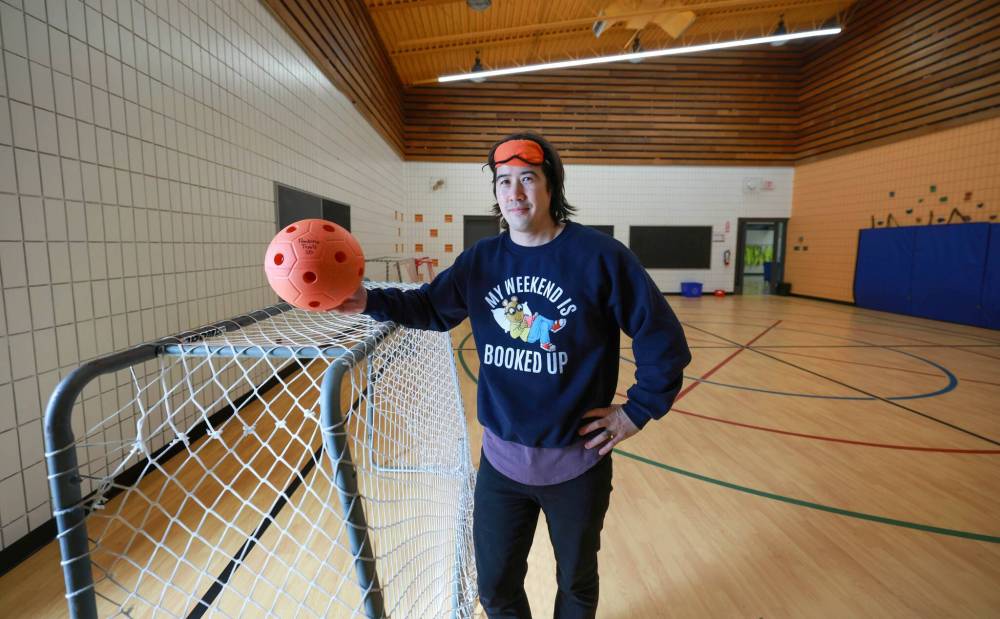
Ruth Bonneville / Free Press
Jordan Adam, phys-ed teacher at Beaverlodge School, which has started a new inclusive sports program to expose students to lesser-known activities and spark discussion about accessibility.
Originally created for athletes who have visual impairments, the Paralympic team sport is played with a ball that has a bell inside it.
Competitors listen for ringing to determine how best to defend their large nets. They wear blackout masks and shoot underhand.
“My philosophy, what I really try to do, is give a buffet of activities and hopefully, every kid will find something they like and can enjoy for the rest of their life,” Adam said, following a midday match at his kindergarten-to-Grade 5 school in west Winnipeg.

This year, he’s launched a new inclusive sports program to expose students to lesser-known activities and spark discussion about accessibility.
The initiative was inspired by a Grade 3 student who entered the halls of Beaverlodge in a wheelchair in the fall.
She often asks, “What am I supposed to do?” during phys-ed, Adam said, noting they’ve been coming up with adaptations together throughout the year.
While they’ve found ways to adjust programming, Adam said he wanted to plan a unit that wouldn’t elicit such a question.
He reached out to Basketball Manitoba and secured a $500 provincial healthy schools grant to rent a set of wheelchairs through the organization.
Students’ widespread excitement and engagement about wheelchair basketball motivated him to introduce goalball. He’s considering sitting volleyball next.
The Pembina Trails School Division has a goalball set and adjustable nets, along with other inclusive equipment that teachers can borrow.
“Kids are being exposed to the disability community, accessible sport and inclusive initiatives that value everybody,” said Michael Baker, an inclusive support services consultant for the division.
Incorporating accessible sports creates a sense of belonging for students with disabilities and builds knowledge and understanding among others, Baker said.
Adam introduced goalball by talking to his students about terminology, including visual impairment, blindness and “person-first language.”
He said his goal, along with teaching students about strategy, fair play and fitness, is to build empathy.
There’s been a noticeable shift in schools embracing adaptive recreation over the last decade, said Jared Funk, executive director of Accessible Sport Connection Manitoba.
“It’s growing every year, which is great. The one problem we have — and it’s a good problem — is having enough equipment to share with schools,” he said.
Funk, a three-time Paralympic medalist in wheelchair rugby, has been involved in the accessible sport world for 30 years. He’s been using a wheelchair since he suffered a spinal cord injury at age 18.
“People see disability as a stopping point. Really, it’s just a starting point,” Funk said, adding that it can spark educational discussions and creative thinking surrounding adaptation.
His team has been working on multiple guides to help schools and other community-serving organizations embed adaptive sports, recreation and leisure activities, into their programming.
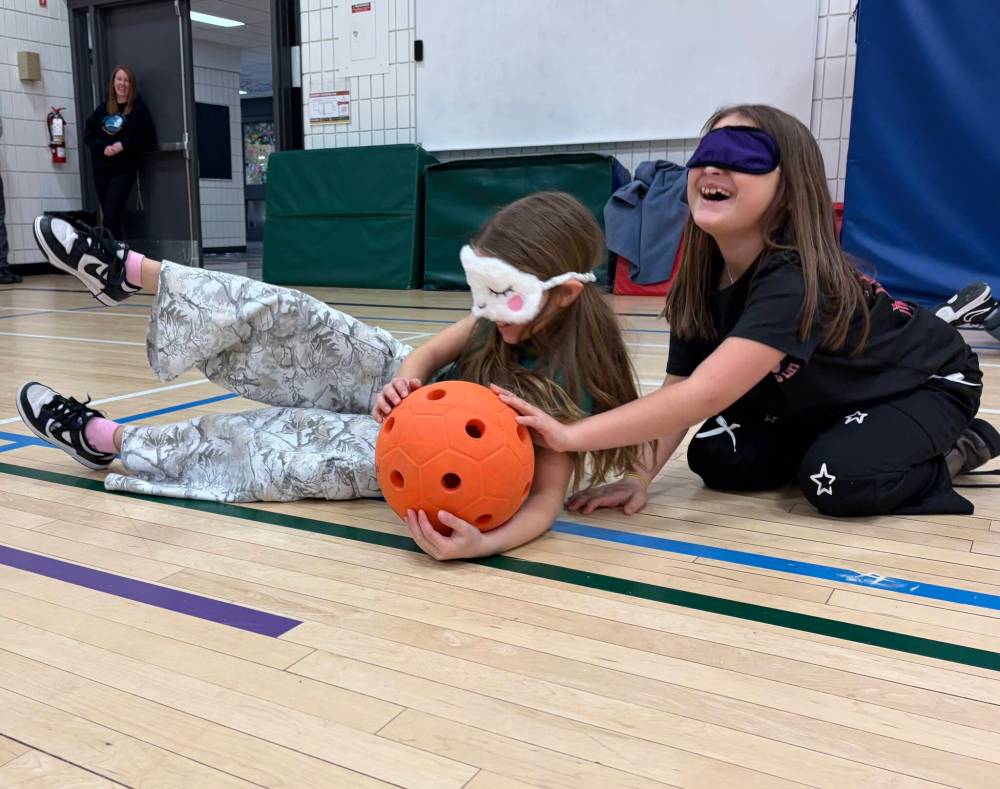
MAGGIE MACINTOSH / FREE PRESS
The Paralympic team sport goalball was originally created for athletes who have visual impairments.
The non-profit organization is launching the project, dubbed Access Joy, this weekend.
maggie.macintosh@freepress.mb.ca
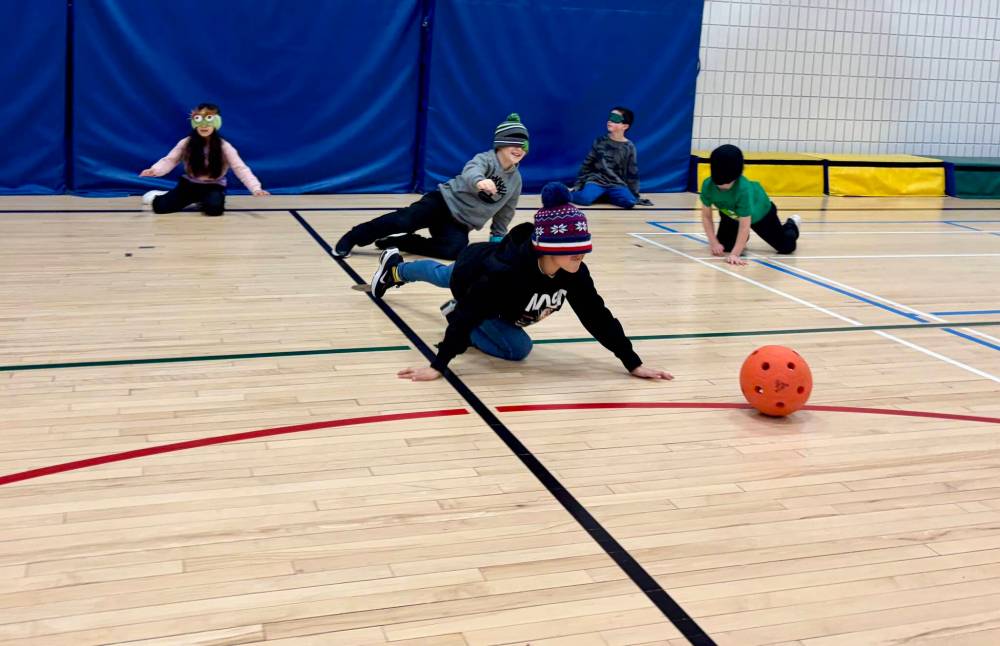
MAGGIE MACINTOSH / FREE PRESS
Students compete in goalball during phys-ed classes at Beaverlodge School. The sport requires blindfolded players to be hyperaware of the sounds around them since it’s played with a ball that has a bell inside it.
Maggie Macintosh
Education reporter
Maggie Macintosh reports on education for the Free Press. Originally from Hamilton, Ont., she first reported for the Free Press in 2017. Read more about Maggie.
Funding for the Free Press education reporter comes from the Government of Canada through the Local Journalism Initiative.
Every piece of reporting Maggie produces is reviewed by an editing team before it is posted online or published in print — part of the Free Press‘s tradition, since 1872, of producing reliable independent journalism. Read more about Free Press’s history and mandate, and learn how our newsroom operates.
Our newsroom depends on a growing audience of readers to power our journalism. If you are not a paid reader, please consider becoming a subscriber.
Our newsroom depends on its audience of readers to power our journalism. Thank you for your support.
Maggie Macintosh
Education reporter
Maggie Macintosh reports on education for the Free Press. Originally from Hamilton, Ont., she first reported for the Free Press in 2017. Read more about Maggie.
Funding for the Free Press education reporter comes from the Government of Canada through the Local Journalism Initiative.
Every piece of reporting Maggie produces is reviewed by an editing team before it is posted online or published in print — part of the Free Press‘s tradition, since 1872, of producing reliable independent journalism. Read more about Free Press’s history and mandate, and learn how our newsroom operates.
Our newsroom depends on a growing audience of readers to power our journalism. If you are not a paid reader, please consider becoming a subscriber.
Our newsroom depends on its audience of readers to power our journalism. Thank you for your support.
Related Articles
Province announces phys-ed curriculum overhaul
Advertisement Advertise With Us
Advertisement Advertise With Us