

Failure of system not care givers, says nurses group
Health-care delays tied to five of 16 deaths in annual critical-incident report

Advertisement
Read this article for free:
or
Already have an account? Log in here »
To continue reading, please subscribe:

Digital Subscription
One year of digital access for only $205*
- Enjoy unlimited reading on winnipegfreepress.com
- Read the E-Edition, our digital replica newspaper
- Access News Break, our award-winning app
- Play interactive puzzles
*First annual payment billed as $205.00 + GST for one year. This annual subscription will automatically renew at $233.00 + GST every 52 weeks (10% off the regular annual price of $259.35). Offer available to new and qualified returning subscribers only. Cancel any time.
To continue reading, please subscribe:
Add Free Press access to your Brandon Sun subscription for only an additional
$1 for the first 4 weeks*
- Enjoy unlimited reading on winnipegfreepress.com
- Read the E-Edition, our digital replica newspaper
- Access News Break, our award-winning app
- Play interactive puzzles
*Your next Brandon Sun subscription payment will increase by $1.00 and you will be charged $17.95 plus GST for four weeks. After four weeks, your payment will increase to $24.95 plus GST every four weeks.
Read unlimited articles for free today:
or
Already have an account? Log in here »
Hey there, time traveller!
This article was published 28/03/2026 (191 days ago), so information in it may no longer be current.
Five patients who faced delays in Manitoba’s health-care system were among 16 deaths that were listed in the province’s latest critical-incident reports.
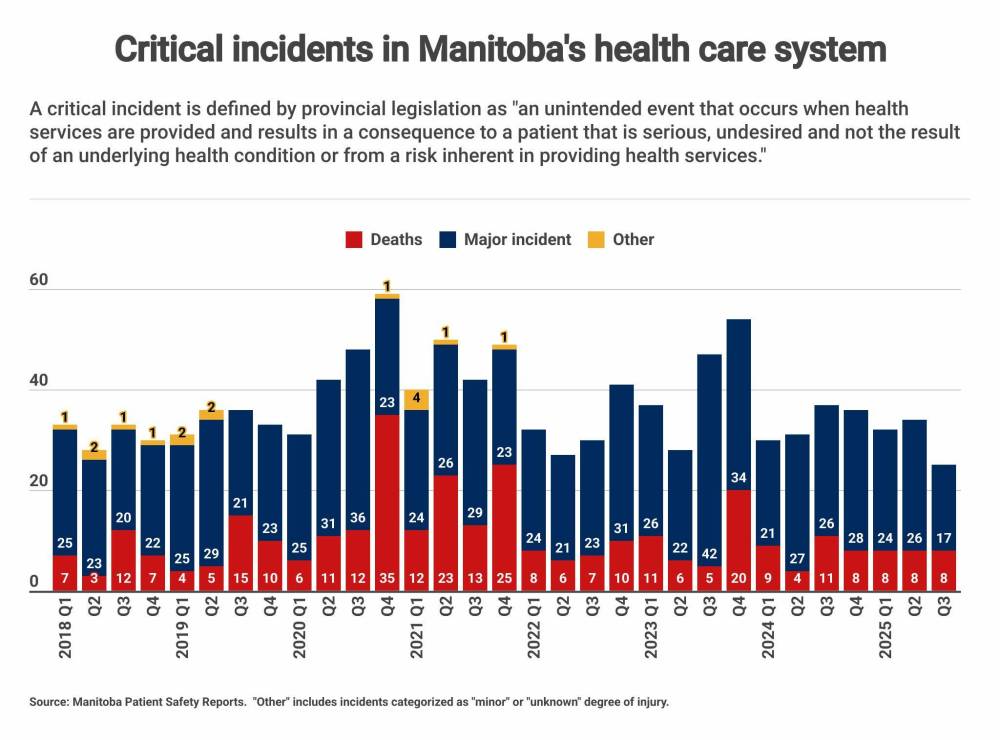
The reports contain brief descriptions of the 16 deaths and 43 major injuries — all deemed critical incidents that required investigations — between April 1 and Sept. 30, 2025.
“Our thoughts are with the patients, families and staff affected by the incidents outlined in these reports,” Health Minister Uzoma Asagwara said in a statement.

MIKE DEAL / FREE PRESS FILES
Jason Linklater, Manitoba Association of Health Care Professionals: targeted investments needed.
“These are not just numbers, they are people, and every incident is taken seriously.”
Government reports listed 91 critical incidents in the first nine months of 2025, down from 98 during the same period in 2024 and 112 in 2023, and comparable to 89 in 2022.
The province cautioned that more analysis and data are needed to draw firm conclusions, because the number of incidents listed per quarter reflect the investigations that have been completed by the time of reporting. Some investigations may be ongoing.
Several incidents involved delays, gaps, missed opportunities for earlier involvement, falls or equipment failures.
One patient died after they were discharged and suffered a “clinical deterioration.” “Opportunities for earlier recognition and intervention were not realized,” one of the reports said.
A different patient died after self-harming. “Opportunities for earlier assessment and treatment were not fully in place,” the report said.
Five patients died after facing delays in either accessing care or treatment, or delays in the response to their medical conditions.
Of the major injuries, a delay in the diagnosis of a patient’s serious medical condition led to harm, while a different patient’s care for an “acute medical event” was delayed due to gaps in reporting and assessment.
Two people were injured by fellow patients in what the reports described only as “interactions.”
Critical-incident reports do not contain details that could identify patients or residents, workers or locations. Investigations are intended to find ways to prevent similar incidents from happening.
Many critical incidents are preventable, said Manitoba Nurses Union president Darlene Jackson.
“What stands out in these reports is not just the number of critical incidents, it’s the pattern,” she said. “Over and over again, we see the same language: missed opportunities, delays in recognition, gaps in monitoring, delayed treatment. Those aren’t random human failures. Those are system signals.”
When the same themes repeat, it points to a system that is stretched too thin to respond in time, she said.
Prevention starts with having enough staff, with the right supports, Jackson said.
“Patient safety is not just about policies or reviews after the fact. It’s about real-time capacity at the bedside,” she said. “Until that is addressed, we will continue to see the same patterns, and that should concern everyone.”
Asagwara said increasing staffing, improving patient flow and reducing wait times are essential to improving patient safety.
“Initiatives like better staffing levels and clearer standards of care are part of that effort, but there is no single solution. This is ongoing work,” the minister said.
Jason Linklater, president of the Manitoba Association of Health Care Professionals, pointed to shortages of respiratory therapists in Winnipeg’s three emergency rooms, and paramedics in rural Manitoba.
“We’re not going to see patient safety, or staff safety, improve until government is willing to make the targeted investments needed to improve staffing levels, bring down wait times and enforce safety legislation,” he said.

“We know from front-line reports that allied health staffing shortages have contributed to critical incidents.”
MAHCP is suing the government for allegedly failing to ensure the safety and health of its members.
The Opposition Tories recently called for a public inquiry after the recent deaths of patients awaiting medical care.
Manitoba legislation defines a critical incident as an unintended event that occurs when health services in hospitals, personal care homes or other settings result in “serious and undesired” consequences, such as death, injury or disability, and do not result from the person’s underlying health condition “or from a risk inherent in providing the health services.”
chris.kitching@freepress.mb.ca
Chris Kitching is a general assignment reporter at the Free Press. He began his newspaper career in 2001, with stops in Winnipeg, Toronto and London, England, along the way. After returning to Winnipeg, he joined the Free Press in 2021, and now covers a little bit of everything for the newspaper. Read more about Chris.
Every piece of reporting Chris produces is reviewed by an editing team before it is posted online or published in print — part of the Free Press‘s tradition, since 1872, of producing reliable independent journalism. Read more about Free Press’s history and mandate, and learn how our newsroom operates.
Our newsroom depends on a growing audience of readers to power our journalism. If you are not a paid reader, please consider becoming a subscriber.
Our newsroom depends on its audience of readers to power our journalism. Thank you for your support.
Chris Kitching is a general assignment reporter at the Free Press. He began his newspaper career in 2001, with stops in Winnipeg, Toronto and London, England, along the way. After returning to Winnipeg, he joined the Free Press in 2021, and now covers a little bit of everything for the newspaper. Read more about Chris.
Every piece of reporting Chris produces is reviewed by an editing team before it is posted online or published in print — part of the Free Press‘s tradition, since 1872, of producing reliable independent journalism. Read more about Free Press’s history and mandate, and learn how our newsroom operates.
Our newsroom depends on a growing audience of readers to power our journalism. If you are not a paid reader, please consider becoming a subscriber.
Our newsroom depends on its audience of readers to power our journalism. Thank you for your support.
Related Articles
NDP unveils proposed patient safety charter


Advertisement Advertise With Us
Advertisement Advertise With Us