

Manitoba man paying $28K a month wants province to cover brain cancer treatment
Father seeks help for life-extending treatment to slow cancer progression

Advertisement
Read this article for free:
or
Already have an account? Log in here »
To continue reading, please subscribe:

Digital Subscription
One year of digital access for only $205*
- Enjoy unlimited reading on winnipegfreepress.com
- Read the E-Edition, our digital replica newspaper
- Access News Break, our award-winning app
- Play interactive puzzles
*First annual payment billed as $205.00 + GST for one year. This annual subscription will automatically renew at $233.00 + GST every 52 weeks (10% off the regular annual price of $259.35). Offer available to new and qualified returning subscribers only. Cancel any time.
To continue reading, please subscribe:
Add Free Press access to your Brandon Sun subscription for only an additional
$1 for the first 4 weeks*
- Enjoy unlimited reading on winnipegfreepress.com
- Read the E-Edition, our digital replica newspaper
- Access News Break, our award-winning app
- Play interactive puzzles
*Your next Brandon Sun subscription payment will increase by $1.00 and you will be charged $17.95 plus GST for four weeks. After four weeks, your payment will increase to $24.95 plus GST every four weeks.
Read unlimited articles for free today:
or
Already have an account? Log in here »
A Winnipeg man who’s paying $28,000 a month to use a device that has shrunk his aggressive brain tumour wants the provincial government to pick up the bill.
Chico Colosimo, who was diagnosed with glioblastoma last year, hopes to convince the government to fund the Optune Gio device before he runs out of money from a fundraiser and his family’s savings.
“It works,” Colosimo, 47, said on Wednesday. “My tumour has shrunk.”
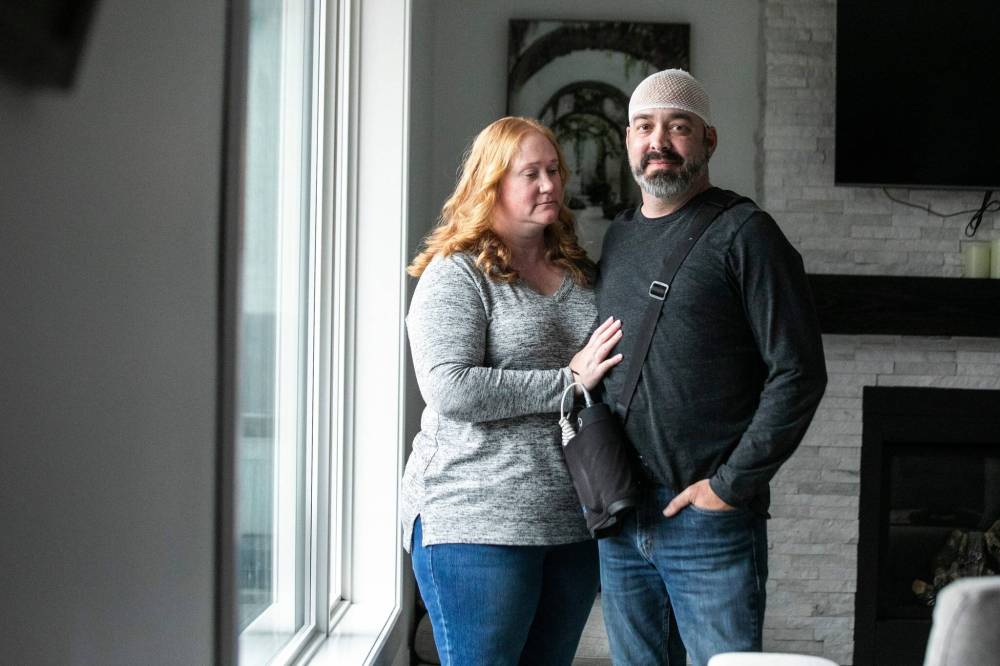
Photos by Mikaela MacKenzie / Free Press
Chico Colosimo with his wife, Shauna. The 47-year-old father of two, currently battling glioblastoma, is paying $28,000 a month to treat the aggressive form of brain cancer.
“If it gets me another six months to a year of my life, I will take it. And the quality of life is significantly better. I can walk around with my wife and I can work in my yard. I couldn’t do that before I started this.”
The Brain Tumour Foundation of Canada says glioblastoma is the most common primary brain tumour in males that affects almost five out of 100,000 people.
Patients with Colosimo’s diagnosis are usually given six to 18 months to live.
A fundraising campaign launched by family friends has raised more than $164,000, but Colosimo’s wife, Shauna, said it won’t be long before the money runs out.
“My husband is now considering stopping treatment — not because it is not working, but because of the immense financial strain and the fear of the long-term financial impact on our family,” she said.
“No patient should be forced to make that decision.”
Shauna said the positive changes in his condition since he put on the device in December, have been miraculous.
“I know him because we’ve been together 27 years,” she said. “He was at the point where he couldn’t walk or understand simple directions. He went from not being able to communicate or walk to having 97 per cent of himself back. People who saw him in December are floored by the improvement”
She said most patients don’t use it because of the expense.
“We would have started using it once he was diagnosed if we had known.”
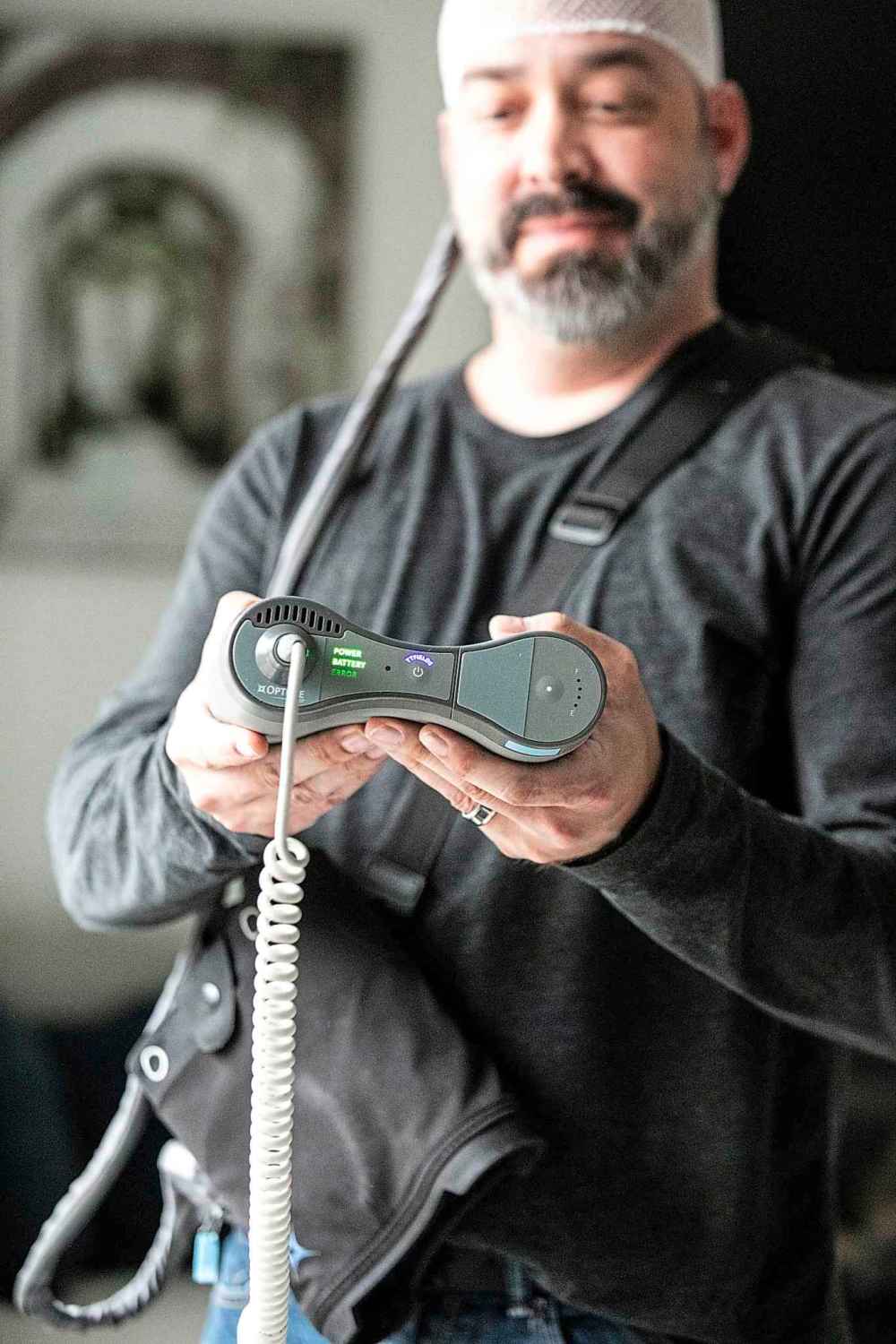
MIKAELA MACKENZIE / FREE PRESS
Chico Colosimo holds the Optune Gio device.
The device, which a patient wears on their head, uses electric fields to slow down or stop tumour growth.
It was developed by Novocure, a company founded in 2000 by Yoram Palti, a professor emeritus of physiology and biophysics at the Israel Institute of Technology, who had theorized electric fields could be used to treat tumours.
It was approved by the Food and Drug Administration in the United States in 2011 and by Health Canada in 2022.
British Columbia, which started to cover the cost as of February, remains the only province to do so.
The couple has written to Manitoba’s health minister to ask for coverage. In response, Manitoba Health’s non-insured benefits branch told them their case is under review.
“As this technology is classified as a medical device, rather than a drug, any consideration of public funding requires careful assessment of clinical benefit, cost-effectiveness, and overall system affordability, as well as discussion with the manufacturer. At this time, no decisions have been made.”
In a statement, Health Minister Uzoma Asagwara said the government recognizes the “significant emotional strain” on the couple.
“Other jurisdictions across the country, including Manitoba, are now working through similar review processes. We remain focused on making sure Manitobans have access to safe and effective care, while continuing to carefully evaluate new and emerging treatments as evidence evolves.”
Colosimo, the father of a 15-year-old boy and 12-year-old girl, was diagnosed on May 4, 2025.
A few weeks earlier, he had collapsed in his bathroom. He said he has no memory of even getting up that morning, and only remembers waking up in the hospital — nine or 10 days later.
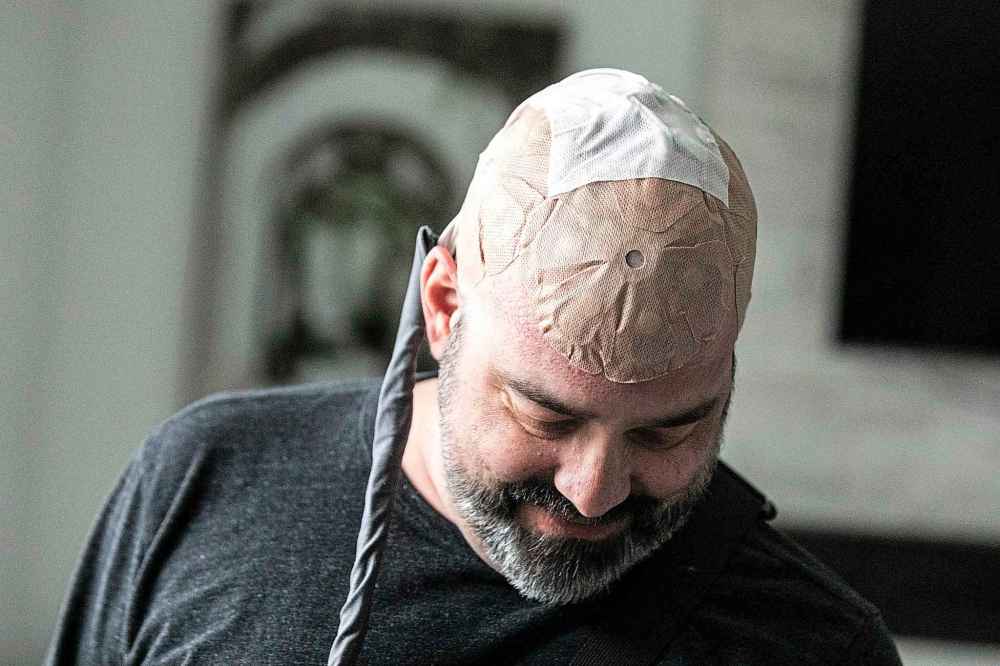
MIKAELA MACKENZIE / FREE PRESS
The Optune Gio device uses electric fields to slow down or stop tumour growth.
The diagnosis was made after a biopsy was conducted.
He received surgery to reduce the size of the tumour, and endured radiation and chemotherapy treatments. However, the tumour continued to grow and the couple had no further options. Then they heard about the Optune Gio device.

“I didn’t even know about it and I work at CancerCare Manitoba,” Shauna said, adding it should be covered by the provincial health plan.
“It should never be if you don’t have the money, you don’t have the device.”
Colosimo said he is at peace knowing the device is extending his life. He hopes his experience can help others.
“If I can get four or five more months, that is something. And if I can get four months without having to spend it on a couch and can do things, or if I’m just helping others, I call that a win.”
kevin.rollason@freepress.mb.ca
Kevin Rollason
Reporter
Kevin Rollason was a general assignment reporter at the Free Press.
Our newsroom depends on a growing audience of readers to power our journalism. If you are not a paid reader, please consider becoming a subscriber.
Our newsroom depends on its audience of readers to power our journalism. Thank you for your support.
Kevin Rollason
Reporter
Kevin Rollason was a general assignment reporter at the Free Press.
Our newsroom depends on a growing audience of readers to power our journalism. If you are not a paid reader, please consider becoming a subscriber.
Our newsroom depends on its audience of readers to power our journalism. Thank you for your support.
Related Articles
A new strategy to attack aggressive brain cancer shrank tumors in two early tests

Advertisement Advertise With Us
Advertisement Advertise With Us
History
Updated on Saturday, May 9, 2026 10:37 AM CDT: Adds photos, corrects spelling in captions