

Fort Richmond elementary school shedding racist lord’s name

Advertisement
Read this article for free:
or
Already have an account? Log in here »
To continue reading, please subscribe:

Digital Subscription
One year of digital access for only $205*
- Enjoy unlimited reading on winnipegfreepress.com
- Read the E-Edition, our digital replica newspaper
- Access News Break, our award-winning app
- Play interactive puzzles
*First annual payment billed as $205.00 + GST for one year. This annual subscription will automatically renew at $233.00 + GST every 52 weeks (10% off the regular annual price of $259.35). Offer available to new and qualified returning subscribers only. Cancel any time.
To continue reading, please subscribe:
Add Free Press access to your Brandon Sun subscription for only an additional
$1 for the first 4 weeks*
- Enjoy unlimited reading on winnipegfreepress.com
- Read the E-Edition, our digital replica newspaper
- Access News Break, our award-winning app
- Play interactive puzzles
*Your next Brandon Sun subscription payment will increase by $1.00 and you will be charged $17.95 plus GST for four weeks. After four weeks, your payment will increase to $24.95 plus GST every four weeks.
Read unlimited articles for free today:
or
Already have an account? Log in here »
Dalhousie School is undergoing a rebrand so it’s no longer affiliated with a Scottish soldier, lord and colonial leader who supported slavery.
The Pembina Trails School Division put a out a call this week for suggestions to rename the elementary building located at 262 Dalhousie Dr.
Its current namesake is George Ramsay, also known as Lord Dalhousie or the ninth Earl of Dalhousie — a title of nobility passed down in his prominent Scottish clan.
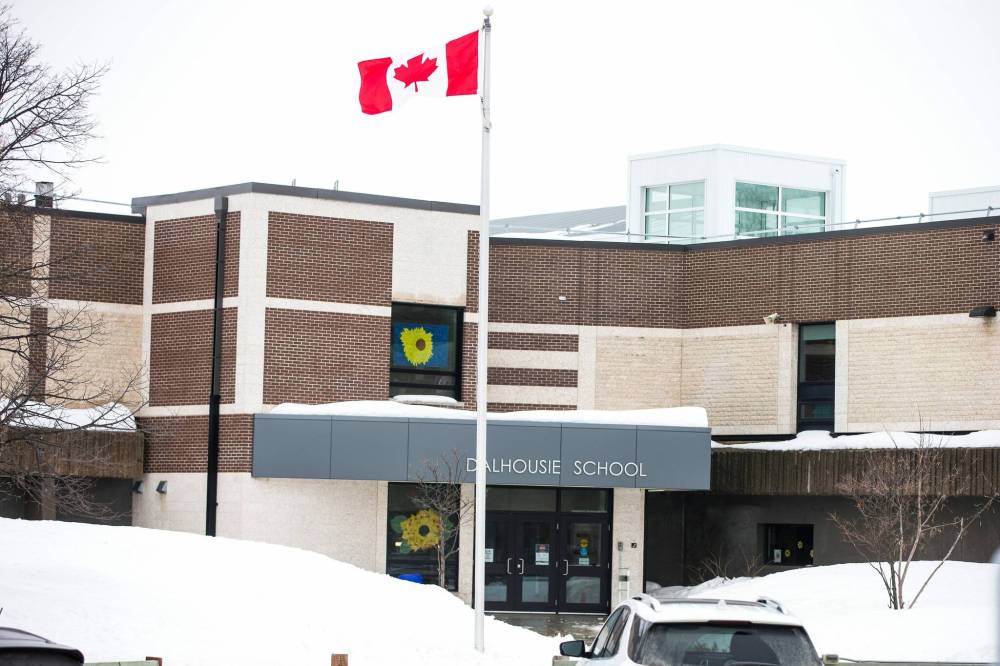
MIKAELA MACKENZIE / FREE PRESS FILES
Dalhousie School is named after George Ramsay, also known as Lord Dalhousie, a pro-slave British nobleman who espoused racist views of Black people.
“Our whole slogan is, ‘Our differences make us strong,’” said Evi Klostermaier, acting principal of the kindergarten-to-Grade 5 school in Fort Richmond.
“The goal is to ensure our school name reflects the spirit of belonging, respect and pride and the diversity that’s in our community and in our building.”
Inspired by the recent renaming of nearby Prairie Sunrise School — previously named Ryerson School — the staff team set out last spring to investigate their building’s namesake.
What they learned — Dalhousie (1770-1838) was pro-slavery and held racist beliefs about Black people — was extremely troubling, Klostermaier said.
Teachers took their concerns to the board office in the fall and received approval to start an official renaming process involving all 440 students and their families.
“We have a lot of immigrant families within our community who didn’t know yet of Dalhousie.… We shared our reasoning for (change) and they were very open to it,” Klostermaier said.
Provincial census data shows more than half of all residents in the Fort Richmond constituency are visible minorities. Ten per cent of the population identifies as Black.
Halifax-based Dalhousie University is also named after the man who, then-lieutenant-governor of Nova Scotia, founded the post-secondary institution in 1818.
The university established a team of researchers in 2016 to probe its founder’s relationship to slavery, race and anti-Black racism. The panel’s 132-page report details how Dalhousie cut rations for Black refugees and sought to deport them to their former slave masters.
The panel called on the school to issue an apology to the African Nova Scotia community. It did not recommend the campus be renamed.
Over the last five years there’s been a growing movement across the country to strip public schools of names honouring historical figures whose beliefs and actions caused harm to Indigenous people and other marginalized populations.
The 2021 announcement that ground-penetrating radar surveys revealed approximately 200 potential unmarked graves at the site of a former residential school site in Kamloops ignited public outrage and discussion about Canadian monuments.
Manitoba school trustees have since approved the renaming of Cecil Rhodes School (now Keewatin Prairie Community School) and Wolseley School (Little Bluestem School), among others.
Pembina Trails requires its buildings be renamed after the community they’re located in, a symbol of their unique programming or as a tribute to inclusivity, reconciliation and respect for human rights and diversity.
Division rules state names should be chosen “with a view towards staying relevant and appropriate for the future.”
The National Centre for Truth and Reconciliation’s education director said she’s on board with renaming institutions, but she has two conditions.
Kaila Johnston said it’s important the affected community is on board and the history of an original namesake is acknowledged in some shape or form.

“Context is very important,” Johnston said. “Otherwise, it can be lost to history.”
As part of their renaming process, Dalhousie School teachers asked their students to reflect on where their names came from and invited an elder to speak about Indigenous naming practices.
The school is compiling a time capsule of yearbooks and other historical artefacts representing the school since its inception in 1970.
The board of trustees is expected to approve a new name before the end of the school year. Suggestions are being collected in an online survey that closes Wednesday.
maggie.macintosh@freepress.mb.ca
Maggie Macintosh
Education reporter
Maggie Macintosh reports on education for the Free Press. Originally from Hamilton, Ont., she first reported for the Free Press in 2017. Read more about Maggie.
Funding for the Free Press education reporter comes from the Government of Canada through the Local Journalism Initiative.
Every piece of reporting Maggie produces is reviewed by an editing team before it is posted online or published in print — part of the Free Press‘s tradition, since 1872, of producing reliable independent journalism. Read more about Free Press’s history and mandate, and learn how our newsroom operates.
Our newsroom depends on a growing audience of readers to power our journalism. If you are not a paid reader, please consider becoming a subscriber.
Our newsroom depends on its audience of readers to power our journalism. Thank you for your support.
Maggie Macintosh
Education reporter
Maggie Macintosh reports on education for the Free Press. Originally from Hamilton, Ont., she first reported for the Free Press in 2017. Read more about Maggie.
Funding for the Free Press education reporter comes from the Government of Canada through the Local Journalism Initiative.
Every piece of reporting Maggie produces is reviewed by an editing team before it is posted online or published in print — part of the Free Press‘s tradition, since 1872, of producing reliable independent journalism. Read more about Free Press’s history and mandate, and learn how our newsroom operates.
Our newsroom depends on a growing audience of readers to power our journalism. If you are not a paid reader, please consider becoming a subscriber.
Our newsroom depends on its audience of readers to power our journalism. Thank you for your support.
Related Articles
Fiddling and a jig mark ceremony to rename Wolseley-area school
Advertisement Advertise With Us
Advertisement Advertise With Us