

School science changes spark concerns

Advertisement
Read this article for free:
or
Already have an account? Log in here »
To continue reading, please subscribe:

Digital Subscription
One year of digital access for only $205*
- Enjoy unlimited reading on winnipegfreepress.com
- Read the E-Edition, our digital replica newspaper
- Access News Break, our award-winning app
- Play interactive puzzles
*First annual payment billed as $205.00 + GST for one year. This annual subscription will automatically renew at $233.00 + GST every 52 weeks (10% off the regular annual price of $259.35). Offer available to new and qualified returning subscribers only. Cancel any time.
To continue reading, please subscribe:
Add Free Press access to your Brandon Sun subscription for only an additional
$1 for the first 4 weeks*
- Enjoy unlimited reading on winnipegfreepress.com
- Read the E-Edition, our digital replica newspaper
- Access News Break, our award-winning app
- Play interactive puzzles
*Your next Brandon Sun subscription payment will increase by $1.00 and you will be charged $17.95 plus GST for four weeks. After four weeks, your payment will increase to $24.95 plus GST every four weeks.
Read unlimited articles for free today:
or
Already have an account? Log in here »
Calls for more teacher training, consultation and updating Manitoba’s overhauled science curriculum are growing ahead of a mandatory rollout planned for the fall.
The Education Department is in the process of adjusting what scientific concepts students must learn and experiment with between kindergarten and Grade 10.
The new curriculum calls on teachers to regularly integrate Indigenous perspectives into their lessons and focus on building scientific literacy while leaving a lot up to professional discretion.
MIKAELA MACKENZIE / FREE PRESS FILES Manitoba’s new science curriculum asks teachers to regularly integrate Indigenous perspectives into their lessons and focus on building scientific literacy while leaving a lot up to discretion.
A pair of local researchers who’ve been surveying pilot participants have found “mixed responses.”
What’s clear is that teachers want more explicit guidance and complementary resources, said lead investigator Latika Raisinghani, a scholar who trains teacher candidates at the University of Winnipeg and University of Manitoba.
“Teachers are left wondering by themselves how they will assess students’ progress,” Raisinghani said, referring to the ambiguous language in the new K-10 documents.
A 20-person curriculum development team proposed far fewer specific learning outcomes than what’s been required over the last 25 years. The assessment checklist has been slashed in half, if not more, in all but one level.
Students are now expected to “demonstrate” their understanding of concepts, instead of “describe,” “compare,” “research,” “give examples” and “use appropriate vocabulary,” among other verbs that previously guided evaluations.
Raisinghani said she and her research collaborator Lilian Pozzer have found early-career teachers are finding it particularly challenging to make sense of the open-ended expectations.
“It’s a vague, hypothetical-type document that they’re not sure how to bring to life in a classroom.”
It’s a stark contrast from the old curriculum that was built based on a hierarchical framework that emphasized the importance of memorization to help students understand and apply their learning, the lead investigator said.
Raisinghani and Pozzer applauded the new inclusive language in the curriculum and its creators’ efforts to forward reconciliation. The challenge, however, is that teachers are struggling to actually Indigenize their lessons, they said.
Manitoba’s science curriculum has long been sorted into “thematic clusters” — such as electricity, the senses, forces and simple machines, the solar system and properties of solids, liquids and gases — that vary by grade.
The updated framework organizes all courses under the same five strands: Indigenous peoples within the natural world; science identity; practical science; nature of science; and scientific knowledge.
Throughout their schooling careers, students are now expected to explore big-picture ideas about the purpose of science, scientific methods and how research is applied and its ethical, environmental, social, economic and political consequences.
“It’s a vague, hypothetical-type document that they’re not sure how to bring to life in a classroom,” said Lillian Klausen, president of the Manitoba Teachers’ Society.
Klausen said teachers have expressed a need for more resources related to Manitoba’s scientific context, especially when it comes to introducing First Nations, Métis and Inuit knowledge systems.
MIKAELA MACKENZIE / FREE PRESS FILES Multiple experienced science teachers say they’re worried key lessons are being left behind.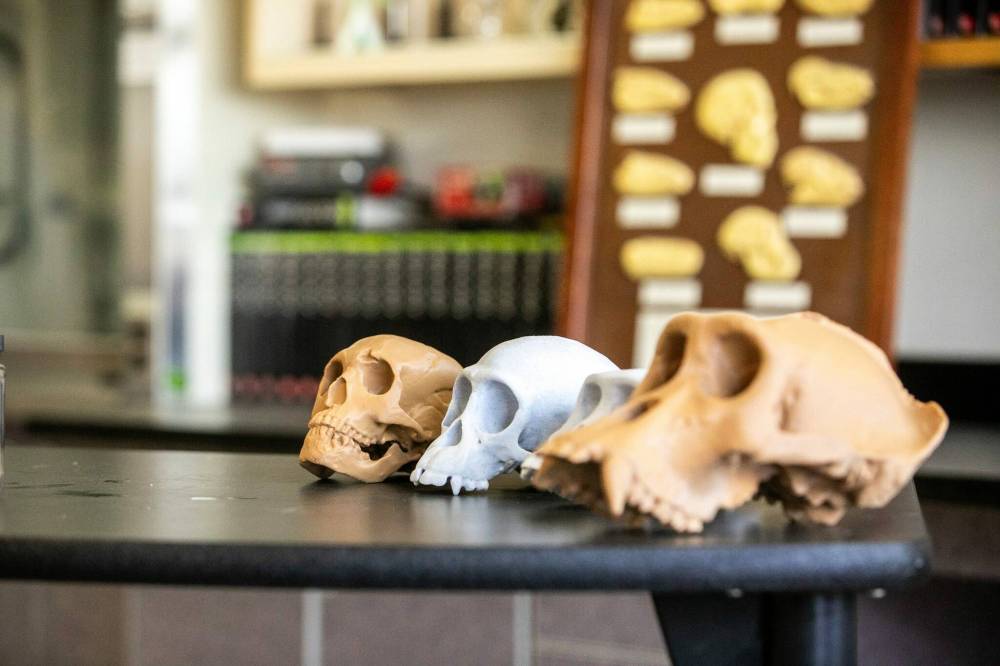
Training has largely been left up to individual teachers and employers who are juggling numerous priorities, the union leader said, noting the province has deployed curriculum developers to deliver training in person in the past.
What’s been released is the product of a “comprehensive, multi-year curriculum renewal process driven by the knowledge and professional expertise of Manitoba teachers,” a government spokesperson said.
They said the Education Department is working closely with teachers and school leaders to provide clear guidance and develop more implementation resources.
Voluntary implementation has been underway since a 2024-25 pilot project involving 90 science teachers.
Education Minister Tracy Schmidt was unavailable for an interview Tuesday. In a statement, Schmidt said the province is committed to ensuring students receive a high-quality science education.
“We will continue working closely with teachers, schools, and divisions to strengthen and refine the curriculum…”
“We will continue working closely with teachers, schools, and divisions to strengthen and refine the curriculum based on feedback to ensure that every student benefits from meaningful, relevant learning that prepares them for the future,” she said.
Despite assurances from government officials, multiple experienced science teachers told the Free Press they’re worried key foundational lessons aren’t being carried over and want the province to pause the rollout to address them.
“There’s absolute holes everywhere.… Science and math is technical. You need explicit direction. Teachers can then bring the creativity,” one high school teacher said.
The Winnipeg-based educator agreed to an interview on the condition of anonymity, citing concerns about retribution from her employer.
She cited specific issues related to the Grade 10 document omitting fundamental concepts, such as acids and bases and chemical compound naming, required for later courses.
Retired curriculum developer Betty Anne Kiddell echoed those concerns, saying she’s worried key skills and ideas in science are being lost because the curriculum has been pared back significantly.
“There are no supporting documents available for teachers with suggested activities, labs or worksheets for each grade of science as in the past,” Kiddell added.
As far as the Manitoba Teachers’ Society is concerned, there’s much work to be done before September if the province wants to mandate the new curriculum.
“Whether that be the old curriculum or the new curriculum, (teachers) need to know what it is that’s asked of them and make sure that’s rolled out in a positive way.”
“Ultimately, all teachers who are science teachers want to have success with the curriculum next year,” Klausen said.
“Whether that be the old curriculum or the new curriculum, they need to know what it is that’s asked of them and make sure that’s rolled out in a positive way.”
Based on what they’ve heard from teachers, Raisinghani and Pozzer said more formal professional development sessions and opportunities for educators to meet with each other will be key.
“The time of transition is always chaotic, it’s always difficult, it’s always challenging.… What is necessary is continued support,” said Pozzer, an associate professor and head of the department of curriculum, teaching and learning at U of M.
The duo continues to seek out teacher experiences with the curriculum as part of their qualitative, rolling-intake study. They are presenting their early findings at the 2026 Big Thinking Summit in Edmonton scheduled for June 9-11.
maggie.macintosh@freepress.mb.ca
Maggie Macintosh
Education reporter
Maggie Macintosh reports on education for the Free Press. Originally from Hamilton, Ont., she first reported for the Free Press in 2017. Read more about Maggie.
Funding for the Free Press education reporter comes from the Government of Canada through the Local Journalism Initiative.
Every piece of reporting Maggie produces is reviewed by an editing team before it is posted online or published in print — part of the Free Press‘s tradition, since 1872, of producing reliable independent journalism. Read more about Free Press’s history and mandate, and learn how our newsroom operates.
Our newsroom depends on a growing audience of readers to power our journalism. If you are not a paid reader, please consider becoming a subscriber.
Our newsroom depends on its audience of readers to power our journalism. Thank you for your support.
Maggie Macintosh
Education reporter
Maggie Macintosh reports on education for the Free Press. Originally from Hamilton, Ont., she first reported for the Free Press in 2017. Read more about Maggie.
Funding for the Free Press education reporter comes from the Government of Canada through the Local Journalism Initiative.
Every piece of reporting Maggie produces is reviewed by an editing team before it is posted online or published in print — part of the Free Press‘s tradition, since 1872, of producing reliable independent journalism. Read more about Free Press’s history and mandate, and learn how our newsroom operates.
Our newsroom depends on a growing audience of readers to power our journalism. If you are not a paid reader, please consider becoming a subscriber.
Our newsroom depends on its audience of readers to power our journalism. Thank you for your support.
Advertisement Advertise With Us
Advertisement Advertise With Us