

City taking steps to reduce speeding in 30 km/h school zones

Advertisement
Read this article for free:
or
Already have an account? Log in here »
To continue reading, please subscribe:

Digital Subscription
One year of digital access for only $205*
- Enjoy unlimited reading on winnipegfreepress.com
- Read the E-Edition, our digital replica newspaper
- Access News Break, our award-winning app
- Play interactive puzzles
*First annual payment billed as $205.00 + GST for one year. This annual subscription will automatically renew at $233.00 + GST every 52 weeks (10% off the regular annual price of $259.35). Offer available to new and qualified returning subscribers only. Cancel any time.
To continue reading, please subscribe:
Add Free Press access to your Brandon Sun subscription for only an additional
$1 for the first 4 weeks*
- Enjoy unlimited reading on winnipegfreepress.com
- Read the E-Edition, our digital replica newspaper
- Access News Break, our award-winning app
- Play interactive puzzles
*Your next Brandon Sun subscription payment will increase by $1.00 and you will be charged $17.95 plus GST for four weeks. After four weeks, your payment will increase to $24.95 plus GST every four weeks.
Read unlimited articles for free today:
or
Already have an account? Log in here »
A pair of 30-kilometre-per-hour school zones known as speeding hot spots are getting safety upgrades this summer amid a citywide probe into posted speed limits.
Winnipeg school officials were recently briefed on hot spots for collisions and photo-radar tickets issued near elementary buildings between the months of September and June, when the maximum limit drops.
“There’s no cookie-cutter kind of solution, unfortunately,” said Denae Dorge, the city’s road safety outreach co-ordinator.
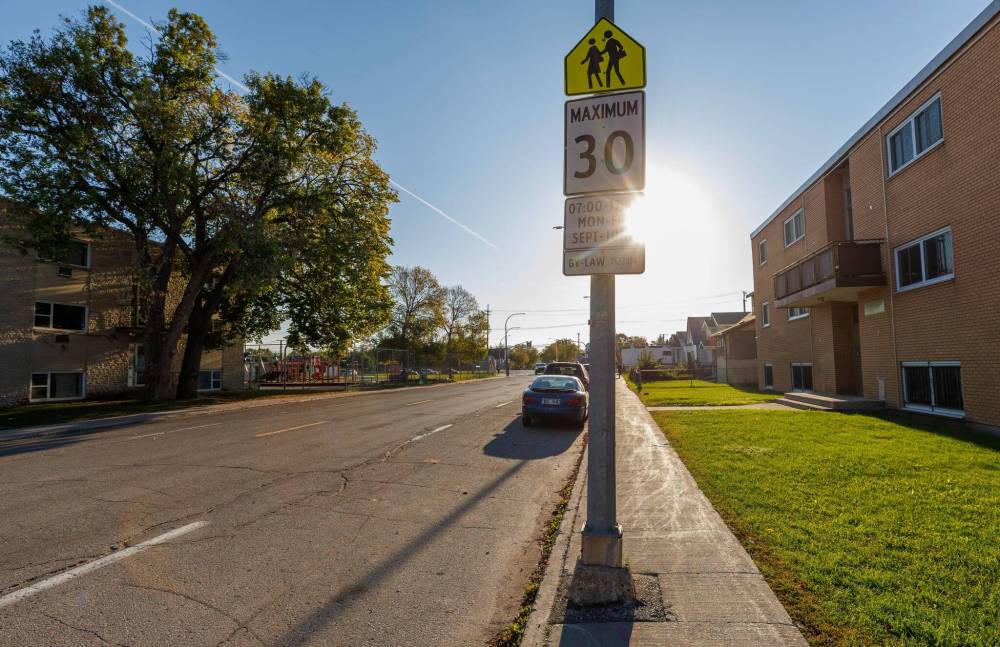
MIKE DEAL / FREE PRESS FILES
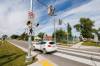
Winnipeg school officials were recently briefed on hot spots for collisions and photo-radar tickets issued near elementary schools.
“You need to have lots of different tools in your toolbox and also, work with the families that attend your school.”
Arthur E. Wright Community School in the Maples (1520 Jefferson Ave.) and H.S. Paul School near St. Vital (160 Southglen Blvd.) will soon have traffic-calming curbs added to their toolboxes.
Ticket hot spots
Listed in alphabetical order, these are the top 10 schools located in reduced-speed zones with the highest rates of tickets per hour of enforcement:
- Arthur E. Wright Community School
- Calvin Christian School
- Greenway School
- H.S Paul School
- River Elm School
- École Riviere Rouge
- École South Pointe School
- Strathcona School
- Stevenson School
- École Van Belleghem
— Mobile speed enforcement data via the City of Winnipeg
A slideshow viewed by the Free Press showed both are on the city’s list of top-10 schools with the highest rates of speeding tickets per hour of enforcement in 30 km/h zones.
Civil servants shared a data-packed presentation, along with new initiatives to reduce traffic and better protect pedestrians, at the Winnipeg School Division headquarters on March 10.
For trustee Ann Evangelista, who represents Ward 9 residents in the inner-city division, the statistics were a wakeup call.
“We could do more. We could do better, and we need to prioritize (school-zone improvements),” Evangelista said, noting she was shocked to learn there’s an average of 75 crashes on city streets every day. “This is an emergency.”
(factBoxRight)
Four schools — Dakota Collegiate (661 Dakota St.), Victor Mager (81 Beliveau Rd.), Kelvin High School (155 Kingsway) and St. Emile School (552 St. Anne’s Rd.) — are located within 200 metres of one of the city’s top-10 problematic intersections, based on network screening data.
The transportation unit ranks its priorities based on collision history, road characteristics and other issues, compared to similar locations.
The Winnipeg School Division submitted a proposal to city hall to implement 24-7, year-round reduced-school speed zones in September.
“Our goal of reducing accidents and fatalities should not be limited to 10 months,” said Evangelista, who chairs the board’s environmental advisory committee.
While she’s personally in favour of lowering limits in all residential neighbourhoods, she said there has been no consensus among or within other boards.
Members of the Manitoba School Boards Association did, however, pass a resolution at their winter convention to lobby governments to formally consult them in matters of traffic safety in and around schools.
Dorge said her unit is keen to work more closely with schools to learn about particularly troublesome areas and brainstorm immediate and permanent measures.
“We’re looking for more nimble ways that we can respond to safety concerns that are quick to install and quite a bit more affordable than a permanent installation,” she said.
Nine schools are involved in a new pilot of in-street crosswalk signage — a traffic-calming measure that’s long been used outside the Perimeter Highway — that began in November.
A total of $4,500 was budgeted to test out high-visibility signage placed in the middle of roads between 8 a.m. and 4 p.m. on school days.
The new addition outside Frontenac School (866 Autumnwood Dr.) immediately elicited positive feedback from student patrollers, families and neighbours in St. Boniface.
Principal Shauna Archer said it’s made “a huge difference” in reducing speeds on the block because drivers can’t ignore the bright yellow post, and they’re forced to navigate around it.
A designated stop-drop-go zone and regular communication with families are all part of the facility’s ongoing efforts to reduce congestion, Archer said.
“It’s important that we’re having these conversations because it is a really essential piece of the puzzle of school,” she said.

Dorge said the pilot has, largely, been seen as a success among participants, but several signs have gone missing.
Along with new signage, her team is regularly reviewing parking zones and lighting and, as of last year, installing traffic-calming curbs, to improve road safety in school zones, she said.
The March 10 slideshow indicates her team has “high-level plans” to analyze all of the top 10 ticket hot spots in school zones over the summer.
maggie.macintosh@freepress.mb.ca
Maggie Macintosh
Education reporter
Maggie Macintosh reports on education for the Free Press. Originally from Hamilton, Ont., she first reported for the Free Press in 2017. Read more about Maggie.
Funding for the Free Press education reporter comes from the Government of Canada through the Local Journalism Initiative.
Every piece of reporting Maggie produces is reviewed by an editing team before it is posted online or published in print — part of the Free Press‘s tradition, since 1872, of producing reliable independent journalism. Read more about Free Press’s history and mandate, and learn how our newsroom operates.
Our newsroom depends on a growing audience of readers to power our journalism. If you are not a paid reader, please consider becoming a subscriber.
Our newsroom depends on its audience of readers to power our journalism. Thank you for your support.
In-street school crosswalk signage pilot
- Victor Mager School and Dakota Collegiate (Beliveau Road, east of Dakota Street)
- Frontenac School (Autumnwood Drive, east of Barberry Road)
- École St. Germain (John Forsyth Road at Thornewood Avenue)
- Princess Margaret School (Rothesay Street and Kingsford Avenue)
- Sun Valley School (Sun Valley Drive and Sunny Hills Road)
- Polson School (Munroe Avenue, west of Watt Street)
- Gladstone School (Gertrude Avenue, east of Nassau Street)
- Stanley Knowles School (King Edward Street and Kinver Avenue)
—2025-26 pilot project, City of Winnipeg
Maggie Macintosh
Education reporter
Maggie Macintosh reports on education for the Free Press. Originally from Hamilton, Ont., she first reported for the Free Press in 2017. Read more about Maggie.
Funding for the Free Press education reporter comes from the Government of Canada through the Local Journalism Initiative.
Every piece of reporting Maggie produces is reviewed by an editing team before it is posted online or published in print — part of the Free Press‘s tradition, since 1872, of producing reliable independent journalism. Read more about Free Press’s history and mandate, and learn how our newsroom operates.
Our newsroom depends on a growing audience of readers to power our journalism. If you are not a paid reader, please consider becoming a subscriber.
Our newsroom depends on its audience of readers to power our journalism. Thank you for your support.
Related Articles
City rejects one-minute school-zone limit
Advertisement Advertise With Us
Advertisement Advertise With Us