

Province unveils findings of grocery price study


Advertisement
Read this article for free:
or
Already have an account? Log in here »
To continue reading, please subscribe:

Digital Subscription
One year of digital access for only $205*
- Enjoy unlimited reading on winnipegfreepress.com
- Read the E-Edition, our digital replica newspaper
- Access News Break, our award-winning app
- Play interactive puzzles
*First annual payment billed as $205.00 + GST for one year. This annual subscription will automatically renew at $233.00 + GST every 52 weeks (10% off the regular annual price of $259.35). Offer available to new and qualified returning subscribers only. Cancel any time.
To continue reading, please subscribe:
Add Free Press access to your Brandon Sun subscription for only an additional
$1 for the first 4 weeks*
- Enjoy unlimited reading on winnipegfreepress.com
- Read the E-Edition, our digital replica newspaper
- Access News Break, our award-winning app
- Play interactive puzzles
*Your next Brandon Sun subscription payment will increase by $1.00 and you will be charged $17.95 plus GST for four weeks. After four weeks, your payment will increase to $24.95 plus GST every four weeks.
Read unlimited articles for free today:
or
Already have an account? Log in here »
Critics say the Manitoba government’s months-long study of grocery prices and its response will do nothing to lower costs for Manitobans.
Finance Minister Adrien Sala on Monday unveiled the report and three new measures government is taking, including giving $2.5 million to Harvest Manitoba to create a new “food transformation centre,” restoring a nutritious food basket tool to regularly measure the cost of food per region and introducing legislation to mandate unit pricing in grocery stores.
“We know there’s more to do,” Sala said, citing steps his government has already taken to address food inflation in Manitoba that’s among the highest in Canada. It has targeted big-grocer property contracts that prevent competition from opening nearby and banned predatory pricing so a consumer’s data can’t be used to charge them more. On July 1, the provincial sales tax is being removed from all grocery foods in Manitoba.
MIKE DEAL / FREE PRESS Finance Minister Adrien Sala introduces the findings of a provincial grocery study at a Monday news conference at the Manitoba legislative building.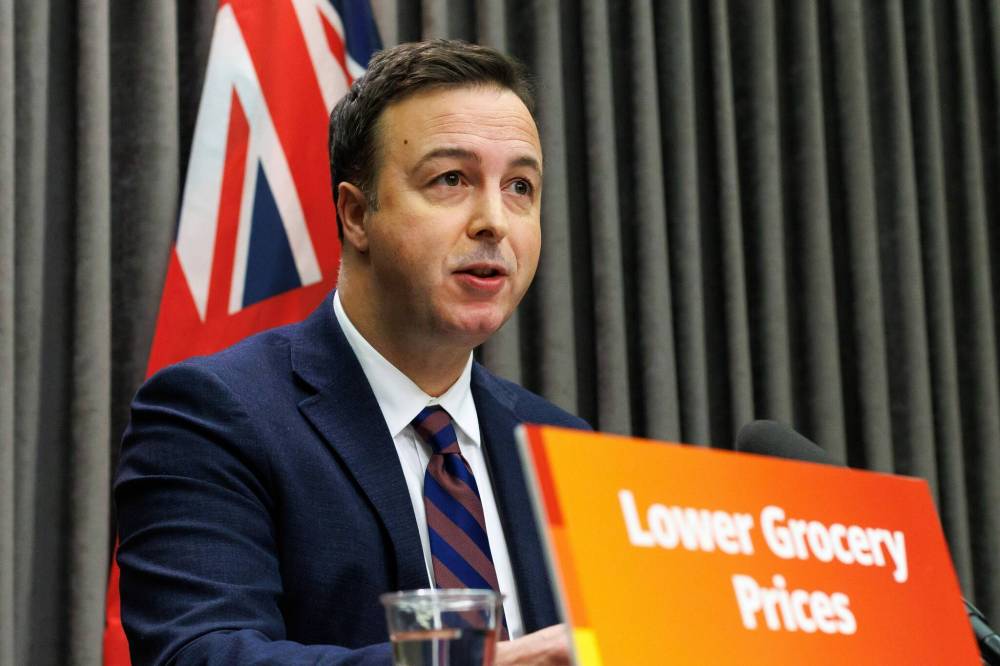
“This study will help guide the next steps,” Sala said of the 40-page report. “We’re committing today to bring in more transparency for Manitobans by ensuring that they can compare and contrast pricing in grocery stores to help them make decisions to save money.”
Price transparency is useful but doesn’t help those who don’t have enough income to buy food in the first place, said Molly McCracken, Manitoba director of the Canadian Centre for Policy Alternatives.
“Corporate grocery chains continue to earn substantial profits while food-bank use is at record levels, and Manitobans on social assistance or low wages cannot afford the basics,” said McCracken.
“We know there’s more to do.”
The Canadian Centre for Policy Alternatives is a think tank that advocates for greater income equality.
McCracken called on the province to tax windfall corporate grocery-store profits and use that revenue to improve social assistance, targeted income transfers for the working poor and to build more social housing.
The $2.5 million to help Manitoba Harvest take bulk donations from farmers and grocery stores to prevent food from going to waste may help food banks operate more efficiently, but they were never intended to be a long-term solution to poverty and food insecurity, she said.
“Today, food banks are filling gaps left by the province,” she said.
Progressive Conservative Leader Obby Khan said Premier Wab Kinew hasn’t kept his promise to address the high cost of groceries.
“This study shows absolutely nothing,” said Khan, who called it a “slap in the face” to Manitobans who are struggling with the cost of living. “Everyone knows the prices of groceries have gone up. What is this government going to do to lower prices?
Manitoba is bringing back a nutritious food basket tool that will regularly measure food prices by region and help the government inform policy. (Graham Hughes / The Canadian Press files)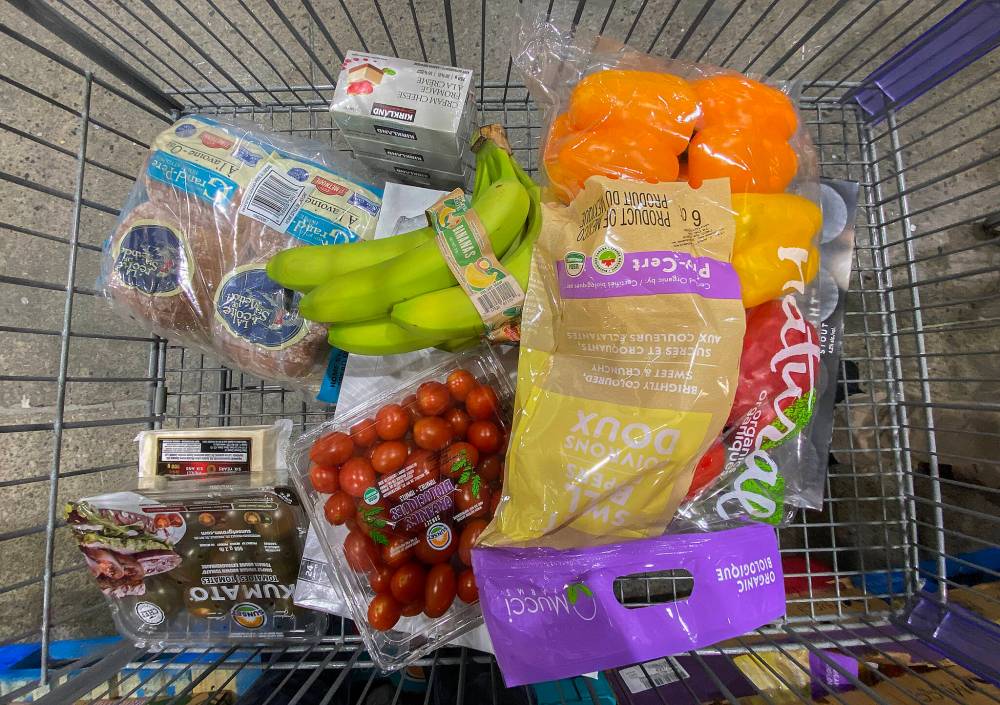
“We have a historic number of Manitobans — over 60,000 — visiting food banks a month.”
Khan said Manitoba’s cost of living increased in May 4.6 per cent, which was higher than most other Canadian provinces. He repeated his call for the province to reduce the amount of income tax Manitobans pay, by nearly doubling the basic personal exemption to $30,000.
“It’s actually appalling that in a time of financial crisis and affordability crisis, that this is the best this NDP government can put forward,” he said.
“This study shows absolutely nothing.”
Sala said legislation is coming that will require all stores to display pricing for food that shows the cost of an item per unit of measurement, such as grams or litres. That will help customers compare products to find the best value, and to call out “shrinkflation.”
Unit pricing could help consumers make informed choices and it could add to operating costs for smaller businessess, the Canadian Federation of Independent Business said Monday.
“Large grocery chains have dedicated pricing and compliance systems already in place, while many independent retailers would have to absorb new costs and administrative work,” said Brianna Solberg. “The government should ensure this policy does not create another competitive disadvantage for small businesses.”
She called on the province to consult with small businesses to ensure those burdens are minimized, provide sufficient time for implementation and to consider exemptions or flexibility for very small retailers.
Grocery prices aren’t likely to come down until until high energy prices fall, said University of Winnipeg economics Prof. Phil Cyrenne.

Energy prices are a key input into food prices through production, distribution and retail costs, Cyrenne said.
“Unless energy prices and restrictions on farmers are reduced, there is little short-term hope that food prices will moderate,” he said.
Manitoba’s inflation rate was 4.6 per cent in May compared with 4.3 per cent in April, Statistics Canada said Monday. It was the third-highest rate among provinces, trailing only Nova Scotia (5.2 per cent) and New Brunswick (4.7 per cent).
Statistics Canada said higher gasoline prices because of the U.S. war with Iran pushed Canada’s inflation rate to 3.2 per cent.
carol.sanders@freepress.mb.ca
chris.kitching@freepress.mb.ca
Carol Sanders
Legislature reporter
In 1997, Carol started at the Free Press working nights as a copy editor. In 2000, she jumped at a chance to return to reporting. In early 2020 — before a global pandemic was declared — she agreed to pitch in, temporarily, at the Free Press legislature bureau. She’s been there ever since.
As a general assignment reporter, Chris covers a little bit of everything for the Free Press.
Our newsroom depends on a growing audience of readers to power our journalism. If you are not a paid reader, please consider becoming a subscriber.
Our newsroom depends on its audience of readers to power our journalism. Thank you for your support.
Odds improving for downtown grocery store
A grocery prices study by the provincial government points to the need for a full-service grocery store in downtown Winnipeg — something that’s long been promoted but may actually be viable now, business advocates say.
“What we’re seeing now is a number of projects that are bringing people downtown where the discussion about the potential of a grocery store becomes even more likely, because now you have that critical mass of people,” said Loren Remillard, president and CEO of the Winnipeg Chamber of Commerce.
“For the longest time, we were always talking in terms of which comes first, the residential population or the grocery store? But we’re seeing the projects bringing the people downtown now,” Remillard said.
Monday’s study pointed to investments in the Portage Place redevelopment and Wehwehneh Bahgahkinahgohn (the former Bay building) that are “helping to bring people downtown and create the business case for a new full-service grocery store in Winnipeg’s core.”
Downtown Winnipeg BIZ CEO Kate Fenske also expressed optimism that downtown is well-poised for a full-service grocery store to set up shop.
“More people are choosing to live downtown and that means we need more amenities,” Fenske said in a prepared statement.
“Significant mixed-use development projects are taking shape and we’re seeing different kinds of businesses open in 2026 which reinforces the confidence we’re seeing downtown as it transforms into a vibrant urban neighbourhood.”
— Carol Sanders
Carol Sanders
Legislature reporter
In 1997, Carol started at the Free Press working nights as a copy editor. In 2000, she jumped at a chance to return to reporting. In early 2020 — before a global pandemic was declared — she agreed to pitch in, temporarily, at the Free Press legislature bureau. She’s been there ever since.
As a general assignment reporter, Chris covers a little bit of everything for the Free Press.
Our newsroom depends on a growing audience of readers to power our journalism. If you are not a paid reader, please consider becoming a subscriber.
Our newsroom depends on its audience of readers to power our journalism. Thank you for your support.
Related Articles
Manitoba’s removal of PST from some groceries doesn’t amount to much

Advertisement Advertise With Us
Advertisement Advertise With Us
History
Updated on Monday, June 22, 2026 6:14 PM CDT: Adds factbox