

Poor drainage also blamed for flooded fields
Farmers anxiously waiting for high waters to recede

Advertisement
Read this article for free:
or
Already have an account? Log in here »
To continue reading, please subscribe:

Digital Subscription
One year of digital access for only $205*
- Enjoy unlimited reading on winnipegfreepress.com
- Read the E-Edition, our digital replica newspaper
- Access News Break, our award-winning app
- Play interactive puzzles
*First annual payment billed as $205.00 + GST for one year. This annual subscription will automatically renew at $233.00 + GST every 52 weeks (10% off the regular annual price of $259.35). Offer available to new and qualified returning subscribers only. Cancel any time.
To continue reading, please subscribe:
Add Free Press access to your Brandon Sun subscription for only an additional
$1 for the first 4 weeks*
- Enjoy unlimited reading on winnipegfreepress.com
- Read the E-Edition, our digital replica newspaper
- Access News Break, our award-winning app
- Play interactive puzzles
*Your next Brandon Sun subscription payment will increase by $1.00 and you will be charged $17.95 plus GST for four weeks. After four weeks, your payment will increase to $24.95 plus GST every four weeks.
Read unlimited articles for free today:
or
Already have an account? Log in here »
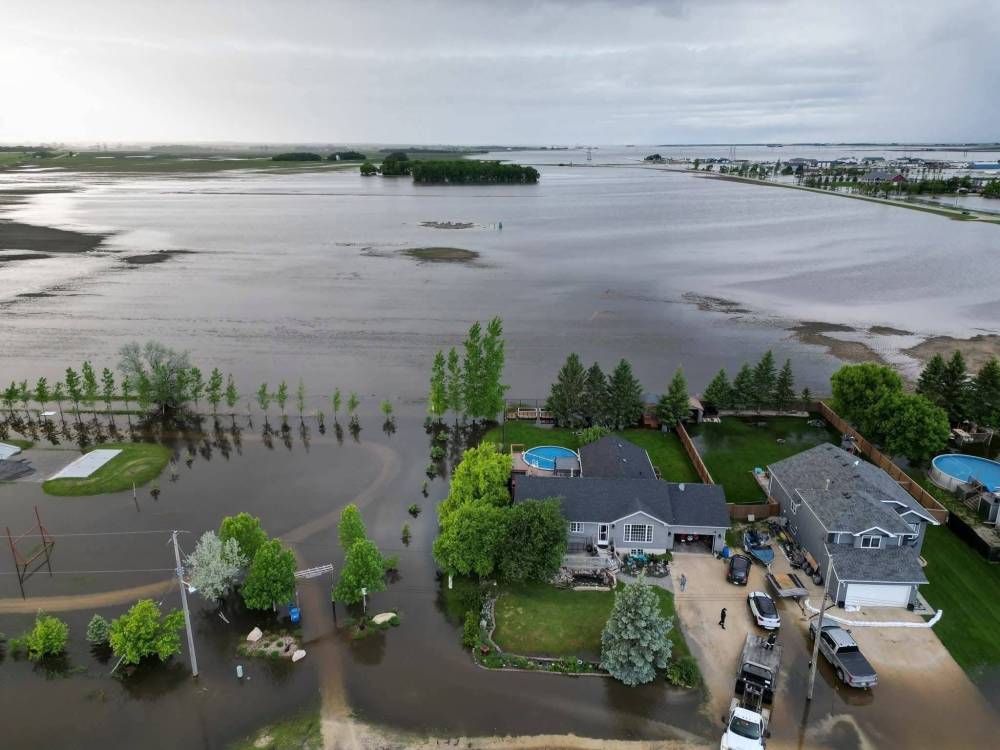
RURAL MUNICIPALITY OF ROCKWOOD — Looking out at his fields Monday afternoon, Curtis Campbell likened his normally green and lush land to retention ponds.
Out of the 3,000 acres of canola and cereal grains he usually farms, he only has about 300 acres left of salvageable crops after a June 9 storm dumped 255 mm of rain in the area. The 37-year-old farmer guesses it will be another month before floodwaters recede.
Even once the water is gone, Campbell estimates he’ll have losses of $600,000 — that’s with crop insurance — and his fields won’t return to normal for another four or five years because of nutrient loss and erosion.
SUPPLIED
Campbell estimates his fields won’t return to normal for another four or five years.
“I won’t make an income for three years,” Campbell said.
Farmers and local leaders in the Interlake region are continuing to call on the provincial and federal government to improve drainage in the area after some farm fields have been under water for nearly a month. Continued rain throughout June has prolonged flood conditions.
In addition to the precipitation, Campbell blames the continued flooding on water flowing from Stony Mountain and Stonewall that has no where to go because the culverts have not been properly maintained for decades.
“It seems to have started to peter down but it’s trapped here,” he said, pointing to a flooded field. “(The water) went up the road, it got to two culverts, then it came backwards.”
Campbell’s fields rely on the Sturgeon and Wavey creeks to carry water from the area and eventually into the Red River, but without proper maintenance the areas continue to flood and farmers are suffering the consequences.
Dozens of agriculture producers held a press conference on June 18 in the neighbouring municipality of Woodlands calling on the province to improve drainage in the area, and the persistent flooding in the region has only heightened their calls for action.
Lakeside MLA Trevor King said the issue transcends politics, and all levels of government need to work together to address the underlying issues of the flooding. Some problems in the area have persisted for four or five decades, King said.
King says he spoke with Agriculture Minister Ron Kostyshyn, who is due to attend a series of meetings next week with ministers from across Canada and their federal counterparts and plans to discuss support for farmers dealing with flooding.
Right now, the only assistance farmers are eligible for is through the province’s disaster financial assistance program via affected municipalities, as well as crop insurance if they have it.
King could not put a dollar figure on anticipated losses in the RM, but says hundreds of thousands of acres have been affected.
Curtis McRae, who farms near Oak Hammock Marsh, has also been inundated with floodwater. His field has been underwater so long he can’t get into it with a vehicle, and his rubber boots only get sucked into the mud. He has resorted to checking his fields in his bare feet.
“It’s a loss and it hurts, but there’s a lot of people I do business with that, it’s not just me, there’s other businesses that thrive off the farming community that they’re going to hurt even harder,” he said.
McRae suggested the province start with “low-hanging fruit” improvements like installing culvert traps, which would catch material and prevent it from clogging the drain systems.
McRae and King also questioned whether Oak Hammock Marsh and other watersheds in the region are being maintained properly. They say the wetlands should have been able to absorb some of the water currently sitting in fields.
“What we need to do is work together to try and make these improvements come to fruition,” King said.
Rockwood Reeve Wes Taplin said the municipality is at the mercy of the province and its drainage infrastructure. In the eight years he’s led the municipality, he says he’s never seen maintenance done on the ditches and culverts.
Since the early June storm, Manitoba Transportation and Infrastructure crews have been removing debris, repairing dikes and placing erosion protection at culvert ends to restore water flow, according to a statement from Kostyshyn’s office.

In 2019, the then Progressive Conservative government amended the Water Rights Act to reduce red tape for low-impact drainage projects, but declined to implement suggestions from the agriculture industry to allow for more robust drainage. Farmers were disappointed the amendments didn’t give farmers the ability to drain wetlands on their lands to maintain productive fields.
Keystone Agricultural Producers passed several resolutions at its annual general meeting in February relating to drainage and infrastructure, including that it lobby the provincial government to ensure that provincial drainage networks are maintained on an annual basis, and that it ask the province review the drainage permitting process, consult with producers and make changes to improve the speed and predictability of agricultural subsurface drainage projects.
The organization is currently seeking feedback from farmers on water control infrastructure to guide its advocacy.
Manitoba Agricultural Services Corporation and Manitoba Agriculture are working with crop and livestock producers to get a clearer picture of the damage and what’s needed for future resiliency, Kostyshyn’s office said Monday evening.
nicole.buffie@freepress.mb.ca
Nicole Buffie
Multimedia producer
Nicole Buffie is a reporter for the Free Press city desk. Born and bred in Winnipeg, Nicole graduated from Red River College’s Creative Communications program in 2020 and worked as a reporter throughout Manitoba before joining the Free Press newsroom as a multimedia producer in 2023. Read more about Nicole.
Every piece of reporting Nicole produces is reviewed by an editing team before it is posted online or published in print — part of the Free Press‘s tradition, since 1872, of producing reliable independent journalism. Read more about Free Press’s history and mandate, and learn how our newsroom operates.
Our newsroom depends on a growing audience of readers to power our journalism. If you are not a paid reader, please consider becoming a subscriber.
Our newsroom depends on its audience of readers to power our journalism. Thank you for your support.
Nicole Buffie
Multimedia producer
Nicole Buffie is a reporter for the Free Press city desk. Born and bred in Winnipeg, Nicole graduated from Red River College’s Creative Communications program in 2020 and worked as a reporter throughout Manitoba before joining the Free Press newsroom as a multimedia producer in 2023. Read more about Nicole.
Every piece of reporting Nicole produces is reviewed by an editing team before it is posted online or published in print — part of the Free Press‘s tradition, since 1872, of producing reliable independent journalism. Read more about Free Press’s history and mandate, and learn how our newsroom operates.
Our newsroom depends on a growing audience of readers to power our journalism. If you are not a paid reader, please consider becoming a subscriber.
Our newsroom depends on its audience of readers to power our journalism. Thank you for your support.
Related Articles
Canadian military team in Parkland region to assist flood-ravaged communities


Advertisement Advertise With Us
Advertisement Advertise With Us