

Frustration, not fear, as Exchange swells after drug crackdown

Advertisement
Read this article for free:
or
Already have an account? Log in here »
To continue reading, please subscribe:

Digital Subscription
One year of digital access for only $205*
- Enjoy unlimited reading on winnipegfreepress.com
- Read the E-Edition, our digital replica newspaper
- Access News Break, our award-winning app
- Play interactive puzzles
*First annual payment billed as $205.00 + GST for one year. This annual subscription will automatically renew at $233.00 + GST every 52 weeks (10% off the regular annual price of $259.35). Offer available to new and qualified returning subscribers only. Cancel any time.
To continue reading, please subscribe:
Add Free Press access to your Brandon Sun subscription for only an additional
$1 for the first 4 weeks*
- Enjoy unlimited reading on winnipegfreepress.com
- Read the E-Edition, our digital replica newspaper
- Access News Break, our award-winning app
- Play interactive puzzles
*Your next Brandon Sun subscription payment will increase by $1.00 and you will be charged $17.95 plus GST for four weeks. After four weeks, your payment will increase to $24.95 plus GST every four weeks.
Read unlimited articles for free today:
or
Already have an account? Log in here »
Natassia Brazeau says she doesn’t feel unsafe living and working in Winnipeg’s Exchange District — instead, she feels heartbreak.
She said that feeling intensified last week during the Winnipeg Police Service’s controversial 10-day crackdown on open drug use and drug trafficking which pushed people away from the Main Street strip.
Brazeau, who owns a business in the area, said she has never seen so many people head to the Exchange District at once.
“I’m absolutely enraged at the police response last week,” Brazeau said. “Not only was that incredibly short-sighted and doesn’t do anything, it doesn’t assist anyone that are already in incredibly vulnerable situations.”
Last week, she said there were two overdoses near her shop, including one outside her storefront, where she administered naloxone to revive a woman in distress.
She said the police response lacked compassion.
“I’m absolutely enraged at the police response last week. Not only was that incredibly short-sighted and doesn’t do anything, it doesn’t assist anyone that are already in incredibly vulnerable situations.”
“This is not an unsafe situation,” she said. “We’re not seeing violence. We’re not seeing some of the negative effects of this drug crisis. That’s not my experience and that’s definitely something I’m not interested in contributing to.”
Front-line outreach organizations have voiced similar concerns, warning the operation would just push the drug users into less visible spaces.
Another business owner in the Exchange, who asked not to be identified, said the public has lost sight of the human cost of the crisis.
A couple of weeks ago, he said, a woman was standing in the middle of the street in the “fentanyl fold,” in which drug users appear to be slumped over and frozen in place. Traffic continued to speed past the woman, he said, and some motorists slowed only long enough to roll down their windows and yell at the woman.
He said he’s rarely had confrontations with drug users and said about 95 per cent of the time, a conversation is enough to de-escalate the situation.
“Unfortunately some people don’t like to look at it,” he said. “But tough s—-. This is the reality right now. Whether you like it or not, nobody asks for it, but this is where we are. It’s do or die for some of these people.
“We have an obligation to help the people in this city. And getting angry and calling the police, calling people to try and push them further into hiding, that’s how we lose lives.”
“We have an obligation to help the people in this city.”
Michael Paille has adopted a similar philosophy in the West End. The co-owner of Cobra Collectibles on Sargent Avenue said he has watched former customers — children he once knew — succumb to addiction.
“It’s hard to see that,” he said Tuesday.
Paille said he routinely asks groups who have gathered outside businesses to move along, with no confrontation. He has also administered naloxone to roughly 40 people, including a 12-year-old.
He carries injectable naloxone, nasal Narcan, water, medical supplies and a list of resources for people seeking shelter, food or addictions services.
“I think we need more people out there doing this,” he said.
The work has come at a cost. Paille, who wears a camera for his own safety, said he has been assaulted twice while helping people, including once when he was struck on the back of the neck with a two-by-four, causing a minor concussion.
Outreach workers say they feared the scenarios outlined by business owners.
During a meeting with Winnipeg police Chief Gene Bowers and senior officials, agencies described the harms they witnessed as people were displaced during the crackdown.
MIKE DEAL / FREE PRESS FILES Winnipeg Police Service Chief Gene Bowers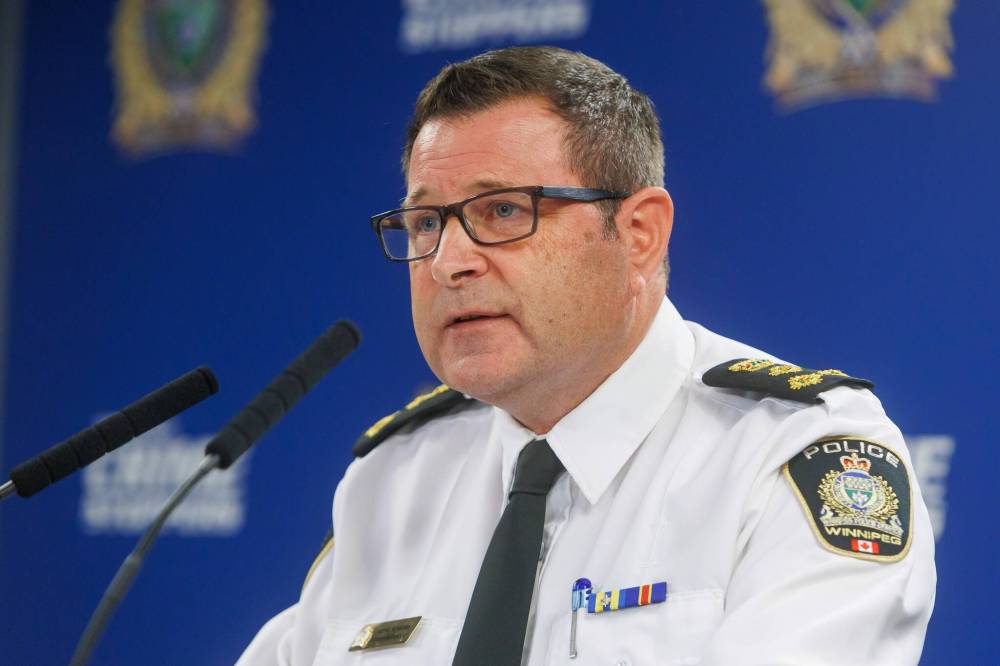
The agencies told police a woman had died from an apparent drug poisoning after being found in the bushes near the West Central Women’s Resource Centre — an unmonitored location.
Lorie English, executive director of the centre, said staff found another person near the same bushes a couple of days later.
“We know that people are looking for places out of sight,” she said.
On Monday, staff received a threat from someone who said they planned to burn down the building because the organization distributes harm-reduction supplies.
“When we do things like this, what we do is embolden the general public, who doesn’t understand harm reduction, who doesn’t understand what good, evidence-based, public health responses look like to a toxic drug crisis,” she said. “It emboldens them to further bring violence and harm to our unsheltered relatives, particularly people who use drugs, but also to lash out at agencies like ours.”
The outreach agencies said the police chief told them that after learning of the death, officers would only focus on serious offences, such as assaults, during the final two days of the operation. The agencies also said he agreed to redirect the remaining sweeps away from the Main Street corridor, where many outreach organizations are based.

For a time, they believed police were prepared to change course. Instead, they said, the campaign continued.
“I don’t know how to make this any clearer, but it’s mind-boggling to me how they don’t see the harm that was caused,” English said.
When announcing the operation two days after it began, Bowers acknowledged he should have informed front-line agencies beforehand.
On the final day, outreach organizations released a joint statement saying the campaign had taken a heavy toll on the homeless and workers trying to keep them safe.
Agency representatives have said a follow-up meeting with the police chief is planned.
scott.billeck@freepress.mb.ca
Scott Billeck is a general assignment reporter for the Free Press. A Creative Communications graduate from Red River College, Scott has more than a decade’s worth of experience covering hockey, football and global pandemics. He joined the Free Press in 2024. Read more about Scott.
Every piece of reporting Scott produces is reviewed by an editing team before it is posted online or published in print — part of the Free Press‘s tradition, since 1872, of producing reliable independent journalism. Read more about Free Press’s history and mandate, and learn how our newsroom operates.
Our newsroom depends on a growing audience of readers to power our journalism. If you are not a paid reader, please consider becoming a subscriber.
Our newsroom depends on its audience of readers to power our journalism. Thank you for your support.
Scott Billeck is a general assignment reporter for the Free Press. A Creative Communications graduate from Red River College, Scott has more than a decade’s worth of experience covering hockey, football and global pandemics. He joined the Free Press in 2024. Read more about Scott.
Every piece of reporting Scott produces is reviewed by an editing team before it is posted online or published in print — part of the Free Press‘s tradition, since 1872, of producing reliable independent journalism. Read more about Free Press’s history and mandate, and learn how our newsroom operates.
Our newsroom depends on a growing audience of readers to power our journalism. If you are not a paid reader, please consider becoming a subscriber.
Our newsroom depends on its audience of readers to power our journalism. Thank you for your support.
Related Articles
Police crackdown on Main a pointless, ineffective bit of street theatre






Advertisement Advertise With Us
Advertisement Advertise With Us
History
Updated on Wednesday, July 8, 2026 7:56 PM CDT: tweaks description