

Play for all: story time inspires students to fight for accessible playgrounds

Advertisement
Read this article for free:
or
Already have an account? Log in here »
To continue reading, please subscribe:

Digital Subscription
One year of digital access for only $205*
- Enjoy unlimited reading on winnipegfreepress.com
- Read the E-Edition, our digital replica newspaper
- Access News Break, our award-winning app
- Play interactive puzzles
*First annual payment billed as $205.00 + GST for one year. This annual subscription will automatically renew at $233.00 + GST every 52 weeks (10% off the regular annual price of $259.35). Offer available to new and qualified returning subscribers only. Cancel any time.
To continue reading, please subscribe:
Add Free Press access to your Brandon Sun subscription for only an additional
$1 for the first 4 weeks*
- Enjoy unlimited reading on winnipegfreepress.com
- Read the E-Edition, our digital replica newspaper
- Access News Break, our award-winning app
- Play interactive puzzles
*Your next Brandon Sun subscription payment will increase by $1.00 and you will be charged $17.95 plus GST for four weeks. After four weeks, your payment will increase to $24.95 plus GST every four weeks.
Read unlimited articles for free today:
or
Already have an account? Log in here »
Concerned about injustice on their school jungle gym, St. Vital students spent months researching upgrades to make playgrounds more accessible for children in Manitoba.
Darwin School is dismissed for the summer, but one of its teachers plans to resume an advocacy project after the break.
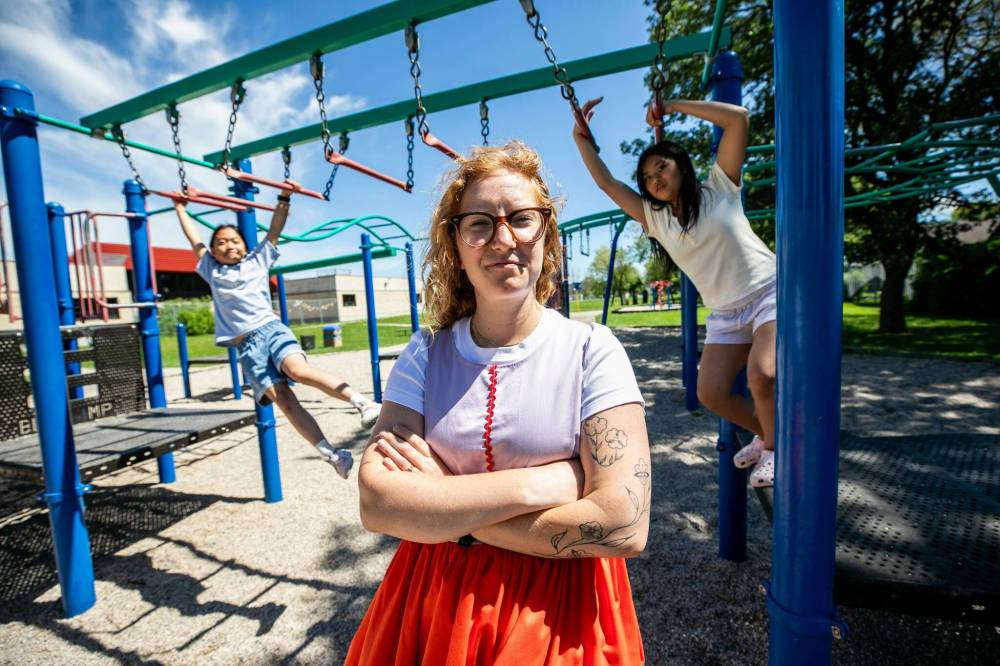
“It’s not fair,” 12-year-old Selena Wei said about the fact one of her classmates — along with other children who use wheelchairs — can’t fully experience the pea-gravel playground at 175 Darwin St. and others like it.
MIKAELA MACKENZIE / FREE PRESS
Grade five/six teacher Tia Friesen with students Fiona and Selena at the Darwin School playground on Tuesday. Their class spent much of the year researching accesible playgrounds and advocating for upgrades, but were disappointed to learn about how costly it would be to include their classmate, who is in a wheelchair.
“A playground is a really big part of a child’s life. It’s where they experience most of their outside time and where they’re the most social,” Selena said.
Midway through the school year, as elected officials debated who should pay to build and replace school swingsets and slides, Tia Friesen’s Grade 5/6 class was studying common disabilities and adaptable infrastructure.
The students learned it would cost about $300,000 to give their schoolyard in Winnipeg an inclusive makeover.
The Grade 5 and 6 students recently penned letters to MLAs, trustees and Darwin’s parent council, among others, to request support for the proposed renovations.
“The kids latched onto this concept — that the world isn’t made with everyone in mind — and that the people who are forgotten need allies,” Friesen said.
A classroom reading of a picture book written by a pair of disability activists sparked questions about who is left out on playgrounds.
This Is How We Play, a kid-friendly guide to exploring disability that features families who adapt so all of the characters can have fun, was among the books Friesen shared with her students in the fall.
The elementary school teacher said she was “so excited” about the interest her students showed, their empathy and the discussions about universal design that came out of it. The activity snowballed into a multi-pronged assignment they revisited repeatedly until the end of June.
Prior to entering the teaching profession, Friesen worked in interior design. General accessibility, as well as the inaccessible nature of school buildings built before the 21st century, is often on her mind, she said.
Darwin School opened in 1973. The building is surrounded by a soccer field, baseball diamond and play structure equipped with monkey bars, slides and railing-protected platforms.
Fiona Xiao, 12, has spent a lot of her young life on playgrounds, often on the monkey bars or competing in a tag-like game of grounders.
Drawing on her experience and Grade 6 research, Fiona said the “giant slide” and overall setup at Assiniboine Park is far superior to the facilities at her school.
The nature playground in west Winnipeg has wide paths, rubber flooring and a wheelchair-accessible swing with adjustable handlebars.
The site became a case study, along with Jumpstart Playground, a universally accessible site that opened near Pan Am Pool in 2018.
Friesen split students into six groups and tasked each with studying a different topic, such as autism, ADHD or auditory, mobility or visual impairments.
The teams used their newfound knowledge and manufacturer catalogs to come up with a proposal to upgrade their kindergarten-to-Grade 8 school playground. Then came a persuasive writing assignment.
The children sent letters in a bid to convince adults in positions of power that helping them fundraise would benefit everyone in their community.
“People in this community deserves to play,” Fiona said.
Both Fiona and Selena endorsed flat playground surfaces — instead of woodchips or pebbles that can get stuck in wheel wells — and communication boards.
(Some playgrounds in the city already have weatherproof signage with icons, text and stick figures to help nonverbal users communicate.)
Their class landed an end-of-year meeting with trustees, but Friesen said she plans to revisit the initiative in the fall. She’s expected to teach many of the same students next year.
Manitoba schools often rely on volunteer-run parent councils to fundraise for playgrounds — a reality that has sparked calls for change at Winnipeg City Hall.

The province created a new playground fund, with $3 million set aside to build new structures at existing schools, in Budget 2026.
Darwin School’s council has raised money to upgrade a basketball court and create an outdoor classroom over the last decade.
Longtime member Melissa Martin said she was excited to learn about the Grade 5/6 group’s advocacy work.
“Many families” have noted there’s a need for accessibility enhancements on the playground, Martin said.
maggie.macintosh@freepress.mb.ca
Maggie Macintosh
Education reporter
Maggie Macintosh reports on education for the Free Press. Originally from Hamilton, Ont., she first reported for the Free Press in 2017. Read more about Maggie.
Funding for the Free Press education reporter comes from the Government of Canada through the Local Journalism Initiative.
Every piece of reporting Maggie produces is reviewed by an editing team before it is posted online or published in print — part of the Free Press‘s tradition, since 1872, of producing reliable independent journalism. Read more about Free Press’s history and mandate, and learn how our newsroom operates.
Our newsroom depends on a growing audience of readers to power our journalism. If you are not a paid reader, please consider becoming a subscriber.
Our newsroom depends on its audience of readers to power our journalism. Thank you for your support.
Maggie Macintosh
Education reporter
Maggie Macintosh reports on education for the Free Press. Originally from Hamilton, Ont., she first reported for the Free Press in 2017. Read more about Maggie.
Funding for the Free Press education reporter comes from the Government of Canada through the Local Journalism Initiative.
Every piece of reporting Maggie produces is reviewed by an editing team before it is posted online or published in print — part of the Free Press‘s tradition, since 1872, of producing reliable independent journalism. Read more about Free Press’s history and mandate, and learn how our newsroom operates.
Our newsroom depends on a growing audience of readers to power our journalism. If you are not a paid reader, please consider becoming a subscriber.
Our newsroom depends on its audience of readers to power our journalism. Thank you for your support.
Advertisement Advertise With Us
Advertisement Advertise With Us