

Nearly one in four watercraft fail inspection during roadside blitz to prevent aquatic pests

Advertisement
Read this article for free:
or
Already have an account? Log in here »
To continue reading, please subscribe:

Digital Subscription
One year of digital access for only $205*
- Enjoy unlimited reading on winnipegfreepress.com
- Read the E-Edition, our digital replica newspaper
- Access News Break, our award-winning app
- Play interactive puzzles
*First annual payment billed as $205.00 + GST for one year. This annual subscription will automatically renew at $233.00 + GST every 52 weeks (10% off the regular annual price of $259.35). Offer available to new and qualified returning subscribers only. Cancel any time.
To continue reading, please subscribe:
Add Free Press access to your Brandon Sun subscription for only an additional
$1 for the first 4 weeks*
- Enjoy unlimited reading on winnipegfreepress.com
- Read the E-Edition, our digital replica newspaper
- Access News Break, our award-winning app
- Play interactive puzzles
*Your next Brandon Sun subscription payment will increase by $1.00 and you will be charged $17.95 plus GST for four weeks. After four weeks, your payment will increase to $24.95 plus GST every four weeks.
Read unlimited articles for free today:
or
Already have an account? Log in here »
More than 120 watercraft failed a roadside inspection over the weekend aimed at slowing the spread of aquatic invasive species, including zebra mussels.
The inspections were conducted by Fisheries and Oceans Canada in partnership with the Manitoba government between June 19 and 21 on the Trans-Canada Highway at the Manitoba-Ontario border. It was the second roadside blitz of the summer season.
One of the 455 vehicles transporting 502 watercraft or related equipment had visible zebra mussels present. Inspectors found 120 watercraft were not cleaned, drained, or dried and failed the inspection. Thirteen watercraft required decontamination.
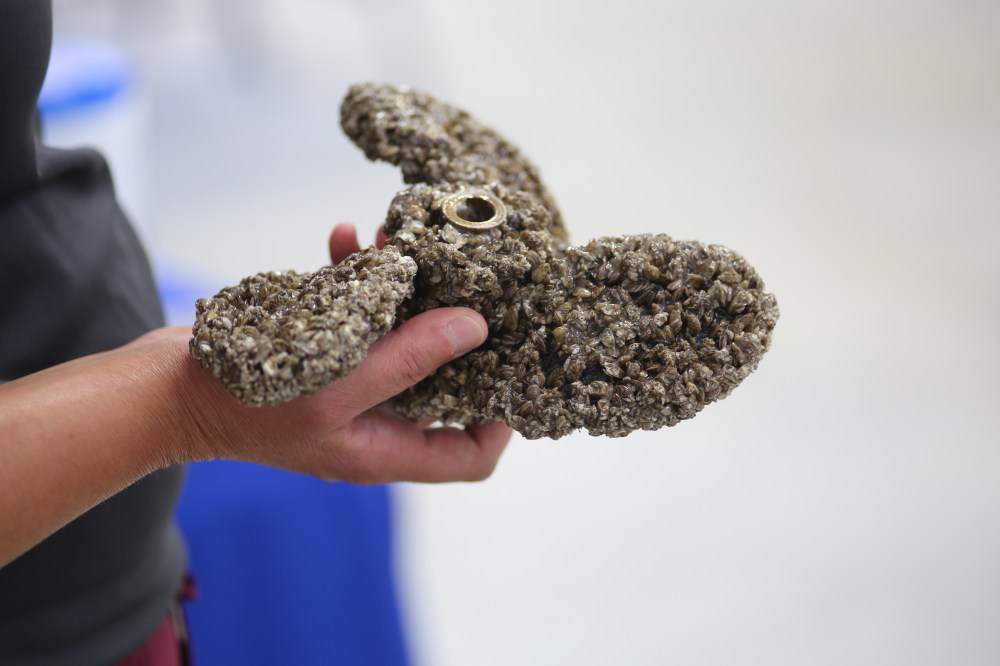
KYLE DARBYSON / THE BRANDON SUN FILES
Adult zebra mussels on a standard boat propeller in 2020. At a roadside inspection this weekend, 120 watercraft were not cleaned, drained, or dried and failed the inspection.
“Healthy lakes and rivers are essential to the communities that rely on them. Through joint inspection efforts with the Government of Manitoba, we are working to protect those waters from aquatic invasive species and preserve Canada’s freshwater ecosystems for generations to come,” federal Fisheries Minister Joanne Thompson said in a news release.
Motorized and non-motorized watercraft were inspected, including canoes, kayaks, fishing boats, sailboats, jet skis, inflatables, anchors and fishing gear.
Individuals who violate regulations may face up to $100,000 in fines.
The inspections have increased in recent years to intercept vehicles transporting watercraft and equipment that may carry aquatic pests, including zebra and quagga mussels. Aquatic invasive species can grow quickly, compete with native species and alter habitats. They can cost billions of dollars annually in damages to infrastructure and revenue loss in Canada, the news release said.
Watercraft inspection stations are set up throughout the province. Anyone transporting boats, motorized or not, is required to stop for an examination.
The federal government lifted a ban on motorboats in Clear Lake this summer, after they were outlawed following the discovery of zebra mussels in the waterway.

In 2023, Parks Canada instituted a “one boat, one lake” policy following the discovery of zebra mussels. All boats, except for the Martese tour boat, were banned in the summer of 2024 after it was determined the invasive species couldn’t be contained.
In early July, the province announced zebra mussel larvae was detected in Lake of the Prairies, a manmade reservoir on the Assiniboine River that straddles the Manitoba-Saskatchewan border.
The province has activated its aquatic invasive species early detection rapid response plan and set up a joint Manitoba-Saskatchewan incident command structure, with help from the feds. Officials are working on a multi-jurisdictional containment plan.
All boats and any water-related equipment used on the Lake of the Prairies must be decontaminated before being used on another body of water, officials said.
nicole.buffie@freepress.mb.ca
Nicole Buffie
Multimedia producer
Nicole Buffie is a reporter for the Free Press city desk. Born and bred in Winnipeg, Nicole graduated from Red River College’s Creative Communications program in 2020 and worked as a reporter throughout Manitoba before joining the Free Press newsroom as a multimedia producer in 2023. Read more about Nicole.
Every piece of reporting Nicole produces is reviewed by an editing team before it is posted online or published in print — part of the Free Press‘s tradition, since 1872, of producing reliable independent journalism. Read more about Free Press’s history and mandate, and learn how our newsroom operates.
Our newsroom depends on a growing audience of readers to power our journalism. If you are not a paid reader, please consider becoming a subscriber.
Our newsroom depends on its audience of readers to power our journalism. Thank you for your support.
Nicole Buffie
Multimedia producer
Nicole Buffie is a reporter for the Free Press city desk. Born and bred in Winnipeg, Nicole graduated from Red River College’s Creative Communications program in 2020 and worked as a reporter throughout Manitoba before joining the Free Press newsroom as a multimedia producer in 2023. Read more about Nicole.
Every piece of reporting Nicole produces is reviewed by an editing team before it is posted online or published in print — part of the Free Press‘s tradition, since 1872, of producing reliable independent journalism. Read more about Free Press’s history and mandate, and learn how our newsroom operates.
Our newsroom depends on a growing audience of readers to power our journalism. If you are not a paid reader, please consider becoming a subscriber.
Our newsroom depends on its audience of readers to power our journalism. Thank you for your support.
Related Articles
Zebra mussels found in Lake of the Prairies

Advertisement Advertise With Us
Advertisement Advertise With Us
History
Updated on Wednesday, July 22, 2026 10:19 AM CDT: Corrects month