

Coalition dismayed after U of M decides not to establish master’s in speech-language pathology

Advertisement
Read this article for free:
or
Already have an account? Log in here »
To continue reading, please subscribe:

Digital Subscription
One year of digital access for only $205*
- Enjoy unlimited reading on winnipegfreepress.com
- Read the E-Edition, our digital replica newspaper
- Access News Break, our award-winning app
- Play interactive puzzles
*First annual payment billed as $205.00 + GST for one year. This annual subscription will automatically renew at $233.00 + GST every 52 weeks (10% off the regular annual price of $259.35). Offer available to new and qualified returning subscribers only. Cancel any time.
To continue reading, please subscribe:
Add Free Press access to your Brandon Sun subscription for only an additional
$1 for the first 4 weeks*
- Enjoy unlimited reading on winnipegfreepress.com
- Read the E-Edition, our digital replica newspaper
- Access News Break, our award-winning app
- Play interactive puzzles
*Your next Brandon Sun subscription payment will increase by $1.00 and you will be charged $17.95 plus GST for four weeks. After four weeks, your payment will increase to $24.95 plus GST every four weeks.
Read unlimited articles for free today:
or
Already have an account? Log in here »
A new coalition representing students who stutter, speak with a lisp and struggle with other speech challenges is decrying the University of Manitoba’s decision to shelve plans to train in-demand clinicians.
U of M recently scrapped a proposal to establish a master of speech-language pathology — a program that exists only outside the province.
“It’s hard to provide the support that students deserve and support teachers and school teams and families with our large caseloads,” said Allison Sexton, a speech-language pathologist who works in the public education sector.
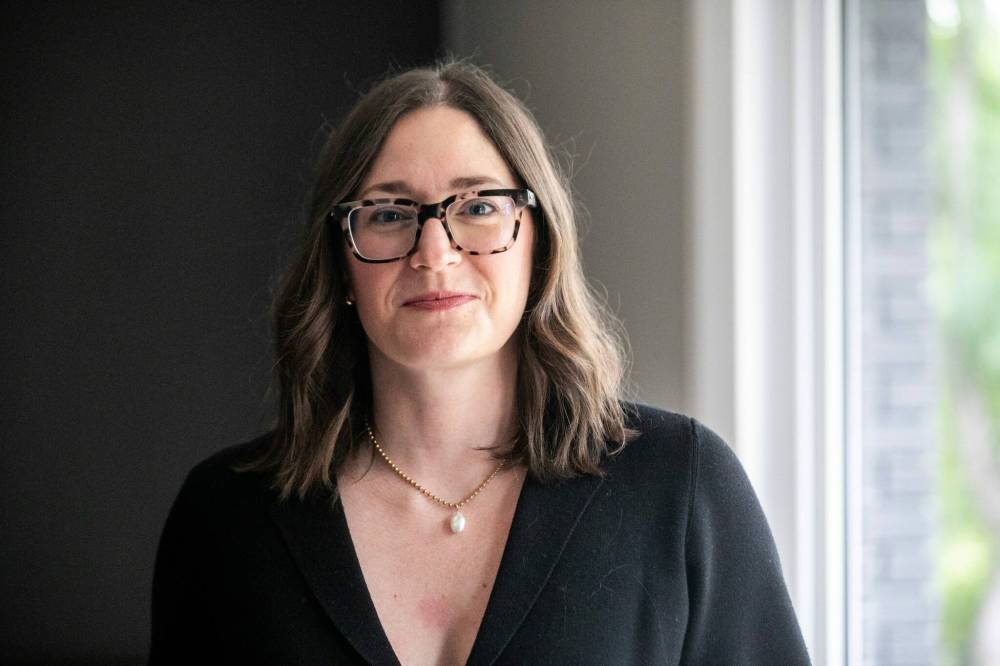
MIKAELA MACKENZIE / FREE PRESS
Jade Fisette is a speech language pathologist who runs Sandbox Speech Therapy in Winnipeg.
Sexton is one of the organizers behind a campaign that is ramping up ahead of back-to-school season to raise awareness about a chronic shortage of experts in her field and related wait lists.
It is common for a single professional to be assigned more than 100 students in Winnipeg, she said, adding that ratios are even more challenging outside the Perimeter Highway.
Speech-language pathologists assess oral communication skills, deploy intervention techniques and monitor progress. They also train educational assistants to do one-on-one coaching and create adaptive plans for children who cannot rely solely on speech to communicate.
Not unlike many of her colleagues, Jade Fisette moved south of the border to train to become a certified clinician who can help children with stuttering, voice resonance and related problems.
Fisette said she was “very surprised” to learn U of M isn’t moving forward with an equivalent to the graduate program she completed at Minot State University in 2018.
Sandbox Speech Therapy is regularly receiving requests for support to help toddlers and three-year-olds who aren’t talking yet or have an extremely limited vocabulary, the private clinic’s co-owner said.
“I see the demand first-hand and how many families are actively looking for speech-language services for their children. Even families who have private insurance or are willing to pay out of pocket can have difficulty finding services,” Fisette said.
Sarah Boaz sought public and private services for her now 10-year-old son, who required intensive, explicit and repetitive lessons to master every consonant sound in the English language.
“His kindergarten teacher said she understood 10 per cent of what he said when he entered (in September 2021),” said Boaz, a mother of three in Gimli.
At that point, her middle child had already been accessing clinician support, on and off, owing to service disruptions, for three years. It took 18 months for the family to secure an initial visit with a public practitioner.
“There’s a way to solve the problem and that’s educating SLPs, so let’s get on it,” Boaz said.
In a June 9 letter to clinicians, professor Reg Urbanowski, then-dean of the U of M College of Rehabilitation Services, announced the university was pausing efforts to launch a new master’s program.
There was significant complexity, resources and infrastructure required to implement and sustain it, Urbanowski said.
His memo said U of M would need to establish a dedicated department to meet accreditation and disciplinary requirements.
University spokesperson Ilana Simon confirmed the proposal, which took the better part of the last year to develop, never advanced to the stage of seeking the province’s support for it.
Simon called it the first “full program proposal” of its kind, but sources told the Free Press this isn’t the first false start on the campus.
The College of Audiologists and Speech-Language Pathologists of Manitoba, which is in charge of regulating 420 fully licensed speech-language pathologists, is aware of at least two previous attempts to create a local program.
Registrar Colleen Braun said demand for their expertise is high in the education and health-care sectors, and the regulatory college is in support of developing a made-in-Manitoba graduate degree.
Without a local program “we are losing the cultural competence and community knowledge that, really, the clients need,” said Britney Morrish, a speech-language pathologist who was tapped in May 2025 to undertake research and create course outlines for U of M.
The founder of Gimli’s Language and Literacy Clinic of Manitoba said she cried after learning the university wouldn’t be proceeding with the project.
Morrish said it’s disheartening how inequitable access to life-changing services is in rural, northern and remote communities at present.

She noted there’s a higher proportion of First Nations children who need services as is because this population is more likely to be geographically isolated from early screening and intervention services.
“A hodge-podge group” of people who want to improve services and better support children across Manitoba is calling for a U-turn, Morrish said.
Both Morrish and Fisette, of Sandbox Speech Therapy, indicated a surge in demand for speech-language services appears to be tied to an increase in screen time and corresponding drop in early conversations among families.
Multiple speech-language pathologists told the Free Press the status quo pressures are ultimately impacting kids’ confidence levels because they don’t understand why they’re struggling in school or don’t have access to the support they need to succeed.
maggie.macintosh@freepress.mb.ca
Maggie Macintosh
Education reporter
Maggie Macintosh reports on education for the Free Press. Originally from Hamilton, Ont., she first reported for the Free Press in 2017. Read more about Maggie.
Funding for the Free Press education reporter comes from the Government of Canada through the Local Journalism Initiative.
Every piece of reporting Maggie produces is reviewed by an editing team before it is posted online or published in print — part of the Free Press‘s tradition, since 1872, of producing reliable independent journalism. Read more about Free Press’s history and mandate, and learn how our newsroom operates.
Our newsroom depends on a growing audience of readers to power our journalism. If you are not a paid reader, please consider becoming a subscriber.
Our newsroom depends on its audience of readers to power our journalism. Thank you for your support.
Maggie Macintosh
Education reporter
Maggie Macintosh reports on education for the Free Press. Originally from Hamilton, Ont., she first reported for the Free Press in 2017. Read more about Maggie.
Funding for the Free Press education reporter comes from the Government of Canada through the Local Journalism Initiative.
Every piece of reporting Maggie produces is reviewed by an editing team before it is posted online or published in print — part of the Free Press‘s tradition, since 1872, of producing reliable independent journalism. Read more about Free Press’s history and mandate, and learn how our newsroom operates.
Our newsroom depends on a growing audience of readers to power our journalism. If you are not a paid reader, please consider becoming a subscriber.
Our newsroom depends on its audience of readers to power our journalism. Thank you for your support.
Advertisement Advertise With Us
Advertisement Advertise With Us