

Indigenous peoples are deeply invested in Canada

Advertisement
Read this article for free:
or
Already have an account? Log in here »
To continue reading, please subscribe:

Digital Subscription
One year of digital access for only $205*
- Enjoy unlimited reading on winnipegfreepress.com
- Read the E-Edition, our digital replica newspaper
- Access News Break, our award-winning app
- Play interactive puzzles
*First annual payment billed as $205.00 + GST for one year. This annual subscription will automatically renew at $233.00 + GST every 52 weeks (10% off the regular annual price of $259.35). Offer available to new and qualified returning subscribers only. Cancel any time.
To continue reading, please subscribe:
Add Free Press access to your Brandon Sun subscription for only an additional
$1 for the first 4 weeks*
- Enjoy unlimited reading on winnipegfreepress.com
- Read the E-Edition, our digital replica newspaper
- Access News Break, our award-winning app
- Play interactive puzzles
*Your next Brandon Sun subscription payment will increase by $1.00 and you will be charged $17.95 plus GST for four weeks. After four weeks, your payment will increase to $24.95 plus GST every four weeks.
Read unlimited articles for free today:
or
Already have an account? Log in here »
Elections Canada released a report this week that stated that, in the 2025 federal election, approximately 41 per cent of eligible First Nations, Inuit and Métis voters cast a ballot and contributed significantly to the federal Liberals and Prime Minister Mark Carney making a political comeback.
For anyone curious about how Manitoba fared, the numbers in this province were slightly lower — but still very strong, with 34 per cent participation.
This is a far cry from the highest rate of Indigenous participation in a federal election — that would be the 60 per cent who cast a ballot in 2015, when Justin Trudeau’s Liberals defeated Stephen Harper’s Conservatives — but it’s still higher than the abysmal numbers seen in decades previous.
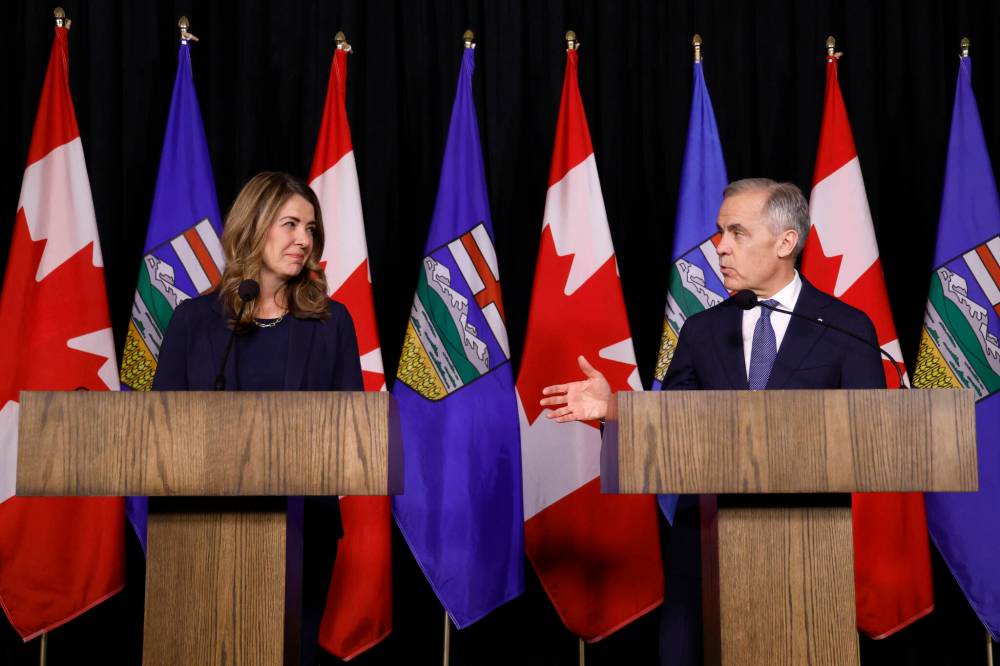
Recently, Carney and Smith were issued a strongly worded warning by the Union of British Columbia Indian Chiefs (UBCIC) about the destructive and disastrous consequences of expanding fossil fuel production as more than 100 devastating wildfires burn throughout that province. (The Canadian Press files)
First Nations voters have only been allowed the legal right to cast a ballot in Canadian elections since 1960, but many in the past — perhaps rightly — felt a sense of complicity in the country’s colonization or, worse, that voting didn’t make a difference.
Not anymore.
Today, Indigenous peoples are more invested than ever in the institutions, economies and communities that make up this country — and they appear to be demonstrating this on a daily basis.
Take, for example, the rise of separatism in Alberta.
While started by right-wing groups and then emboldened by Premier Danielle Smith — and the topic will be included in this fall’s set of provincial referendum questions — the primary voices arguing for Alberta to stay within the Canadian federation has not been Prime Minister Carney or Alberta opposition leader Naheed Nenshi, but First Nations chiefs.
“Any proposal to separate Alberta from Canada has no jurisdiction over the Blackfoot Confederacy, our lands, our Treaties, or our Nations,” a Jan. 30, 2026 statement from the Siksikaitsitapi Blackfoot Confederacy announced. “Treaty 7 is a nation-to-nation agreement with the Crown — not with the Province of Alberta. No provincial government holds the authority to unmake or renegotiate the Treaty relationship.”
Later, at the Western Premiers’ Conference in May, Manitoba Premier Wab Kinew — who has a master’s degree in Indigenous governance and is a member of the Treaty 3 community of the Ojibways of Onigaming — reminded Smith of this fact.
That same month, the Blackfoot Confederacy, alongside other First Nations from Treaty 6 and 8, took the province of Alberta to court — and won — saying any and all moves in the interests of separatism (such as a referendum) require consultation with the First Nations who have treaties with Canada.
The decision was correct; the shared lands that encompass treaties 6, 7, and 8 predate the creation of Alberta and span about 90 per cent of the province.
This all leads to the question: who is fighting hardest to keep Canada together?
This week, Carney and Smith were issued a strongly worded warning by the Union of British Columbia Indian Chiefs (UBCIC) as more than 100 devastating wildfires burn throughout that province.
“The destructive and disastrous consequences of expanding fossil fuel production extend far beyond any single territory,” states the Aug. 9 UBCIC letter to the two Canadian leaders.
“From catastrophic wildfires to destructive floods and rising seas, the impacts of climate change are already being felt across this country. Every new fossil fuel project deepens that crisis.”
Last month, the governments led by Carney and Smith agreed to a partnership to build a 1,250-kilometre pipeline to deliver up to one million barrels of crude oil per day from Alberta through British Columbia and many First Nations territories.
“Canadians are witnessing increasingly destructive wildfires, catastrophic flooding, extreme heat, and other climate disasters with growing frequency,” the UBCIC letter argues. “Governments cannot respond to these disasters while simultaneously approving infrastructure designed to increase fossil fuel extraction and greenhouse gas emissions.
Who is fighting first and foremost for Canada’s air, water, and land and therefore the lives of Canadians?
But wait, there’s more — and we’re talking just this week.
In Saskatchewan, leaders from the Métis Nation-Saskatchewan were lobbying the provincial government to implement an Indigo Alert system that would inform authorities and the public when a vulnerable person such as a child with autism, a mentally ill person, or a senior with dementia goes missing.
In northern Ontario, regional First Nations organizations like Anishinabek Nation and Nishnawbe Aski Nation spent the week mobilizing clothing, emergency lodgings and supply drives to support residents displaced by nearly 100 active wildfires.

While First Nations citizens make up the majority of evacuees, impacted Canadians also come from Dryden, Thunder Bay and Fort Frances.
In Manitoba, meanwhile, the first Indigenous-run safe consumption site opened this week in Winnipeg to allow people from any walk of life experiencing addiction access to safe drugs and alcohol in a supported environment while also offering medical help and resources.
There is this belief — perhaps with some historical merit — that Indigenous peoples are not invested in the success of Canada and Canadians and are mired in mistrust and resistance, refusing to interact with Canadians or participate in the country’s institutions.
It just ain’t true anymore.
niigaan.sinclair@freepress.mb.ca
Niigaan Sinclair is Anishinaabe from Peguis First Nation and a professor in the Department of Indigenous Studies at the University of Manitoba. He’s been a columnist for the Free Press since 2018. Read more about Niigaan.
Every piece of writing Niigaan produces is reviewed by an editing team before it is posted online or published in print — part of the Free Press‘s tradition, since 1872, of producing reliable independent journalism. Read more about Free Press’s history and mandate, and learn how our newsroom operates.
Our newsroom depends on a growing audience of readers to power our journalism. If you are not a paid reader, please consider becoming a subscriber.
Our newsroom depends on its audience of readers to power our journalism. Thank you for your support.
Niigaan Sinclair is Anishinaabe from Peguis First Nation and a professor in the Department of Indigenous Studies at the University of Manitoba. He’s been a columnist for the Free Press since 2018. Read more about Niigaan.
Every piece of writing Niigaan produces is reviewed by an editing team before it is posted online or published in print — part of the Free Press‘s tradition, since 1872, of producing reliable independent journalism. Read more about Free Press’s history and mandate, and learn how our newsroom operates.
Our newsroom depends on a growing audience of readers to power our journalism. If you are not a paid reader, please consider becoming a subscriber.
Our newsroom depends on its audience of readers to power our journalism. Thank you for your support.
Related Articles
Feds reports progress on climate adaptation but climate groups say it isn't enough






Advertisement Advertise With Us
Advertisement Advertise With Us