

Province officially recognizes arboriculture as a trade

Advertisement
Read this article for free:
or
Already have an account? Log in here »
To continue reading, please subscribe:

Digital Subscription
One year of digital access for only $205*
- Enjoy unlimited reading on winnipegfreepress.com
- Read the E-Edition, our digital replica newspaper
- Access News Break, our award-winning app
- Play interactive puzzles
*First annual payment billed as $205.00 + GST for one year. This annual subscription will automatically renew at $233.00 + GST every 52 weeks (10% off the regular annual price of $259.35). Offer available to new and qualified returning subscribers only. Cancel any time.
To continue reading, please subscribe:
Add Free Press access to your Brandon Sun subscription for only an additional
$1 for the first 4 weeks*
- Enjoy unlimited reading on winnipegfreepress.com
- Read the E-Edition, our digital replica newspaper
- Access News Break, our award-winning app
- Play interactive puzzles
*Your next Brandon Sun subscription payment will increase by $1.00 and you will be charged $17.95 plus GST for four weeks. After four weeks, your payment will increase to $24.95 plus GST every four weeks.
Read unlimited articles for free today:
or
Already have an account? Log in here »
Arboriculture has officially been recognized as a trade in Manitoba, which industry experts say will help address the increased demand for tree experts across the province.
On July 20 the approval was granted by the province, making Manitoba the fifth jurisdiction in Canada to recognize arboriculture as a trade, along with Nova Scotia, New Brunswick, B.C. and Ontario.
Currently, arborists working in Manitoba don’t need any specific training. Most have an International Society of Arboriculture certification — a designation earned through a written test and three years’ experience — and a tree pruner’s licence, but there were no set standards for the profession.
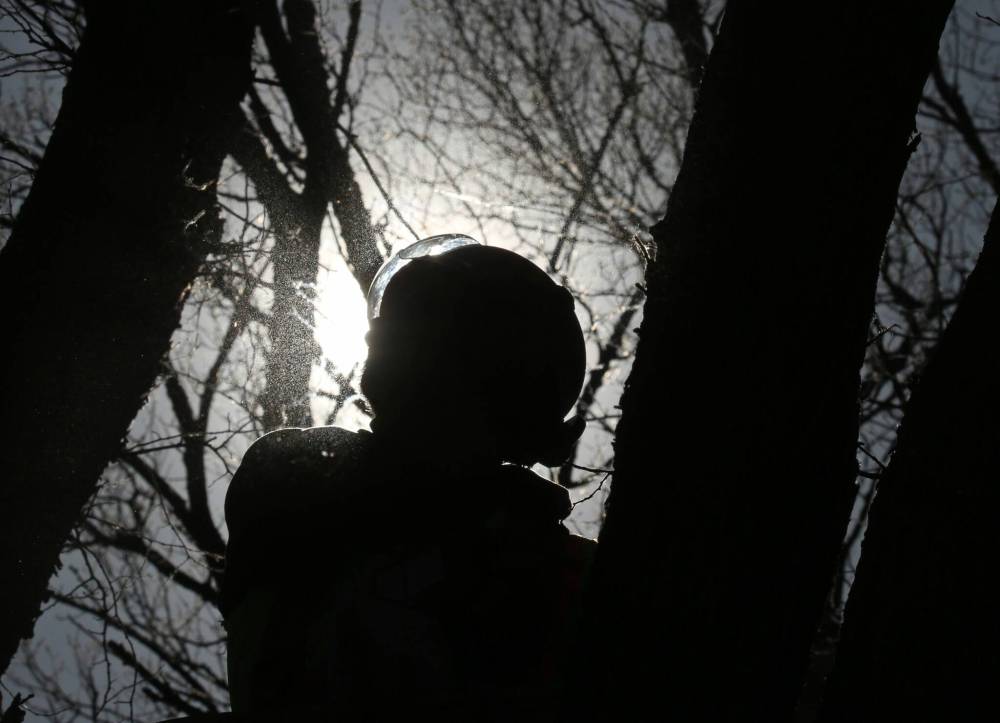
MATT GOERTZEN / THE BRANDON SUN FILES
The official status of Arboriculture as a trade will open up opportunities for mentorship, support and professional development.
“In Manitoba arboriculture kind of fell between some other trades, so it was kind of lumped in together with landscaping,” said Nick Stewart, a committee member of the Manitoba Urban Forest Council. “So the industry was quite fragmented.”
Officially designating trades is driven by industry demand, so in 2019 a group formed the Manitoba Urban Forestry Council to call for the province to recognize arboriculture.
Recognizing arborists for their trade will increase safety in the profession through a set of standardized requirements for schooling and training, as is the case for mechanics, plumbers and electricians, among others, Stewart said.
The province recognizes 54 designated trades.
The City of Winnipeg’s push to increase its urban tree canopy, as well as disease and pests such as Dutch elm disease and the emerald ash borer has increased the demand for arborists in the province and created a labour shortage.
Stewart, who is also the president of Green Drop Lawn Care and has 15 years experience as an arborist, is hopeful the new designation will attract labour to the province and pique the interest of graduating high school students.
“There are a lot of kids coming out of high school who are interested in this sort of thing and know they like working outside, but there’s not really a path for it, so this now helps that,” he said.
The recognition is only the first step in a lengthy process before a course can be taught at trade schools. Apprenticeship Manitoba must now begin the legislative process required to add arborist to Manitoba’s apprenticeship and certification regulations, which will then be followed by the development occupational standards, technical training and certification examinations.
The process is expected to take at least two years.
The designation also creates an opportunity to align the provincial trade with the development of a potential Red Seal designation for arboriculture, but a nationwide designation would also take work, since the trade designation for arboriculture has different requirements in each province where it’s recognized.
Arboriculture will be a voluntary trade and taking courses won’t necessarily be needed to get a job as an arborist in Manitoba, but academics say offering the courses provides a hyper-local understanding of tree health issues that current international certification doesn’t.
“There are a lot of kids coming out of high school who are interested in this sort of thing and know they like working outside, but there’s not really a path for it, so this now helps that.”
Alexander Martin, a PhD student at the University of Oxford who is from Winnipeg and a certified arborist, recently published a research paper on the state of professional regulations for arborists across Canada and found that while Manitoba has some of the strongest legislation across Canada when it comes to who can practise as an arborist, having training that focuses on local trees and their risks will better protect the urban tree canopy.
“You have those health and safety components coming in through both the schooling and the on-the-job training that you might not get without the provincial trade designation,” Martin said.

Some trades also require a continuing education element to maintain certification in the industry, which Martin said would be valuable for arborists, considering the changing nature of urban forestry due to climate change.
Jamie Moses, the provincial minister of business, mining, trade and job creation, said the designation reflects the “strong support we have received from employers, municipalities, educational institutions, and industry organizations across the province.”
Arborists from Manitoba, Saskatchewan and Alberta will be at Kildonan Park this weekend for the 36th annual International Society of Arboriculture prairie chapter’s tree-climbing competition.
Participants will compete in various events involving tree climbing, aerial rescue, rope and equipment handling, movement through the tree canopy, safety and technical skill. The highest-scoring competitors will advance to the masters’ challenge, and the top male and female climbers will have the opportunity to represent the prairie chapter at the ISA International Tree Climbing Championship in Belgium in 2027.
nicole.buffie@freepress.mb.ca
Nicole Buffie
Multimedia producer
Nicole Buffie is a reporter for the Free Press city desk. Born and bred in Winnipeg, Nicole graduated from Red River College’s Creative Communications program in 2020 and worked as a reporter throughout Manitoba before joining the Free Press newsroom as a multimedia producer in 2023. Read more about Nicole.
Every piece of reporting Nicole produces is reviewed by an editing team before it is posted online or published in print — part of the Free Press‘s tradition, since 1872, of producing reliable independent journalism. Read more about Free Press’s history and mandate, and learn how our newsroom operates.
Our newsroom depends on a growing audience of readers to power our journalism. If you are not a paid reader, please consider becoming a subscriber.
Our newsroom depends on its audience of readers to power our journalism. Thank you for your support.
Nicole Buffie
Multimedia producer
Nicole Buffie is a reporter for the Free Press city desk. Born and bred in Winnipeg, Nicole graduated from Red River College’s Creative Communications program in 2020 and worked as a reporter throughout Manitoba before joining the Free Press newsroom as a multimedia producer in 2023. Read more about Nicole.
Every piece of reporting Nicole produces is reviewed by an editing team before it is posted online or published in print — part of the Free Press‘s tradition, since 1872, of producing reliable independent journalism. Read more about Free Press’s history and mandate, and learn how our newsroom operates.
Our newsroom depends on a growing audience of readers to power our journalism. If you are not a paid reader, please consider becoming a subscriber.
Our newsroom depends on its audience of readers to power our journalism. Thank you for your support.
Related Articles
Wolseley residents put down roots to save elms
Advertisement Advertise With Us
Advertisement Advertise With Us