

Interprovincial trade missions on rise under tariffs pressure

Advertisement
Read this article for free:
or
Already have an account? Log in here »
To continue reading, please subscribe:
Digital Subscription
One year of digital access for only $1.44 a week*
- Enjoy unlimited reading on winnipegfreepress.com
- Read the E-Edition, our digital replica newspaper
- Access News Break, our award-winning app
- Play interactive puzzles
*Billed as $5.77 plus GST every four weeks. After 52 weeks, price increases to the regular rate of $19.95 plus GST every four weeks. Offer available to new and qualified returning subscribers only. Cancel any time.
To continue reading, please subscribe:
Add Free Press access to your Brandon Sun subscription for only an additional
$1 for the first 4 weeks*
- Enjoy unlimited reading on winnipegfreepress.com
- Read the E-Edition, our digital replica newspaper
- Access News Break, our award-winning app
- Play interactive puzzles
*Your next Brandon Sun subscription payment will increase by $1.00 and you will be charged $17.95 plus GST for four weeks. After four weeks, your payment will increase to $24.95 plus GST every four weeks.
Read unlimited articles for free today:
or
Already have an account? Log in here »
Interprovincial trade missions are poised to become more common as a Canada-United States trade war persists.
Prairies Economic Development Canada is working with trade commissioners nationwide to create gatherings with business groups, including chambers of commerce, according to the federal cabinet minister overseeing the department.
“I think the idea of interprovincial trade missions is (an) incredibly efficient and sensible way for businesses to learn about one another,” Eleanor Olszewski, Minister of Emergency Management and Community Resilience and Minister Responsible for Prairies Economic Development Canada said.
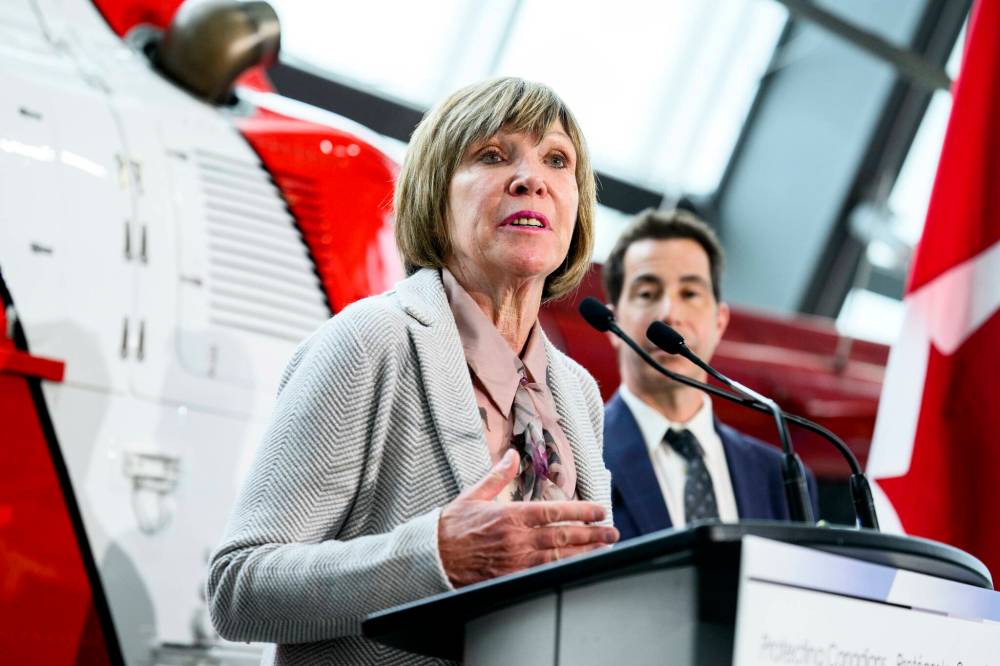
She visited Winnipeg last week and spoke to the Free Press on Friday.
On Tuesday, Canadian counter-tariffs on $27.6 billion worth of United States imports took effect.
Some $3.6 billion worth of Manitoba imports are exposed to retaliatory tariffs, based on 2024 figures, a provincial government spokesperson said. Another $584 million in Manitoba exports are exposed to U.S. tariffs, by 2024 numbers.
Olszewski announced $15.9 million in funding last week for local manufacturers hit by tariffs. Some companies, such as Fort Garry Fire Trucks, are increasing production in Manitoba to avoid counter-tariffs. Many are restructuring their supply chains.
Olszewski said she’s noticed “synergies” between Manitoba and her home province of Alberta. She highlighted defence and critical minerals sectors.
She’s hoping for increased trade between those provinces — and with provinces across the country, she said.
The Manitoba Chambers of Commerce has trade missions tentatively planned for Montreal, Halifax and Regina later this year. Calgary, Regina, Edmonton, Saskatoon and Toronto could be in the books for the first half of 2027.
“The mandate is quite important. It’s really to help Manitoba businesses sell more within Canada, to build new commercial relationships and to ideally reduce reliance on any single market,” said Elisabeth Saftiuk, acting president of the Manitoba chambers.
Visits go both ways, she added: the Manitoba chambers hosted companies from Alberta, Saskatchewan, Ontario and Nunavut in July, to show them around Winnipeg and Churchill.
The non-profit is working increasingly closely with its Alberta and Saskatchewan counterparts. Saftiuk called the regions “natural partners.” Their economies share several key sectors and supply chains, and they face the same questions around market access and transportation, she said.
Alberta sent a delegation to Manitoba in December.
“Any of these economic development tours — it’ll be critically important that whatever it is that we do or undertake is solving a problem for business,” Saftiuk said, adding government supports of other forms are needed as businesses get hit by tariffs.
The Manitoba government announced $500,000 for alcohol industry-focused trade missions, to be partly led by the Manitoba chambers. Staff are awaiting more details, Saftiuk said.
The Winnipeg Chamber of Commerce created a 19-page document highlighting persistent interprovincial trade barriers. Semi-truck size limits and winter road maintenance standards are among the items identified.
Keeping those barriers in place will hinder relationships built during trade missions, said Loren Remillard, president of the Winnipeg chamber.
“There isn’t a single (barrier),” Remillard said. “That’s the insidious part of red tape and interprovincial trade barriers. It works as a complex web — very sticky and very difficult to break through.”
Interprovincial trade barrier removal has been a priority of the premier’s business and jobs council, said Remillard, who’s a member.
(Ottawa announced plans to roll back its internal trade barriers in November. Manitoba has adopted the Fair Trade in Canada Act, which allows for mutual recognition of goods and services with jurisdictions who have similar laws.)
Remillard plans to brainstorm how to increase interprovincial trade during a Canadian Global Cities Council meeting next week. He began chairing the council, which includes the chambers of Canada’s eight largest cities, this spring.
Businesses are seeking liquidity in the short-term and new suppliers and customers in the long-term, Remillard said. The United States will remain Canada’s primary trading partner, he added.
An estimated $42 billion in two-way trade crosses the Manitoba-United States border annually.
“Decoupling from those relationships is not an overnight process,” said Manitoba New Technology Minister Mike Moroz.

The provincial government continues with a handful of information and technology contracts it signed with U.S.-based companies.
The Progressive Conservatives criticized the New Democrats last year for funnelling at least $4.5 million through the contracts. One, with the Iowa Department of Transportation, has since been renewed.
The $157,157 contract began in April and ends in March 2027. Manitoba has been using Iowa’s software for its electronic ticket and motor vehicle crash reports, through Manitoba Transportation and Infrastructure, for years. The Manitoba data isn’t collected in Iowa, a spokesperson for the U.S. department said.
“We need to make sure that as we do that work to bring some of those contracts home, that we’re being diligent about it,” Moroz said. “We’re being thoughtful, in terms of protecting the services that they’re providing for Manitobans … and protecting the economic interests of Manitobans.”
gabrielle.piche@winnipegfreepress.com
Gabrielle Piché reports on business for the Free Press. She interned at the Free Press and worked for its sister outlet, Canstar Community News, before entering the business beat in 2021. Read more about Gabrielle.
Every piece of reporting Gabrielle produces is reviewed by an editing team before it is posted online or published in print — part of the Free Press‘s tradition, since 1872, of producing reliable independent journalism. Read more about Free Press’s history and mandate, and learn how our newsroom operates.
Our newsroom depends on a growing audience of readers to power our journalism. If you are not a paid reader, please consider becoming a subscriber.
Our newsroom depends on its audience of readers to power our journalism. Thank you for your support.
Gabrielle Piché reports on business for the Free Press. She interned at the Free Press and worked for its sister outlet, Canstar Community News, before entering the business beat in 2021. Read more about Gabrielle.
Every piece of reporting Gabrielle produces is reviewed by an editing team before it is posted online or published in print — part of the Free Press‘s tradition, since 1872, of producing reliable independent journalism. Read more about Free Press’s history and mandate, and learn how our newsroom operates.
Our newsroom depends on a growing audience of readers to power our journalism. If you are not a paid reader, please consider becoming a subscriber.
Our newsroom depends on its audience of readers to power our journalism. Thank you for your support.
Related Articles
Kinew says Manitoba stands with PM in trade war with U.S.



Advertisement Advertise With Us
Advertisement Advertise With Us