

Committee vote brings outdoor learning facility one step closer for Riel school division
Project still needs a green light from city hall

Advertisement
Read this article for free:
or
Already have an account? Log in here »
To continue reading, please subscribe:
Digital Subscription
One year of digital access for only $1.44 a week*
- Enjoy unlimited reading on winnipegfreepress.com
- Read the E-Edition, our digital replica newspaper
- Access News Break, our award-winning app
- Play interactive puzzles
*Billed as $5.77 plus GST every four weeks. After 52 weeks, price increases to the regular rate of $19.95 plus GST every four weeks. Offer available to new and qualified returning subscribers only. Cancel any time.
To continue reading, please subscribe:
Add Free Press access to your Brandon Sun subscription for only an additional
$1 for the first 4 weeks*
- Enjoy unlimited reading on winnipegfreepress.com
- Read the E-Edition, our digital replica newspaper
- Access News Break, our award-winning app
- Play interactive puzzles
*Your next Brandon Sun subscription payment will increase by $1.00 and you will be charged $17.95 plus GST for four weeks. After four weeks, your payment will increase to $24.95 plus GST every four weeks.
Read unlimited articles for free today:
or
Already have an account? Log in here »
Plans for an outdoor education facility that would host Indigenous and land-based learning for the Louis Riel School Division are moving forward.
The one-storey, 10,869-square-foot (1,010-square-metre) building would feature three classrooms, seven offices, multi-purpose rooms, workstations and common areas. The site would also offer an entry plaza and an outdoor classroom on 8.2 acres (3.3 hectares) of land at 3280 St. Mary’s Rd. in the St. Vital Perimeter South neighbourhood.
Existing buildings would remain and be used as a bus maintenance shop, outdoor material storage sheds and a covered outdoor work area.
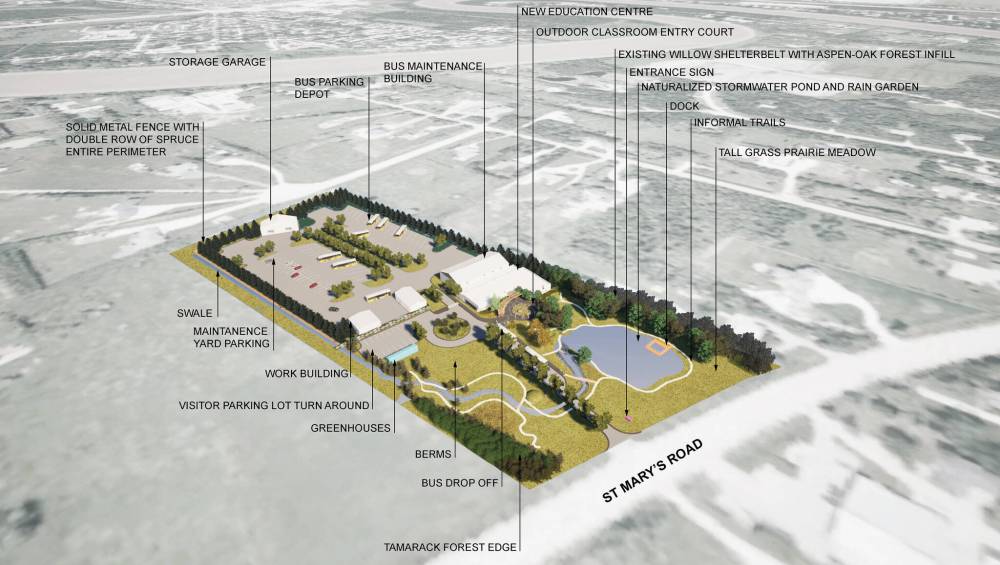
SUPPLIED
Plans for the Louis Riel School Division’s outdoor education facility would include a 10,869-square-foot (1,010-square-metre) building with three classrooms, seven offices, multi-purpose rooms, workstations and common areas and an outdoor classroom on 8.2 acres (3.3 hectares) of land at 3280 St. Mary’s Rd. in the St. Vital Perimeter South neighbourhood.
Once the facility is built, students could take field trips to the site to learn about the environment, as well as Indigenous culture.
“We can expand on (the) types of programming that we do with our Indigenous elders,” said Jamie Rudnicki, the division’s secretary-treasurer and chief financial officer. “So, whether it’s like a summer solstice or those type of ceremonies, that’s the intent of the land.”
The project would also restore a prairie landscape, including a mixed aspen forest, naturalized rain garden and a naturalized pond.
Greenhouses would be used to grow traditional Indigenous medicines, possibly sweet grass, sage or tobacco, which would support lessons. Exact details of programs and the classroom itself will be determined through consultation, Rudnicki said.
“As we walk along our journey to reclaiming that land to its natural space, our Indigenous grandmothers and grandfathers, elders, as well as our Indigenous students and community, will be leading that work,” he said.
On Friday, the Riel community committee held a hearing on the plan at city hall and voted in favour of it.
Michael Robinson, a senior city planner, told the committee the development would be a good fit for the community around it.
“An outdoor education facility is compatible with the rural character of the area,” said Robinson, during the hearing.
The proposal still requires a final city council vote.
No one spoke against the plan at the hearing.
One resident urged the city to reject the use of existing buildings on the site to maintain more than 50 buses, however, arguing that such a structure would be better placed in an industrial area.
“Bus maintenance involves vehicle storage, servicing, traffic, noise, deliveries and potentially other industrial-type activities … We find it’s not compatible with the area,” said Ed Westphal.
He welcomed the education portion of the project.
“The bus transportation part does not suit the area. The rest of it is fantastic,” Westphal said.
Project proponents say a six-foot (1.8-metre) tall privacy fence and a vegetation buffer of about the same height will be placed around a parking area to address those concerns.
The division said it will also follow a city condition that it not wash buses at the site, to avoid creating new demands on an aquifer.
A planner said the site should operate for fewer hours than a landscaping company that previously used the same property.
“There’s no evening use on the site, no weekend use on the site. Compared to the landscaping operation, it will be quite minimal,” said Jeff Pratte, a partner with Landmark Planning and Design.
The property would remain without city sewer and water service, relying on a septic field in its front yard.
Coun. Brian Mayes (St. Vital) said the project would add valuable learning opportunities.
“I think it’s a great outdoor education (space with) … the reconciliation aspects, but also just education about nature,” said Mayes.
The division promised to be good neighbours and responsible stewards of the land.

Rudnicki said organizers hope to construct the facility within the next two to four years, though exact timelines are still being determined.
The development was initially expected to cost about $10 million, though revisions to meet city conditions and address community concerns, such as the fencing buffer, have not yet been added in.
The division said the project was inspired by Seven Oaks School Division’s land-based learning initiative at the Aki Centre in West St. Paul.
joyanne.pursaga@freepress.mb.ca
X: @joyanne_pursaga
Joyanne is city hall reporter for the Winnipeg Free Press. A reporter since 2004, she began covering politics exclusively in 2012, writing on city hall and the Manitoba Legislature for the Winnipeg Sun before joining the Free Press in early 2020. Read more about Joyanne.
Every piece of reporting Joyanne produces is reviewed by an editing team before it is posted online or published in print — part of the Free Press‘s tradition, since 1872, of producing reliable independent journalism. Read more about Free Press’s history and mandate, and learn how our newsroom operates.
Our newsroom depends on a growing audience of readers to power our journalism. If you are not a paid reader, please consider becoming a subscriber.
Our newsroom depends on its audience of readers to power our journalism. Thank you for your support.
Joyanne is city hall reporter for the Winnipeg Free Press. A reporter since 2004, she began covering politics exclusively in 2012, writing on city hall and the Manitoba Legislature for the Winnipeg Sun before joining the Free Press in early 2020. Read more about Joyanne.
Every piece of reporting Joyanne produces is reviewed by an editing team before it is posted online or published in print — part of the Free Press‘s tradition, since 1872, of producing reliable independent journalism. Read more about Free Press’s history and mandate, and learn how our newsroom operates.
Our newsroom depends on a growing audience of readers to power our journalism. If you are not a paid reader, please consider becoming a subscriber.
Our newsroom depends on its audience of readers to power our journalism. Thank you for your support.
Advertisement Advertise With Us
Advertisement Advertise With Us