Daylight time all the time: Manitoba abandoning spring, fall clock changes
Read this article for free:
or
Already have an account? Log in here »
To continue reading, please subscribe:

Digital Subscription
One year of digital access for only $205*
- Enjoy unlimited reading on winnipegfreepress.com
- Read the E-Edition, our digital replica newspaper
- Access News Break, our award-winning app
- Play interactive puzzles
*First annual payment billed as $205.00 + GST for one year. This annual subscription will automatically renew at $233.00 + GST every 52 weeks (10% off the regular annual price of $259.35). Offer available to new and qualified returning subscribers only. Cancel any time.
To continue reading, please subscribe:
Add Free Press access to your Brandon Sun subscription for only an additional
$1 for the first 4 weeks*
- Enjoy unlimited reading on winnipegfreepress.com
- Read the E-Edition, our digital replica newspaper
- Access News Break, our award-winning app
- Play interactive puzzles
*Your next Brandon Sun subscription payment will increase by $1.00 and you will be charged $17.95 plus GST for four weeks. After four weeks, your payment will increase to $24.95 plus GST every four weeks.
Read unlimited articles for free today:
or
Already have an account? Log in here »
Time’s up for the time change in Manitoba.
Manitobans won’t be setting their clocks back an hour in November. The province has decided to permanently stay on daylight time after surveying residents on the twice annual clock adjustment.
“We heard from Manitobans loud and clear — no more changing the clocks in Manitoba,” Premier Wab Kinew said in a news release Thursday.
Ruth Bonneville / Free Press Premier Wab Kinew: “We heard from Manitobans loud and clear — no more changing the clocks in Manitoba.”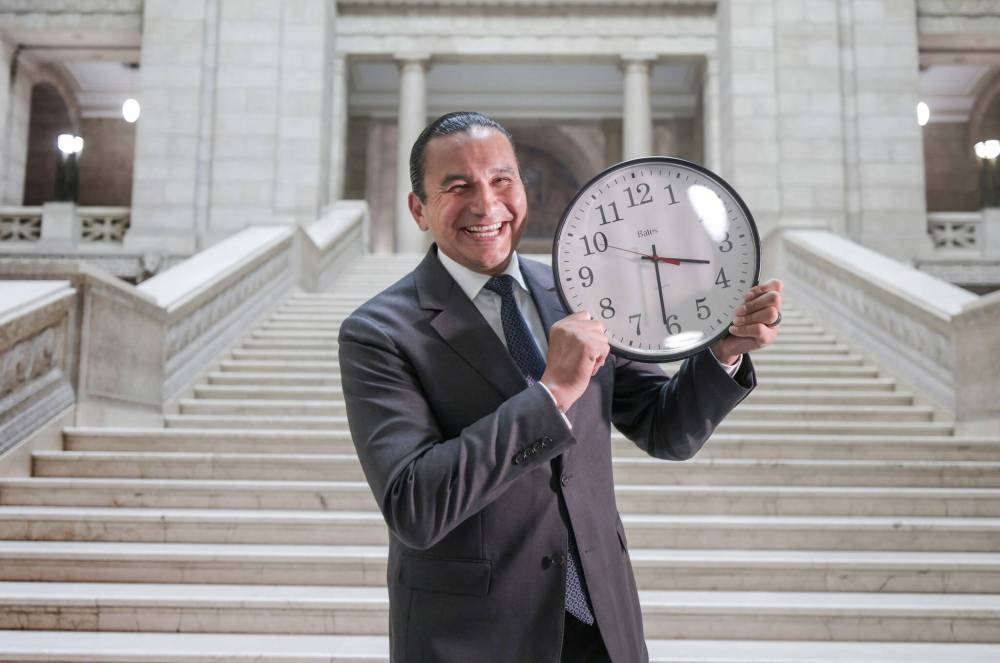
Most of the 72,000 votes submitted in an online EngageMB survey — 92 per cent — said they would like to see the practice end. The survey asked if they preferred earlier sunrises in winter with standard time or the later sunsets in summer with daylight time. More than half of survey participants (58 per cent) indicated a preference to stay on permanent daylight time; 34 per cent voted to eliminate the time change but stay on standard time.
“Permanent daylight saving time is good for our health, good for business and good for parents…. This change means one less adjustment families have to deal with each spring and fall,” the premier said. “That’s why this November, your clocks won’t be changing.”
Not all medical experts agree that staying on permanent daylight time is best for the health of Manitobans.
“This change means one less adjustment families have to deal with each spring and fall.”
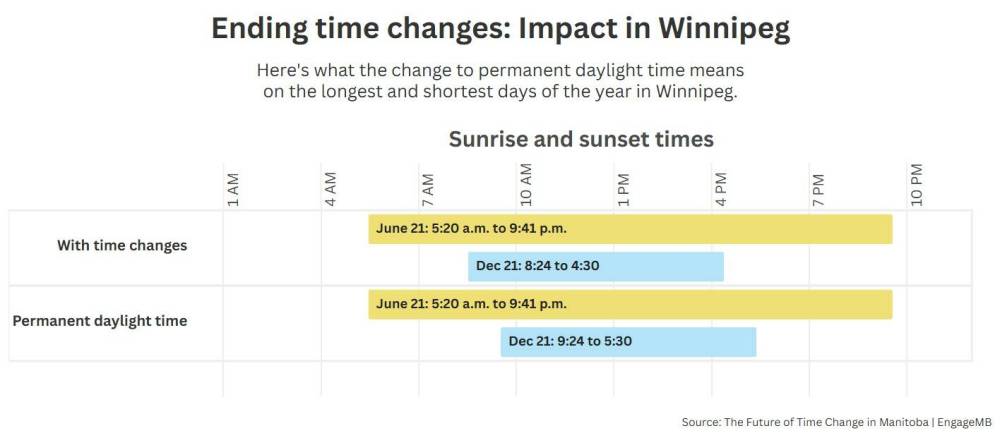
“What happens when we stay on the daylight time is that our internal clock doesn’t align with the outside clock, and that can cause a lot of adverse health impacts — both long term and short term,” said Inna Rabinovich-Nikitin, a researcher at the Institute of Cardiovascular Sciences at St. Boniface Hospital. She pointed to winter mornings, when the sun won’t come up until after 9 a.m. — long after many Manitobans have to rise and shine.
“Because our body doesn’t align with the light outside, that means that, long term, we will have more cardiovascular diseases, more cases of obesity, diabetes and cancer,” the assistant professor in the department of physiology and pathophysiology at the University of Manitoba said Thursday.
“All of this is evidenced by different population studies that have been done over the years and also by other countries that tried to change to daylight saving time. It wasn’t working, both in terms of health and economy, and they had to go back to either changing the time twice a year or staying on standard time.… It will eventually also influence our economy, because more chronic diseases will impact the health-care system compared to staying on standard time and having less chronic diseases.”
A survey conducted by Doctors Manitoba in the spring found that 80 per cent of physicians supported an end to the seasonal time change.
“Research clearly shows that changing our clocks twice per year impacts our sleep and our health, with more heart attacks, injuries and mental-health concerns,” advocacy group president Dr. Alon Altman said in a prepared statement.
“While permanent standard time may offer the closest alignment with our natural circadian rhythm, permanent daylight time offers other health and societal benefits, particularly more usable sunlight in the late afternoon and evening. We encourage Manitobans to make the most of the extra daylight by getting outside and being active.”
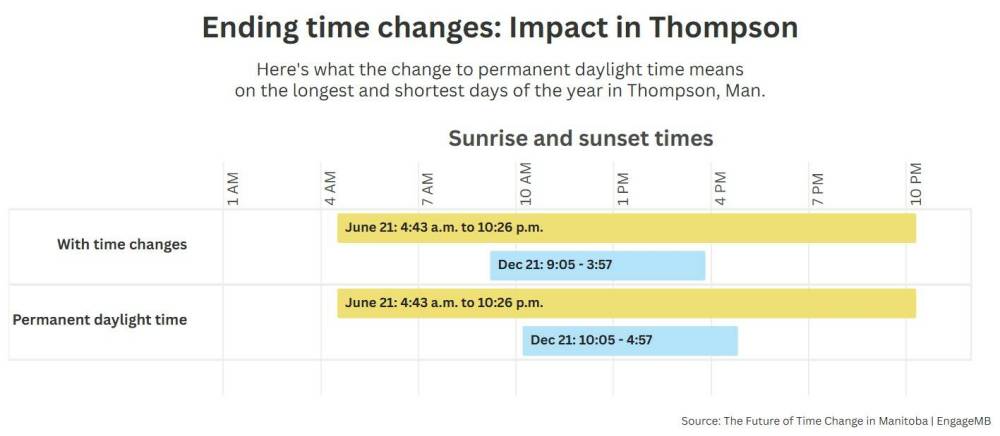
In Thompson, where the sun won’t come up until 10:05 a.m. on Dec. 21, the mayor welcomed permanent daylight time.
“We will have more cardiovascular diseases, more cases of obesity, diabetes and cancer.”
“I’m glad we’ve chosen to stick to one time,” Colleen Smook said Thursday. “We are privileged to have long days from May to early September, but come winter it will be nice to have that extra hour for the kids.”
Winnipeg Mayor Scott Gillingham said that he’s in favour of staying on daylight time and “glad the debate has finally ended.”
“I like long summer evenings and, so, I’m supportive of the change that’s being made,” the mayor said Thursday.
“I think this is a decision that had to be made one way or the other. The province has made this decision, now we can all adjust our lives accordingly and move on.”
In a prepared statement, the mayor said there will be an adjustment in the winter, particularly during the morning commute, and that the city will monitor any impacts on travel patterns, transit and road safety.
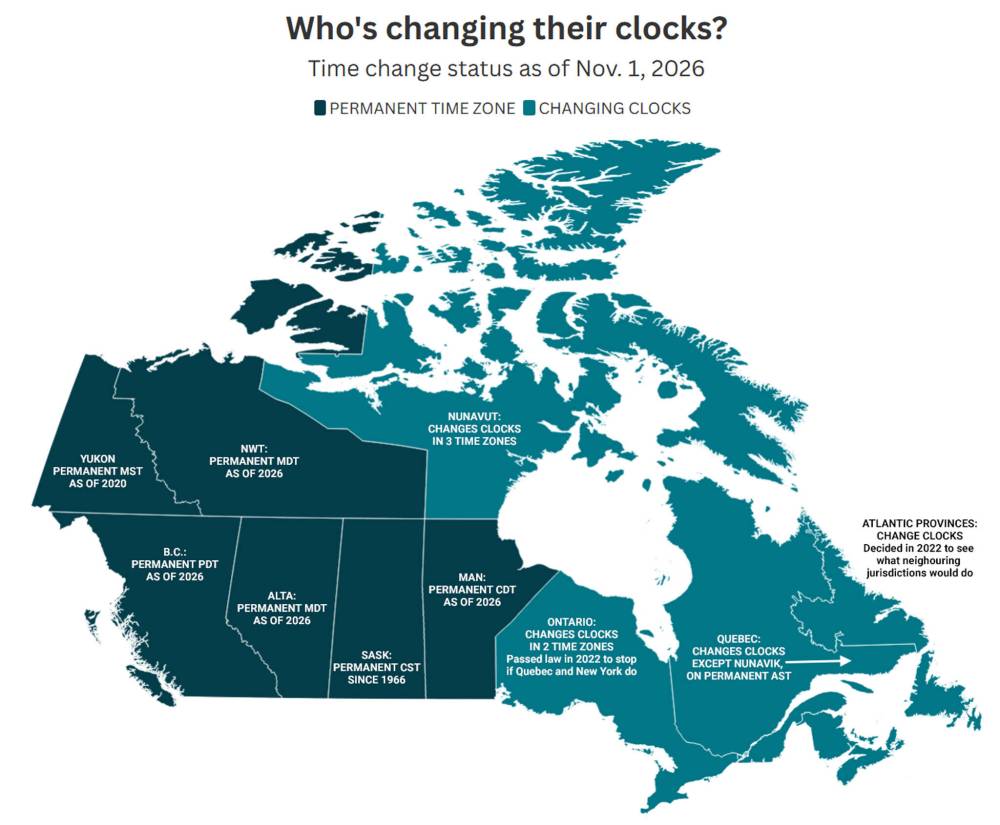
Manitoba arrived at the decision to stay on daylight time year-round after other jurisdictions made similar moves. British Columbia and Alberta are now on year-round daylight time, while Saskatchewan and Yukon are on permanent standard time.
After B.C. announced in March that it would stick to daylight time, Kinew said Manitoba had other, more important things to focus on.
“Everybody’s got an opinion on it, but we only have so many hours in a day, and we’re going to spend those hours on health care and lowering your cost of living,” he said at the time.
But after hearing from many Manitobans who were tired of the practice, a few weeks later Kinew announced the online survey.
At the time, the premier referenced a 2025 study by researchers at California’s Stanford University, who concluded that adopting one time for the entire year is better for human health. That study, which was cited in the Manitoba survey, suggested permanent standard time would bring the most health benefits, including a reduction in obesity and strokes.
“Changing our clocks twice per year impacts our sleep and our health, with more heart attacks, injuries and mental-health concerns.”
However, a public opinion poll in May indicated that Manitobans preferred year-round daylight time. That survey, conducted by Winnipeg-based Prairie Research Associates, found roughly three in four Manitobans supported an end to seasonal time changes.
“It affects every Manitoban” said University of Manitoba adjunct political studies professor Christopher Adams. “It’s a typical Wab Kinew thing to do — to listen to what people are saying and respond. It’s not unlike the gas tax holiday.”
The NDP suspended the 14-cent per litre fuel tax in Manitoba for one year in 2024 as an affordability measure, before bringing it back in 2025 at a reduced 12.5-cents per litre.
“These are things that really catch people on a basic level, so I’m not surprised that he’s done this,” Adams said.
Ending seasonal time has been a perennial issue on both sides of the political aisle.
In 2019, while in opposition, the New Democrats launched public consultations; Kinew hasn’t said what became of them.
In 2022, under the Tories, the provincial government considered moving to year-round daylight time. Legislation was passed but never proclaimed because it was tied to the United States ending its seasonal time change. The U.S. bill has repeatedly stalled, including last October in the Senate.
Progressive Conservative MLA Ron Schuler introduced a private member’s bill last year to move Manitoba to permanent daylight time. On Thursday, he welcomed the province’s decision to act on it.
“I think we’re all just kind of pleased that it’s getting over the finish line and we’re kind of exhausted with this whole topic,” the longtime MLA for Springfield-Ritchot said.
The U.S. still has seasonal time change, but most of Manitoba’s neighbours to the west have decided to abandon it, Schuler said.
“It’s probably time we just go and join Western Canada and go with it,” he said.
The NDP majority government has just 13 sitting days when the fall session resumes Sept. 29 to pass legislation ending seasonal time change before the clocks are scheduled to fall back one hour on Nov. 1.
“I’d be surprised if the PCs try to block this effort,” Adams said.
The practice of moving the clocks ahead one hour on the second Sunday in March and back again on the first Sunday in November in Canada was introduced by the Canadian government in 1918 as a way to increase production and conserve energy during the First World War.

Winnipeg, however, aligned itself with many European countries and some other North American cities in 1916, moving the clocks forward by an hour on the first Sunday of April and switching back on the last Sunday of September. The city ended the experiment a year later because Brandon, Selkirk and rural areas of the province had chosen not to join in, leaving Winnipeg with its own time zone.
The federal government reinstated the practice during the Second World War, and when it was over left it up to cities to retain or abandon it. The clock change has been in place in Winnipeg since 1946 and provincewide legislation went into effect in 1963.
— With files from Joyanne Pursaga
carol.sanders@freepress.mb.ca
Report on health implications of time change

Carol Sanders
Legislature reporter
Carol Sanders is a reporter at the Free Press legislature bureau. The former general assignment reporter and copy editor joined the paper in 1997. Read more about Carol.
Every piece of reporting Carol produces is reviewed by an editing team before it is posted online or published in print — part of the Free Press‘s tradition, since 1872, of producing reliable independent journalism. Read more about Free Press’s history and mandate, and learn how our newsroom operates.
Our newsroom depends on a growing audience of readers to power our journalism. If you are not a paid reader, please consider becoming a subscriber.
Our newsroom depends on its audience of readers to power our journalism. Thank you for your support.
Related Articles
Kinew delivered what most of us wanted; now we’ll have to deal with the consequences







History
Updated on Thursday, September 17, 2026 9:55 AM CDT: Adds graphics, PDF.
Updated on Thursday, September 17, 2026 5:36 PM CDT: Updates headline, adds edits, photo
Updated on Friday, September 18, 2026 8:48 AM CDT: Corrects references areas using daylight or standard time year-round