


Gillingham in lead with decided voters
More than 50 per cent undecided, poll shows

Advertisement
Read this article for free:
or
Already have an account? Log in here »
To continue reading, please subscribe:

Digital Subscription
One year of digital access for only $205*
- Enjoy unlimited reading on winnipegfreepress.com
- Read the E-Edition, our digital replica newspaper
- Access News Break, our award-winning app
- Play interactive puzzles
*First annual payment billed as $205.00 + GST for one year. This annual subscription will automatically renew at $233.00 + GST every 52 weeks (10% off the regular annual price of $259.35). Offer available to new and qualified returning subscribers only. Cancel any time.
To continue reading, please subscribe:
Add Free Press access to your Brandon Sun subscription for only an additional
$1 for the first 4 weeks*
- Enjoy unlimited reading on winnipegfreepress.com
- Read the E-Edition, our digital replica newspaper
- Access News Break, our award-winning app
- Play interactive puzzles
*Your next Brandon Sun subscription payment will increase by $1.00 and you will be charged $17.95 plus GST for four weeks. After four weeks, your payment will increase to $24.95 plus GST every four weeks.
Read unlimited articles for free today:
or
Already have an account? Log in here »
A cloud of uncertainty is hanging over Winnipeg as October’s municipal election nears.
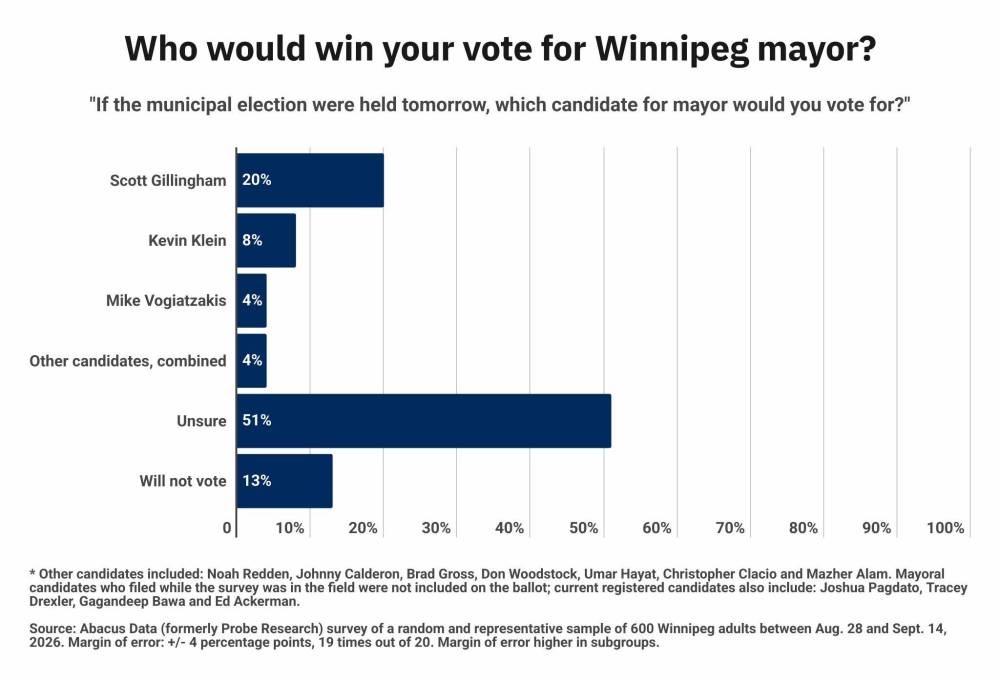
Three months after a poll showed more than 40 per cent of Winnipeggers wanted to see someone other than current mayor Scott Gillingham elected, a new Abacus Data poll indicates more than half of Winnipeg voters are undecided heading into next month’s civic election.
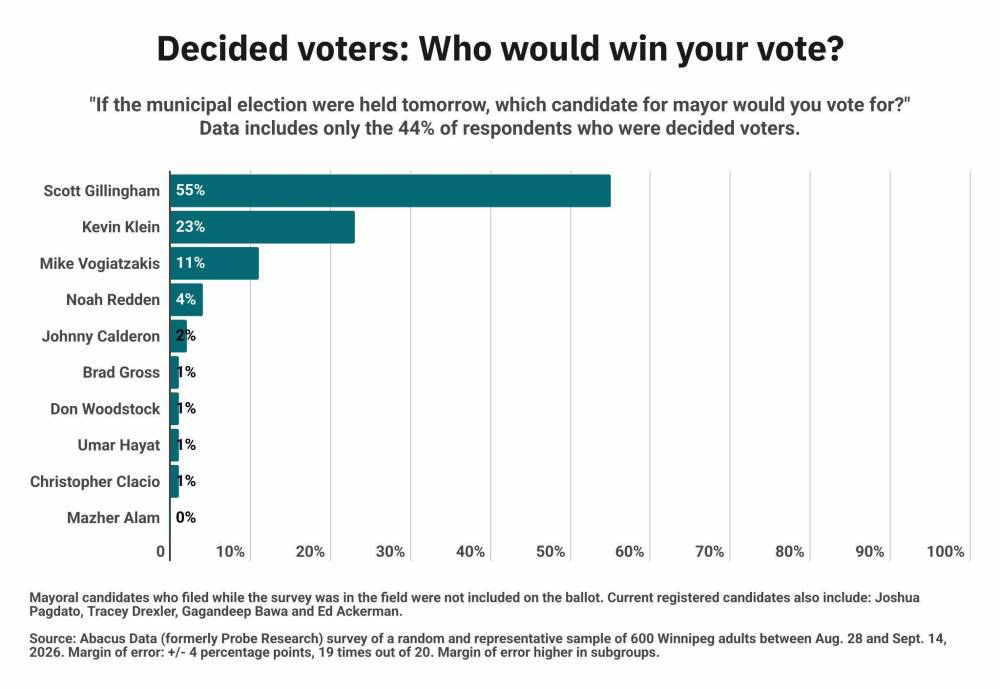
Of decided voters, 55 per cent favour Gillingham compared to 23 per cent for former councillor and provincial cabinet minister Kevin Klein and 11 per cent for funeral director Mike Vogiatzakis.
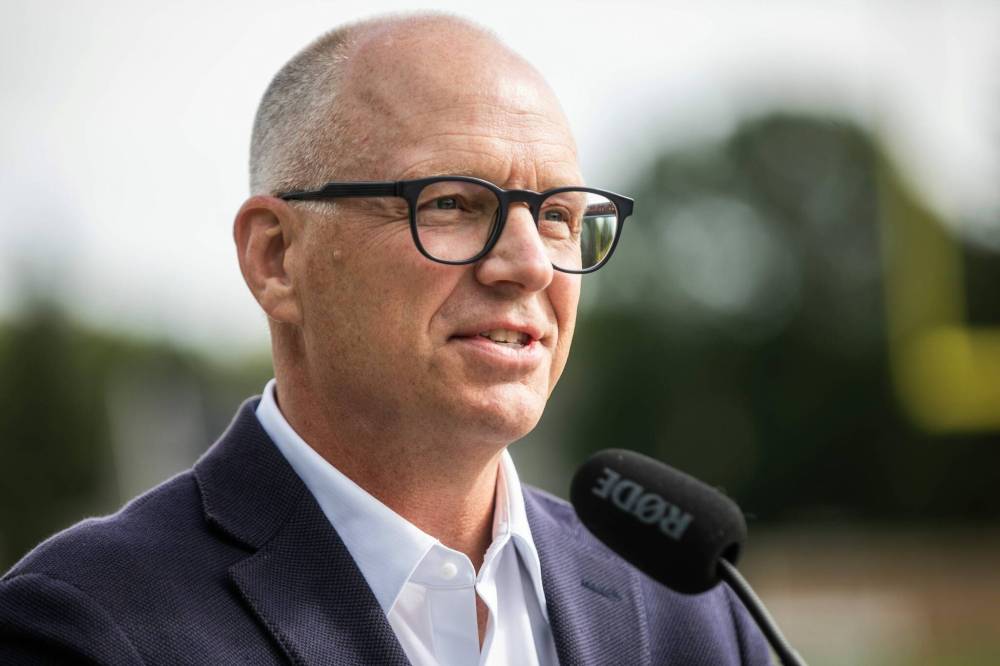
MIKAELA MACKENZIE / FREE PRESS FILES
New polling data shows 55 per cent of decided voters favour incumbent mayor Scott Gillingham compared to 23 per cent for Kevin Klein and 11 per cent for Mike Vogiatzakis.
Of all respondents, just over 50 per cent said they were unsure while 13 per cent said they will not vote.
“It’s frankly remarkable,” said Curtis Brown, vice president of Abacus Data (formerly Probe). “This really says to me that people are tuned out.”
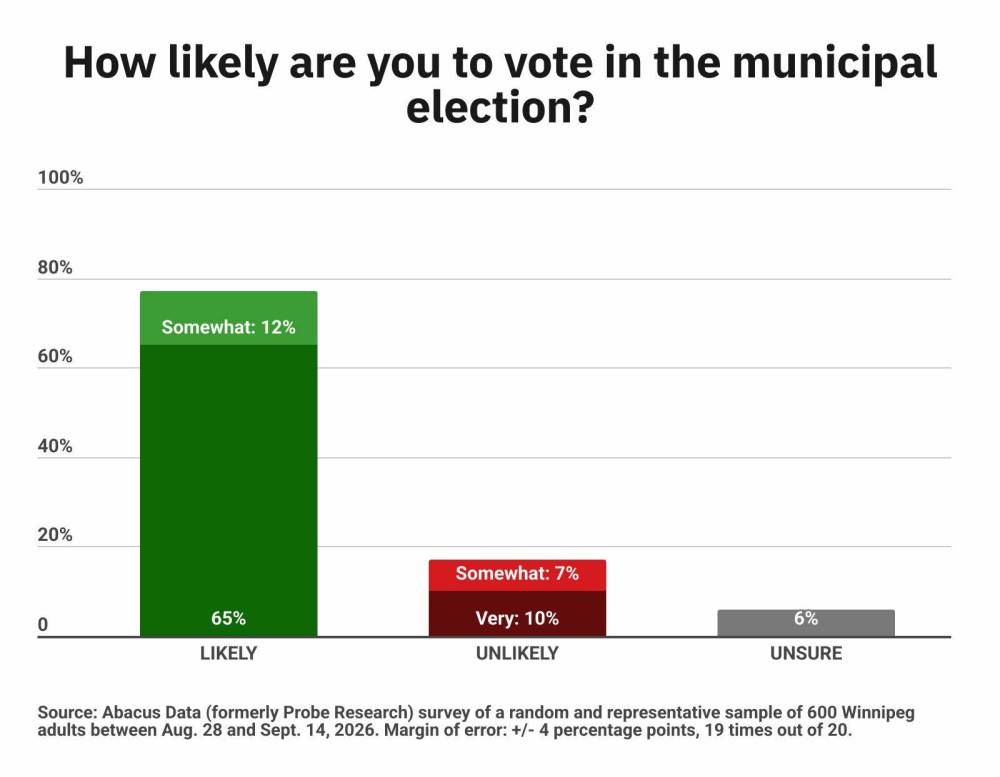
Municipal politics historically generates less interest and a lower voter turnout, but the number of ballots cast has also decreased in recent years. In 2022, 37.5 per cent of Winnipeggers voted; in 2018, it was 42 per cent and in 2014 it was 50 per cent.
Voter uncertainty has grown since June’s poll, which indicated 36 per cent were unsure of who they would support. By comparison, five weeks out from 2022’s municipal election, a poll showed 30 per cent of voters were uncertain about their decision, with another eight per cent indicating they didn’t plan to vote.
While data earlier this summer indicated trouble for the incumbent, the latest figure of 55 per cent of support is more than double the 27.5 per cent of the vote he received on election night in 2022.
The numbers may mean voters don’t see any other viable option, Brown said.
“This really says to me that people are tuned out.”
“No one has really been able to come in and and really put a deep scare into Scott Gillingham’s support, even though it does look relatively weak at this point,” he said.
A political science expert says the poll could reflect that many voters have not yet paid much attention to the campaign.
“That statistic of people who are unsure is an indication that people don’t really care, or whether it’s just people haven’t been paying attention yet is remains to be seen,” said University of Winnipeg political science Prof. Aaron Moore.
Klein announced his bid for mayor Sept. 1 and launched his campaign Friday, pledging to make Winnipeg the safest city in Canada by the end of his four-year term, if elected. After the top three, the remaining registered candidates collectively hold 11 per cent of the city’s decided vote, the poll said.
Most voters don’t have a second choice either — 68 per cent of Gillingham’s supporters don’t have a second choice, and only 10 per cent of decided voters would choose Vogiatzakis as their backup.
No incumbent mayor has lost a bid for re-election since the 1950s. Moore speculates Gillingham could take the race only because it’s the best the city could come up with.
“My sense is there’s not a lot of people out there who love Scott Gillingham, but if they’re going to vote, they might still vote for him if they feel that there isn’t any other strong candidate,” he said.
Richard Lambert isn’t sure who he will vote for, but he knows it won’t be the current mayor.
Lambert, 50, votes in every election but he’s faced with a tough choice this time around. He feels the city has gone in the wrong direction in the four years Gillingham has been at the helm and doesn’t see another viable option.
“No one’s gonna fix crime. That’s not a talking point, as far as I’m concerned. It is, but there’s a lot more bigger issues no one seems to be talking about,” Lambert said.
The Regina transplant has resigned himself to knowing Gillingham will likely win another term, but he wishes candidates would reach out to neighbourhoods who are less likely to vote, rather than appeal to people who already will.
“There’s not a lot of people out there who love Scott Gillingham, but if they’re going to vote, they might still vote for him.”
Paul Davis, on the other hand, is all in on Gillingham.
“I think things take time. I always think he’s sincere. He might not be perfect in his approach with absolutely everything, but I think it’s really hard to be,” said Davis.
The 40-year-old developer is happy with Gillingham’s track record and plans to vote for him a second time. The incumbent’s commitment to building more housing bodes well for Davis, but he also believes Gillingham can improve the city if given another chance.
Speaking as a decided voter, Davis said some may not be sure who to throw their support behind because of all the political noise.
“With so much media and social media, everyone has an opinion, and sometimes whoever’s loudest gets the larger share of that period of time or your or your algorithm, not necessarily the best candidate,” he said.
To vote for a candidate, one must know a candidate. Door-knocking and shaking hands at community events, especially lower-income neighbourhoods or those with a lower median age, are some of the easiest way to reach undecided voters, Moore and Brown said.
“If you actually take the time to go out and engage with people in those communities, they’re more likely to actually feel like this person cares,” Moore said.
Gillingham was not made available for an interview. In an emailed statement, the candidate acknowledged voter turnout has been a challenge in major cities across Canada in recent years and he’s “not taking a single vote for granted.”
“I’m going to keep working hard to earn support until election day, and I hope every Winnipegger takes the time to learn about their choices and vote on October 28,” he said.
The poll surveyed 600 random Winnipeg adults between Aug. 28 and Sept. 14. Its margin of error is plus or minus four percentage points 95 times out of 100.
As of Friday, 15 candidates were registered to become Winnipeg’s mayor on Oct. 28. In addition to Gillingham, Klein and Vogiatzakis, they include: Chris Clacio, Umar Hayat, Mazher Alam, Don Woodstock, Joshua Pagdato, Johnny Calderon, Noah Redden, Brad Gross, Tracey Drexler, Gagandeep Bawa, Ed Ackerman and Abdel-Kareem Chehadi. The nomination period ends Sept. 22.
nicole.buffie@freepress.mb.ca
Nicole Buffie
Multimedia producer
Nicole Buffie is a reporter for the Free Press city desk. Born and bred in Winnipeg, Nicole graduated from Red River College’s Creative Communications program in 2020 and worked as a reporter throughout Manitoba before joining the Free Press newsroom as a multimedia producer in 2023. Read more about Nicole.
Every piece of reporting Nicole produces is reviewed by an editing team before it is posted online or published in print — part of the Free Press‘s tradition, since 1872, of producing reliable independent journalism. Read more about Free Press’s history and mandate, and learn how our newsroom operates.
Our newsroom depends on a growing audience of readers to power our journalism. If you are not a paid reader, please consider becoming a subscriber.
Our newsroom depends on its audience of readers to power our journalism. Thank you for your support.
Nicole Buffie
Multimedia producer
Nicole Buffie is a reporter for the Free Press city desk. Born and bred in Winnipeg, Nicole graduated from Red River College’s Creative Communications program in 2020 and worked as a reporter throughout Manitoba before joining the Free Press newsroom as a multimedia producer in 2023. Read more about Nicole.
Every piece of reporting Nicole produces is reviewed by an editing team before it is posted online or published in print — part of the Free Press‘s tradition, since 1872, of producing reliable independent journalism. Read more about Free Press’s history and mandate, and learn how our newsroom operates.
Our newsroom depends on a growing audience of readers to power our journalism. If you are not a paid reader, please consider becoming a subscriber.
Our newsroom depends on its audience of readers to power our journalism. Thank you for your support.
Related Articles
Elmwood–East Kildonan candidate promises to tackle ‘inefficiency’ in government


Advertisement Advertise With Us
Advertisement Advertise With Us