

There is still hope for Portage Place

Advertisement
Read this article for free:
or
Already have an account? Log in here »
To continue reading, please subscribe:
Digital Subscription
One year of digital access for only $1.44 a week*
- Enjoy unlimited reading on winnipegfreepress.com
- Read the E-Edition, our digital replica newspaper
- Access News Break, our award-winning app
- Play interactive puzzles
*Billed as $5.77 plus GST every four weeks. After 52 weeks, price increases to the regular rate of $19.95 plus GST every four weeks. Offer available to new and qualified returning subscribers only. Cancel any time.
To continue reading, please subscribe:
Add Free Press access to your Brandon Sun subscription for only an additional
$1 for the first 4 weeks*
- Enjoy unlimited reading on winnipegfreepress.com
- Read the E-Edition, our digital replica newspaper
- Access News Break, our award-winning app
- Play interactive puzzles
*Your next Brandon Sun subscription payment will increase by $1.00 and you will be charged $17.95 plus GST for four weeks. After four weeks, your payment will increase to $24.95 plus GST every four weeks.
Read unlimited articles for free today:
or
Already have an account? Log in here »
Hey there, time traveller!
This article was published 18/03/2013 (4831 days ago), so information in it may no longer be current.
“The face of the city is changing. The heart beat’s stronger. You can feel it in the air. Here’s where the city comes alive — Portage Place!”
These optimistic lyrics, set to an ’80s-style pop tune, echoed through the speakers of Portage Place, Winnipeg’s grand new downtown shopping mall on its opening day in September 1987. That evening, CBC news anchor Mike McCourt wondered if the downtown streets would be able to handle the traffic volumes heading to the mall in years to come.
Nine months later, the CBC would run a follow-up story outlining the struggles those retailers were facing. Business was half of what had been anticipated, restaurants had already closed and many shops were struggling to pay their rent. As regional malls sprang up across North American suburbs in the 1970s, the traditional shopping experience moved from the sidewalks of bustling urban retail streets to the shiny, ceramic tile corridors of million-square-foot, climate-controlled malls.
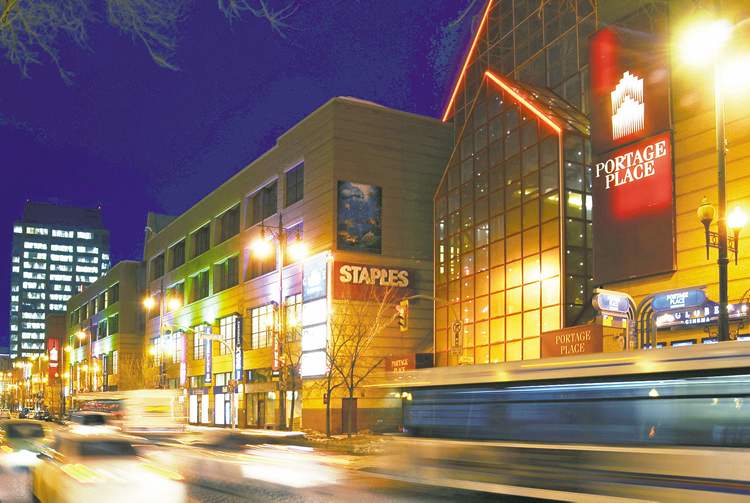
With five new suburban malls being constructed in Winnipeg during that decade, Portage Avenue, the city’s retail heart for a century, fell into decline. The response was to try to out-suburb the suburbs by replacing three square blocks of the faltering downtown with a sparkling new $80-million shopping mall.
As far as mega-projects went, this seemed to be a good one. It was a handsome building with grand day-lit spaces. It connected two shopping landmarks, Eaton’s and the Bay, boasted an IMAX, cinemas, live theatre, 153 shops, office space, a YMCA and more than 400 residential apartments. With sidewalk-facing units open to Portage Avenue and a “European-style” promenade to be filled with cafés and vendors, it was a mixed-use dream of which any 1980s urban planner would be proud.
So, why did Portage Place fail to live up to its lofty expectations?
The overwhelming response to that question will be Winnipeg’s downtown is perceived as unsafe, causing shoppers to stay away. Unquestionably, Portage Place and downtown Winnipeg have an image problem. Cities with thriving downtown shopping malls, such as Calgary and Edmonton, do not battle this perception to the same extent, even as the statistics paint a contradictory picture. According to figures provided by each police service (winnipeg.ca/crimestat/; crimemap.calgarypolice.ca/; crimemapping.edmontonpolice.ca/) for comparable crime types, the number of reported incidents in downtown Winnipeg is half that of Calgary and 20 per cent less than Edmonton.
Crime in the downtown is a reality, however, and the perception of personal security is a crucial hurdle to overcome if Portage Place and the city centre as a whole are to prosper.
As famed urbanist Jane Jacobs wrote, safety comes from “eyes on the street.” There is strength in numbers. Reducing crime and enhancing the feeling of safety around the mall will be dependent on our ability to develop residential density and establish pedestrian activity on the sidewalks, in what is currently an overwhelmingly commercial area.
Supporting this notion is a new study published at the University of Pennsylvania that found single-use commercial neighbourhoods have crime rates up to 45 per cent higher than similar areas that include a residential component. Statistical comparisons between Winnipeg’s downtown and the mixed-use neighbourhood of Osborne Village provide credibility to this finding.
As the city implements the ‘Sports, Hospitality and Entertainment District’ (SHED) to the south of Portage Place, it will be important to include policies and incentives that encourage mixed-use growth within that area, stimulating pedestrian traffic and economic activity for the mall while improving the perception of public safety beyond office hours. Portage Place will likely never be a destination for the entire city as it was hoped, but it might successfully find its place as retail support for a vibrant downtown neighbourhood, providing services and amenities for urban living while catering to transient office workers during the day.
Portage Place can teach us the lesson that successful urban neighbourhoods cannot be sterile and artificially imposed, no matter how well-conceived. Downtown success will come from promoting growth that embraces Portage Place as a supporting resource to a diverse urban neighbourhood, not as a retail island disengaged from a single-use commercial district.
As its neighbourhood evolves, the physical character of Portage Place itself might change to better adapt to its economic realities and urban environment. Centres across the U.S. are implementing creative solutions to increase market density and extend hours of traffic by adding academic, hotel and residential space through the transformation of underperforming retail units or the construction of connected towers (for which Portage Place has existing foundations). Ideas such as the reconfiguration of the Portage Place food court, a source of the mall’s negative stigma, into individual restaurants along the Portage Avenue faßade would help re-engage the sidewalk and break down the mall’s physical mass and introverted layout.

Most critically, capitalizing on the fading opportunity to redevelop the Hudson’s Bay department store into a large-scale mixed-use landmark that energizes pedestrian traffic and ensures the store’s long-term retail presence in the downtown will be a vital strategy in the renewal of Portage Place and the city centre as a whole.
Holistic solutions that transform the diversity, character and safety of the surrounding neighbourhoods while redefining the mall as a supporting amenity within those communities will ensure the prosperity of Portage Place and improve the livability of downtown into the future.
Brent Bellamy is senior design architect for Number Ten Architectural Group.
bbellamy@numberten.com
Brent Bellamy is creative director for Number Ten Architectural Group.
Our newsroom depends on a growing audience of readers to power our journalism. If you are not a paid reader, please consider becoming a subscriber.
Our newsroom depends on its audience of readers to power our journalism. Thank you for your support.
Brent Bellamy is creative director for Number Ten Architectural Group.
Our newsroom depends on a growing audience of readers to power our journalism. If you are not a paid reader, please consider becoming a subscriber.
Our newsroom depends on its audience of readers to power our journalism. Thank you for your support.
Advertisement Advertise With Us
Advertisement Advertise With Us
History
Updated on Monday, March 18, 2013 1:44 PM CDT: Adds missing first paragraph.