Growing for all seasons New 10-acre greenhouse in Dauphin set to produce tomatoes year-round
Read this article for free:
or
Already have an account? Log in here »
To continue reading, please subscribe:

Digital Subscription
One year of digital access for only $205*
- Enjoy unlimited reading on winnipegfreepress.com
- Read the E-Edition, our digital replica newspaper
- Access News Break, our award-winning app
- Play interactive puzzles
*First annual payment billed as $205.00 + GST for one year. This annual subscription will automatically renew at $233.00 + GST every 52 weeks (10% off the regular annual price of $259.35). Offer available to new and qualified returning subscribers only. Cancel any time.
To continue reading, please subscribe:
Add Free Press access to your Brandon Sun subscription for only an additional
$1 for the first 4 weeks*
- Enjoy unlimited reading on winnipegfreepress.com
- Read the E-Edition, our digital replica newspaper
- Access News Break, our award-winning app
- Play interactive puzzles
*Your next Brandon Sun subscription payment will increase by $1.00 and you will be charged $17.95 plus GST for four weeks. After four weeks, your payment will increase to $24.95 plus GST every four weeks.
Read unlimited articles for free today:
or
Already have an account? Log in here »
Hey there, time traveller!
This article was published 28/07/2023 (1166 days ago), so information in it may no longer be current.
Fresh Manitoba-grown tomatoes in local stores — in February — might soon be a possibility.
Sure, the seedlings are from British Columbia. And much of the roughly $40-million greenhouse’s equipment comes from Europe, largely the Netherlands.
The tomatoes, however — the roughly 10 million pounds of tomatoes expected to climb vines in a state-of-the-art greenhouse every 47 weeks — are a product of Dauphin.
“It’s been a long haul, and we’re so looking forward to those plants coming in, and for our first shipment of tomatoes heading out the door,” said Maria Deschauer, managing director of Vermillion Growers.
The site’s ground-breaking ceremony happened in 2019. Nearly four years later, on Thursday, the crew celebrated the grand opening of their first-of-its-kind greenhouse in Manitoba.
As of Tuesday, Vermillion Growers had just a few test pots in its 10-acre greenhouse. The first tomato seedlings are scheduled to arrive Sept. 4 (already approximately one foot tall each). Deschauer expects the first round of tomatoes to be shipped out in November.
SUPPLIED Lucky and Maria Deschauer, a brother and sister duo, are two of three co-founders of Vermillion Growers.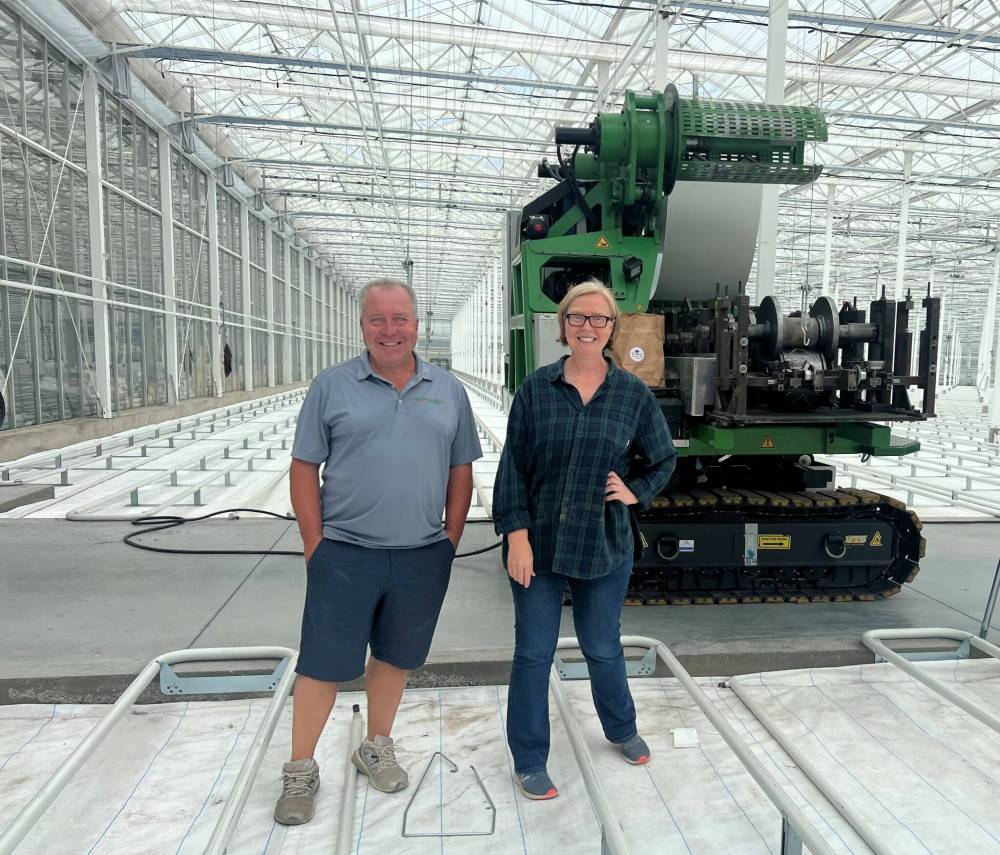
During each 10-week maturing phase, the tomatoes will be handled by Dauphin locals — largely Ukrainian immigrants — and high-tech automation that recycles water for irrigation and redistributes carbon dioxide.
“‘Why Dauphin?’… is the question we’re always asked as a team,” said Cormac Foster, Vermillion Growers’ product engineer. “It’s a great, centralized location.”
Vermillion Growers has a goal of transporting tomatoes from vine to store within 24 hours. All of its tomatoes are pre-bought by Red Sun Farms, a greenhouse vegetables company that will distribute Vermillion Growers’ products to stores, Deschauer said.
The tomatoes will go to grocery chains in Winnipeg, Thunder Bay, Regina, Saskatoon, Calgary and Edmonton, those who worked on Vermillion Growers outlined.
“The need is quite huge in Canada,” Deschauer said. “(There’s) no concern about distributing it.”
Last year, Canada imported $425.9 million worth of tomatoes, or 197,895,929 kilograms, Statistics Canada spokeswoman Melissa Gammage wrote in an email.
“We just wanted to bring year-round production of vegetables to Manitoba,” Deschauer stated.
SUPPLIED As of Tuesday, Vermillion Growers had just a few test pots in its 10-acre greenhouse. 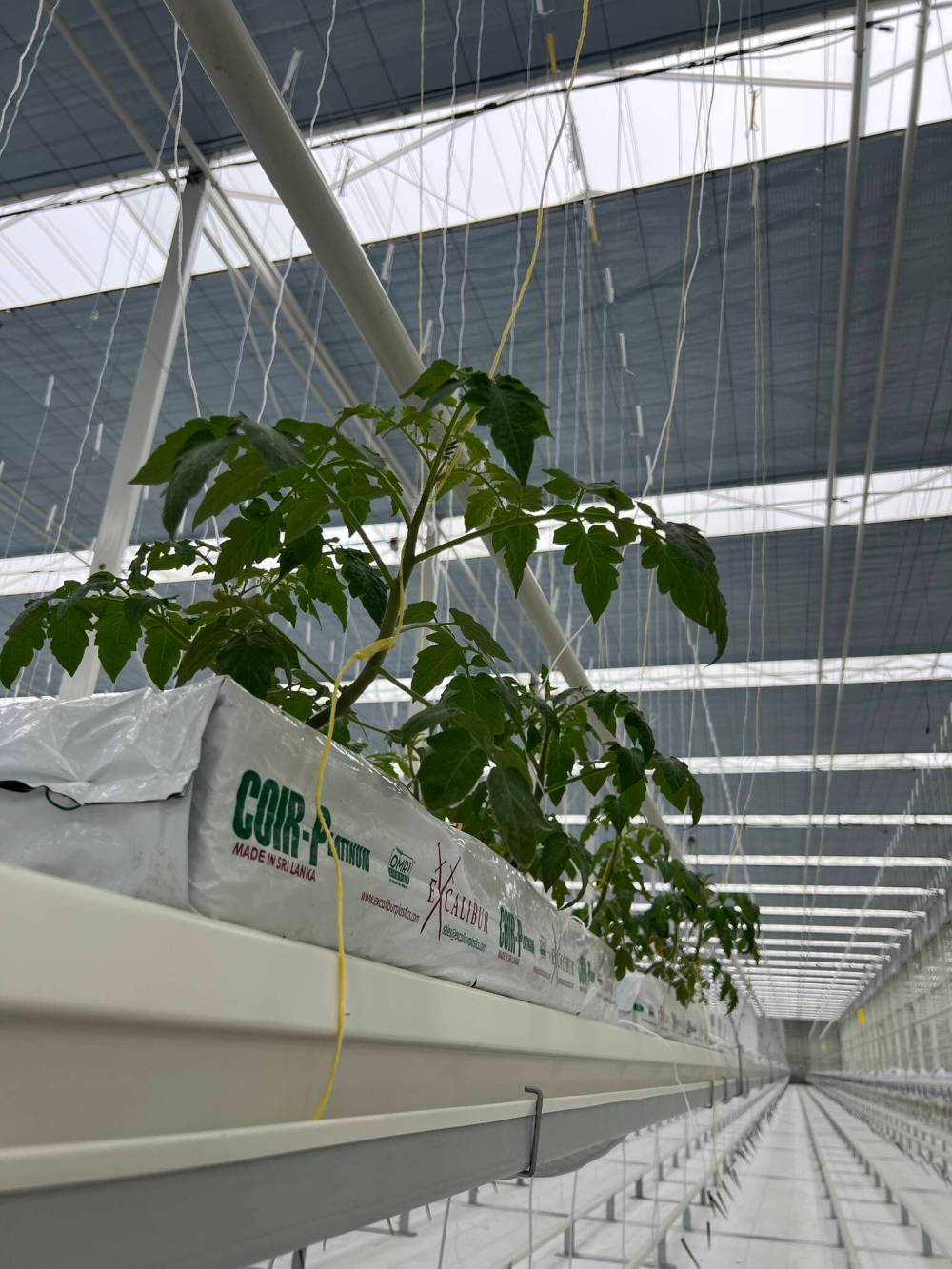
She and her brother Lucky moved to Dauphin more than a decade ago. They built multi-unit homes in the city, making themselves familiar to locals.
Lucky’s background is in building. He’d never erected a commercial greenhouse before, but his fascination with the sites formed in childhood, his sister said. She recalled him building a greenhouse in their Altona backyard from scrap windows he’d scavenged from an elementary school.
Deschauer is versed in property development and management.
The siblings embarked on building a greenhouse in Dauphin — also called the City of Sunshine, which bodes well for such a venture — with local property developer Mark Kohan, who’s now Vermillion Growers’ chief financial officer. They began greenhouse research more than five years ago.
“The research was huge,” Deschauer said. “Most of us didn’t quite have a vision for what this kind of greenhouse facility… looked like.”
First, the crew visited a greenhouse in Otterburne. Then, Ontario, and then the Netherlands.
Kohan called the Netherlands “the birthplace of greenhouses.”
“The research was huge. Most of us didn’t quite have a vision for what this kind of greenhouse facility… looked like.” – Maria Deschauer
The trio spent years researching. They hired a European consultant to conduct a feasibility study, they said. Meantime, they were self-funding.
The feasibility study gave them the confidence to continue.
The next step: raise money through private investment. Local investors, including from Dauphin, “jumped on board” using the province’s small business venture capital tax credit, which refunds investors up to 45 per cent of their investment via a tax credit, Deschauer said.
Vermillion Growers raised about $3.5 million through the tax credit program. About 50 per cent of the project’s funding comes through bank financing, while the latter half is from founder and private investment, Deschauer said.
In 2020, the provincial government announced a tax rebate of up to $4.2 million for the project.
The tomato greenhouse is Phase 1. It consumes roughly 12 acres: 10.8 acres of greenhouse and just over an acre for water treatment and packing.
“Our vision is to go from 10 acres of growing space to 70 acres, all under glass,” Deschauer said.
SUPPLIED Patrick Jolicoeur, with Morgan, said Vermillion Growers envisions a second greenhouse on 40 acres south of the first facility.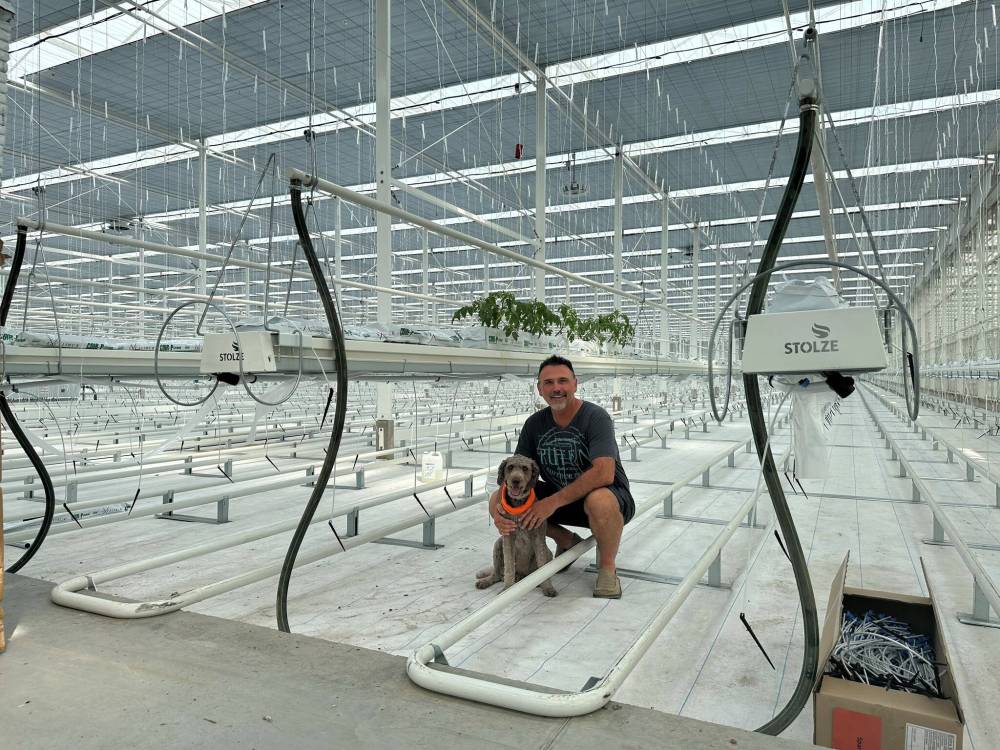
They have the space, surrounding the new build.
Vermillion Growers hired Gakon Netafim, a Netherlands-based greenhouse manufacturing giant, to supply the tomato greenhouse’s technology; irrigation technology company Stolze was also employed. Local business Level Industries, formerly called The Greenhouse Co., built the site.
Level Industries president Patrick Jolicoeur called the European companies “leading innovators in the greenhouse industry.”
Dauphin’s tomato greenhouse is built to collect rainwater, snowmelt and internal condensation for irrigation use. Such water is directed to an on-site treatment plant before being used on crops.
Water not used by plants during watering time will be recycled for future use. Reused water should save 50 per cent of the greenhouse’s water use, said Ricky Elz, a project manager with Gakon Netafim.
The greenhouse’s temperature will hover between 18 C to 25 C during growing time. The facility is designed to distribute carbon dioxide; its glass and screens will be used for insulation and trapping sun energy.
“There’s more sun hours in Dauphin than many places, which lowers the amount of artificial light we need to grow the produce,” Kohan said.
Dauphin Mayor David Bosiak called the greenhouse “awe-inspiring.”
“My gut says ‘Finally, (it’s opening), because it’s been such a long process for them,” Bosiak said.
SUPPLIED The facility is designed to distribute carbon dioxide; its glass and screens will be used for insulation and trapping sun energy.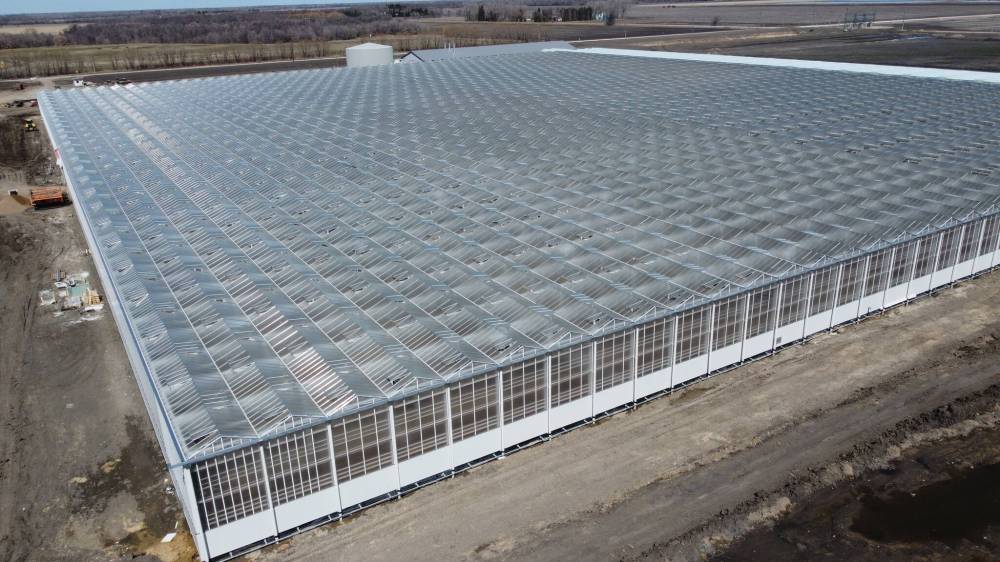
He wasn’t on council when the project was first greenlit. Still, he saw the greenhouse’s delays in real-time: supply chain backlogs held up parts, prices fluctuated and rose. Some equipment was meant to come from Russia; once it invaded Ukraine, “we were scrambling, looking for another source,” Deschauer said.
Dauphin residents’ reactions to the proposed greenhouse oscillated between optimism and skepticism, Mayor Bosiak noted.
The community had heard major projects were coming before — a beef-producing facility, a hemp factory — but they never came to fruition.
“Once the glass started to go up, and people in the community saw the size and the scope of this facility, I think the level of excitement rose dramatically,” Bosiak said.
He hopes Vermillion Growers will have a “trickle-down” effect. Dauphin is ready for new businesses, he said.
However, the city may have to involve Manitoba Hydro if the next phase of Vermillion Growers begins, to ensure there’s enough resources.
“There is a big demand in North America for fresh produced (goods)… locally, just to keep sustainability.”–Ricky Elz
Vermillion Growers envisions a second greenhouse on 40 acres south of the first facility, said Jolicoeur.
Peppers and cucumbers will likely come from the second site.
“There is a big demand in North America for fresh produced (goods)… locally, just to keep sustainability,” said Elz from Gakon Netafim.
North America is the European company’s largest market, he added. Gakon Netafim equips many Ontario greenhouses. It’s recently gotten interest from Quebec, Alberta, British Columbia and Dauphin.
Elz believes more greenhouses like Vermillion Growers are in Canada’s future. The pandemic intensified demand, he added.
Vermillion Growers will employ roughly 30 people. Dauphin’s Co-op will be a recipient of the locally grown tomatoes, Deschauer said.
gabrielle.piche@winnipegfreepress.com


Gabrielle Piché reports on business for the Free Press. She interned at the Free Press and worked for its sister outlet, Canstar Community News, before entering the business beat in 2021. Read more about Gabrielle.
Every piece of reporting Gabrielle produces is reviewed by an editing team before it is posted online or published in print — part of the Free Press‘s tradition, since 1872, of producing reliable independent journalism. Read more about Free Press’s history and mandate, and learn how our newsroom operates.
Our newsroom depends on a growing audience of readers to power our journalism. If you are not a paid reader, please consider becoming a subscriber.
Our newsroom depends on its audience of readers to power our journalism. Thank you for your support.
History
Updated on Friday, July 28, 2023 11:10 PM CDT: Headline fixed