CUSMA exemption confusion abounds ‘What’s our next step?’: Manitoba firms attempt to follow bouncing tariffs, clarify product rules of origin
Read this article for free:
or
Already have an account? Log in here »
To continue reading, please subscribe:

Digital Subscription
One year of digital access for only $205*
- Enjoy unlimited reading on winnipegfreepress.com
- Read the E-Edition, our digital replica newspaper
- Access News Break, our award-winning app
- Play interactive puzzles
*First annual payment billed as $205.00 + GST for one year. This annual subscription will automatically renew at $233.00 + GST every 52 weeks (10% off the regular annual price of $259.35). Offer available to new and qualified returning subscribers only. Cancel any time.
To continue reading, please subscribe:
Add Free Press access to your Brandon Sun subscription for only an additional
$1 for the first 4 weeks*
- Enjoy unlimited reading on winnipegfreepress.com
- Read the E-Edition, our digital replica newspaper
- Access News Break, our award-winning app
- Play interactive puzzles
*Your next Brandon Sun subscription payment will increase by $1.00 and you will be charged $17.95 plus GST for four weeks. After four weeks, your payment will increase to $24.95 plus GST every four weeks.
Read unlimited articles for free today:
or
Already have an account? Log in here »
Hey there, time traveller!
This article was published 11/03/2025 (548 days ago), so information in it may no longer be current.
Within the first week of broad U.S. tariffs being implemented, Manitoba businesses have scrambled to see if they’re exempt and been hit in unexpected ways.
“It’s ludicrous,” Selkirk Mayor Larry Johannson said.
He’s paying close attention to steel and aluminum levies set to take effect Wednesday.

MIKE DEAL / FREE PRESS FILES
Selkirk Mayor Larry Johannson said he's talked to mayors in North Dakota and Minnesota and they all recognized the trade war hurts both countries.As of Tuesday afternoon, a 25 per cent tariff loomed. U.S. President Donald Trump threatened to double the fee earlier in the day — to 50 per cent — in response to Ontario placing a 25 per cent surcharge on its electricity exports to three U.S. states. Ontario later reversed course, as did the Trump administration.
“This back-and-forth is really becoming stressful,” Johannson said.
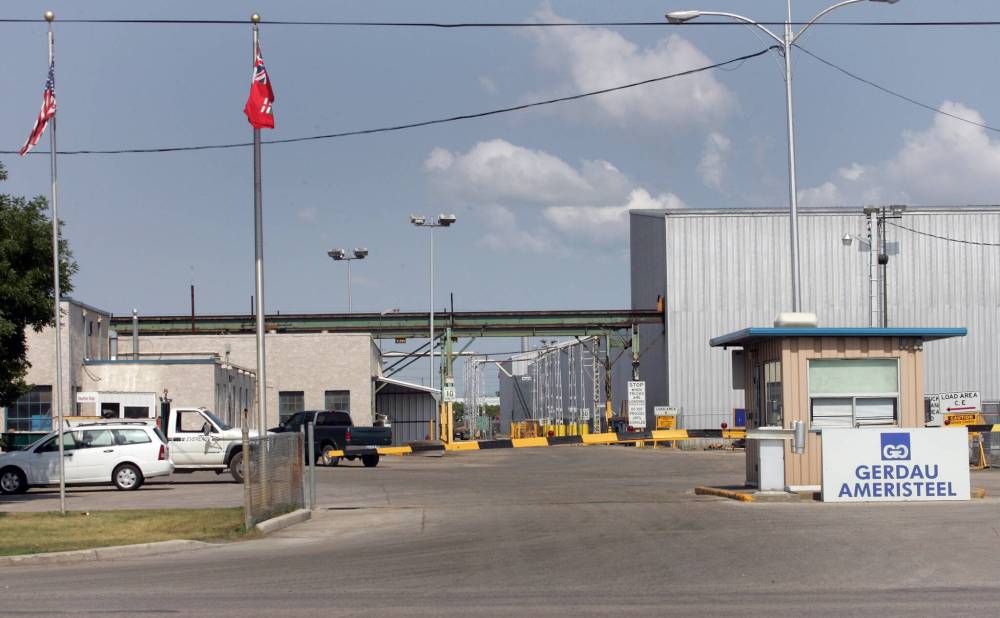
Roughly 550 people work in Selkirk’s steel industry, which includes Brazil-based Gerdau’s mill. Johannson said he spoke with Manitoba Premier Wab Kinew about the plant and its staff Tuesday.
“It really seems to be a battle right now, but I’ve got faith in premier Kinew and the (cabinet) ministers,” Johannson stated. “We will get through this.”
He’s also conversed with fellow mayors in North Dakota and Minnesota, he said, adding there was a mutual recognition the trade war hurts both countries.
“I think of rebuilding California after the wildfires,” Johannson said. “They’re going to need Canadian steel.”
About 75 per cent of steel leaving Selkirk (a city of some 11,000, located roughly 25 kilometres northeast of Winnipeg) lands in the United States, a United Steelworkers spokesperson shared last month. The union represents upwards of 400 members in Selkirk’s steel industry.
“Our local will be working closely with the employer, doing whatever we can to make sure that they can continue to operate and continue to employ the hundreds of folks that they do in the area,” said Scott Lunny, director of USW District 3.
Past conversations have elicited a “level of optimism” Gerdau could push through and keep its staffing levels, Lunny said. A 50 per cent tariff would create a different landscape, he noted.
“This back-and-forth is really becoming stressful.”–Selkirk Mayor Larry Johannson
Meantime, Manitoba businesses across industries have grappled to learn whether their imports meet the rules of origin requirements under the Canada-United States-Mexico Agreement. If so, they dodge 25 per cent tariffs for now.
Neither the province nor business-focused entities such as the Manitoba Chambers of Commerce and World Trade Centre Winnipeg had numbers on how many companies fall under the exemption.
“That’s sort of the question of the day,” said chambers president Chuck Davidson.
Certifying origins of business is a product-by-product venture within companies, noted Terry Shaw, Canadian Manufacturers & Exporters regional vice-president for the Prairies.
“Each product is relatively unique,” Shaw said. “There’s a whole host of nuance and consideration that companies need to understand.”
Firms must account for where their inputs come from, how items are packaged and where they’re shipped. The more materials sourced from elsewhere to make a product in Canada, the more complicated it is to know if the product will be tariff-exempt, Shaw said.
CME Manitoba co-hosted a “country of origin” webinar; around 100 people attended following two days of advertising the event, Shaw said. The exemption adds another level of uncertainty.
“The rules of the game are constantly being changed,” Shaw said. “Both teams playing that game are unable to win, just by virtue of they don’t know the rules of the game.”
Around two-thirds of Canadian exports aren’t considered CUSMA-compliant, The Canadian Press reported earlier this month.
“The rules of the game are constantly being changed.”–Terry Shaw
Davidson has spent the past week hearing from businesses affected by tariffs. Even those who believed they would avoid the fees — for example, by exporting goods from their Canadian plants to their American ones — have received unexpected bills, he said.
“Companies are almost having to relearn (trade) as a result of the tariffs,” Davidson said. “Everyone is waiting on pins and needles on a daily basis to determine ‘What’s our next step?’”
Many entrepreneurs shipped months’ worth of stock to Manitoba in preparation, both Davidson and Shaw noted. Businesses are looking at new supply chains and customer bases, they said.
Upwards of $37 billion trades between Manitoba and the United States annually, Canadian Chamber of Commerce data show.
“Most businesses are in a position where they can hold on for a short term,” Davidson said. “The longer this goes, it’s going to have significant impacts on the … economic viability of companies and their employees.”
Discussions about longer-term business supports are ongoing, he added.
Investment within Manitoba has slowed, said Ryan Kuffner, Economic Development Winnipeg president. The “investment chill” is happening among local businesses and foreign investors, Kuffner wrote in an email.
Sixty-two per cent of foreign direct investment stock in Manitoba — or 90 of roughly 145 foreign companies — are U.S.-based. “Many of them are pausing investment decisions in Manitoba given the current environment,” Kuffner wrote.
American private equity funds who have ownership stakes in Manitoba firms are, for now, less willing to support investment in Canada, he added.
KEN GIGLIOTTI / FREE PRESS FILES
Roughly 550 people work in Selkirk’s steel industry, which includes Brazil-based Gerdau’s mill.Johannson joined the chorus of Manitobans calling on further diversification of export markets. “We have to not be so dependent on one country that they can hold this over our heads,” he said.

André Brin, chief executive of World Trade Centre Winnipeg, echoed Johannson with a caveat: “(The) U.S. will always be a significant trading partner.”
It makes “too much sense” to trade between the nations, given the countries’ geography, Brin commented.
Trump has said he’ll implement reciprocal tariffs beginning April 2.
— with files from The Canadian Press
gabrielle.piche@winnipegfreepress.com

Gabrielle Piché reports on business for the Free Press. She interned at the Free Press and worked for its sister outlet, Canstar Community News, before entering the business beat in 2021. Read more about Gabrielle.
Every piece of reporting Gabrielle produces is reviewed by an editing team before it is posted online or published in print — part of the Free Press‘s tradition, since 1872, of producing reliable independent journalism. Read more about Free Press’s history and mandate, and learn how our newsroom operates.
Our newsroom depends on a growing audience of readers to power our journalism. If you are not a paid reader, please consider becoming a subscriber.
Our newsroom depends on its audience of readers to power our journalism. Thank you for your support.
Related Articles
Ontario suspending surcharge on electricity exports to U.S., Ford going to Washington